
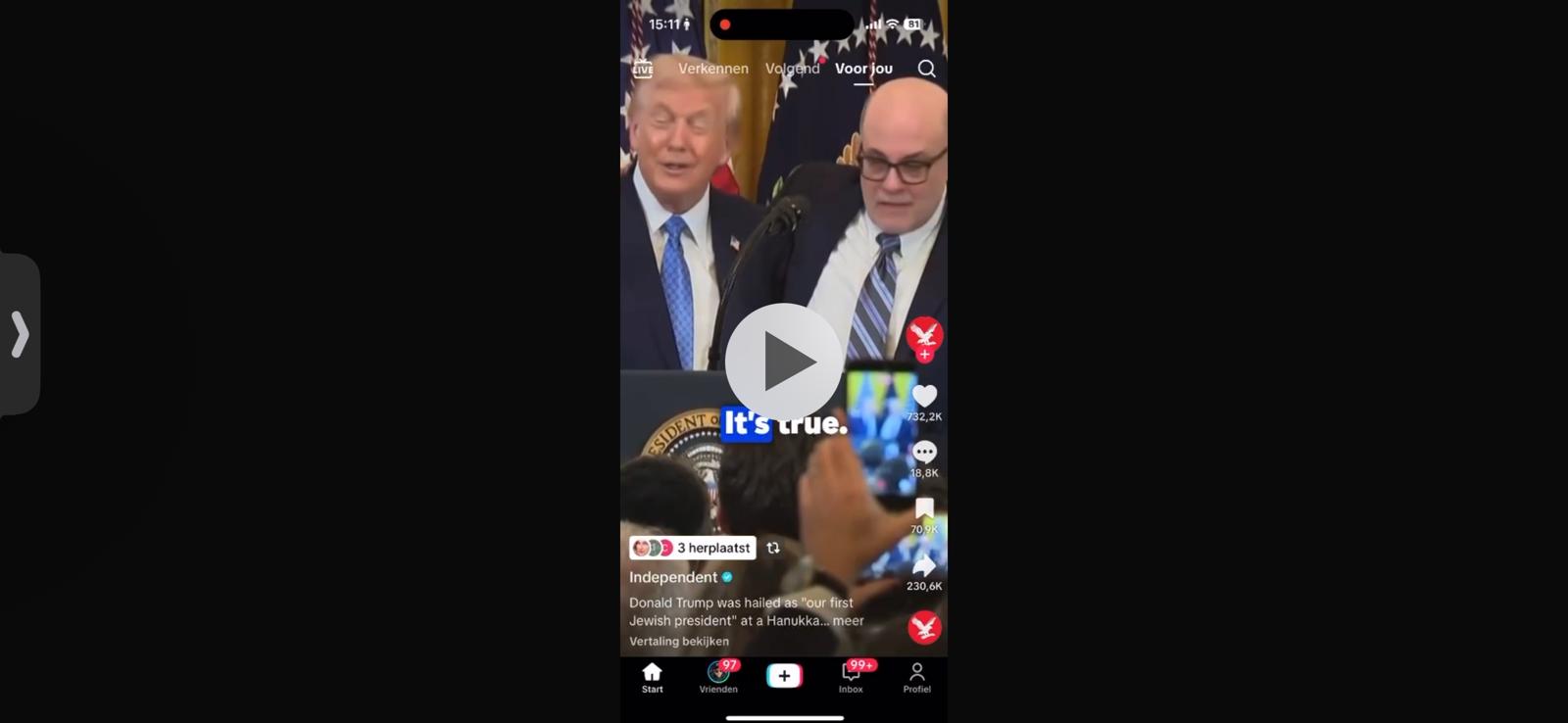
The event that generated one of Donald Trump's most discussed recent statements was not a traditional political rally, but a highly symbolic moment: a public celebration of Hanukkah, the Jewish Festival of Lights, held in an official setting and aimed at signaling support for the Jewish community and the State of Israel. Such events are frequently used in American politics to convey indirect messages through symbolism rather than explicit declarations.
In this context, Donald Trump appeared as the main guest. The atmosphere was relaxed and almost festive, yet the speeches and remarks carried clear political undertones. At one point, the person presenting the event - a public representative of the American Jewish community - referred to Donald Trump as "the first Jewish president". The phrase was not theological or technical, but clearly symbolic, tied to his political actions in support of Israel.
The key moment, however, was not the statement itself, but Trump's reaction. Rather than deflecting, correcting, or dismissing the label as mere rhetoric, Trump responded plainly: "It's true". No elaboration, no visible irony, no distancing.
This response alone was enough to spark a legitimate debate. Not about Donald Trump's personal faith-which is a private matter-but about the public message he chose to accept. In politics, especially at the highest level, publicly accepted words often matter more than those explicitly stated.
Trump did not declare himself Jewish. He did not announce a change of religion. Yet he accepted, without reservation, a label with strong symbolic weight. At the same time, he is known for avoiding direct confirmation of other sensitive allusions, particularly those concerning the possibility of a third presidential term, even though the topic frequently appears "as a joke" in surrounding discourse.
This contrast raises an obvious question: why did Trump choose to confirm one allusion while avoiding the other? Why "It's true" when it comes to symbolic identity, but ambiguity or silence when constitutional limits are involved?
One possible answer lies in political calculation. The label "first Jewish president," even in a metaphorical sense, reinforces Trump's image as the most pro-Israel U.S. president in history. The relocation of the U.S. embassy to Jerusalem, recognition of Jerusalem as Israel's capital, and consistent diplomatic backing are already part of his political record. Accepting this label carries no legal risk and generates symbolic capital.
By contrast, any explicit statement about exceeding the two-term limit would immediately trigger a constitutional confrontation. The 22nd Amendment to the U.S. Constitution is clear, and Trump is well aware of where the legal boundary lies. This is why jokes about presidential terms circulate freely, but are never formally embraced.
This very asymmetry in discourse makes the topic journalistically relevant. It is not about accusation, but about identifying patterns. Trump is a politician who constantly tests public reaction-sometimes through humor, sometimes through silence, sometimes through seemingly casual confirmation.
Ultimately, whether the remark was a joke or a metaphor is secondary. What matters is that it was publicly accepted. And in politics, especially at this level, nothing is entirely accidental. Accepting a label can, in itself, be a statement.


0 Comments
No comments on this article yet. Be the first!