
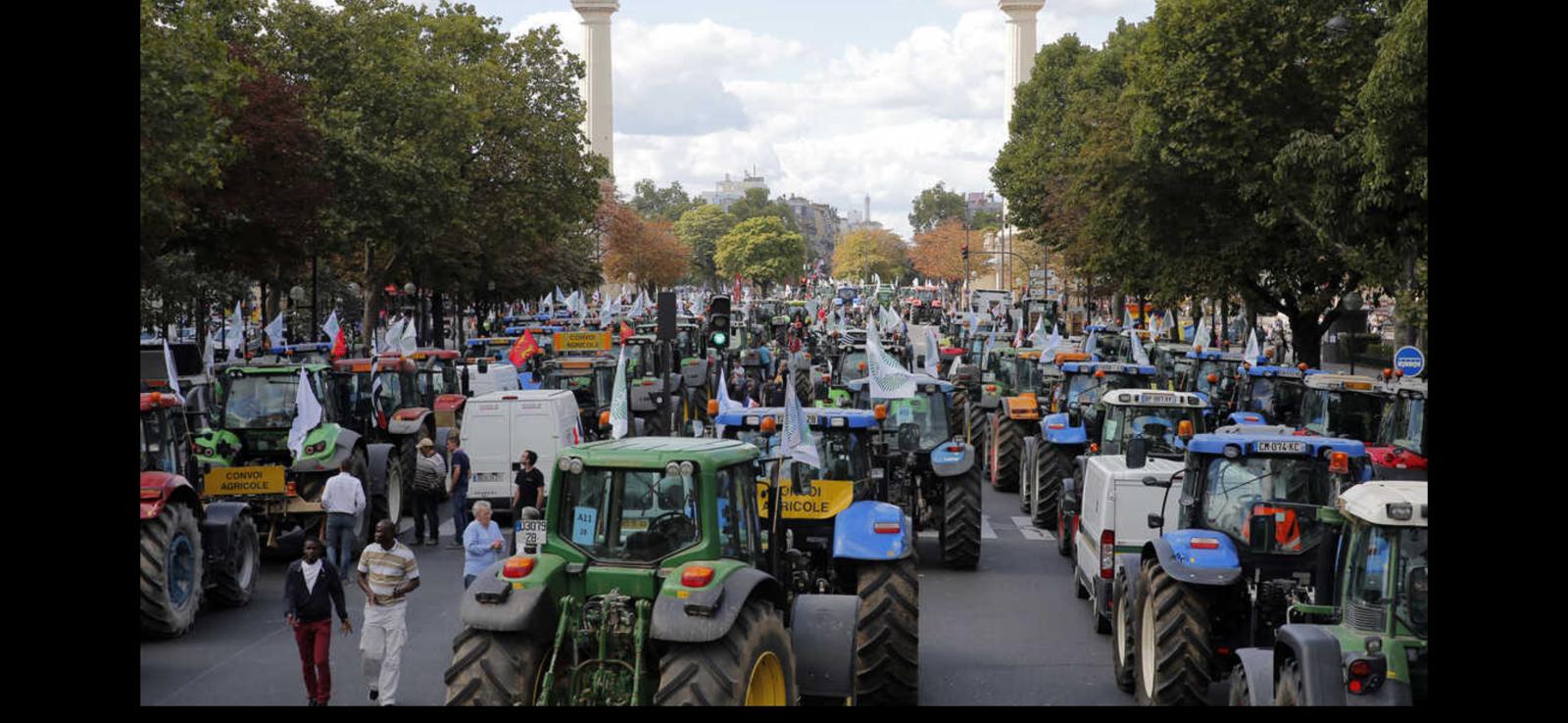
In recent months, Europe has witnessed a wave of farmers' protests that can no longer be dismissed as isolated incidents or local grievances. France, Belgium, Germany, Poland, the Netherlands, Spain, Ireland, and other European countries have seen similar actions: tractors blocking roads, major transport disruptions, clashes with authorities, and a shared message - agriculture is being pushed to the brink.
Although each country has its own political context, the reasons invoked by farmers are strikingly similar: pressure from European regulations, competition from imports outside the European Union, rising production costs, insufficient or conditional subsidies, and administrative decisions perceived as disconnected from realities on the ground. The fact that these protests are occurring simultaneously, in different countries, under different governments, points toward the existence of a common decision-making framework.
Agriculture is not just another economic sector. In every country, it represents a strategic pillar: food security, rural stability, economic independence, and social continuity. Farmers are not merely food producers; they are the backbone of an entire social and economic ecosystem. That is precisely why the constant pressure placed on this sector raises legitimate concerns.
Alongside new agricultural policies, several countries have faced sudden sanitary or environmental crises that resulted in livestock culling, severe restrictions, and significant financial losses for farmers. Officially, these measures are justified as necessary to protect public health or the environment. Unofficially, for those directly affected, they are perceived as additional blows to a sector already under strain.
It is important to note that these concerns do not emerge in a vacuum. For years, influential figures, global economic leaders, financiers, and policy theorists have openly discussed sustainability, limited resources, and the need to reduce pressure on the planet. Some of these discussions explicitly or implicitly include the idea that reducing the number of people or curbing traditional consumption patterns could be part of a long-term solution.
These positions are not secret, marginal, or hidden. They are public, openly stated, and debated in international forums, conferences, and strategic documents. In this context, it is not unreasonable for citizens to question whether certain policies are purely administrative or part of a broader direction that is not being communicated transparently.
When agriculture - the foundation of human survival - is subjected to constant pressure; when farmers are pushed toward bankruptcy; when local production is replaced by imports; and when decisions appear to disregard social consequences, an uncomfortable question inevitably arises: is there an intentional erosion of this fundamental pillar?
Are we witnessing a series of poorly calibrated policies? A profound disconnect between decision-makers and realities on the ground? Or is there a broader plan, not openly communicated to the public, whose effects are becoming increasingly visible?
These questions are not accusations; they are a legitimate demand for clarity. When the same measures produce the same negative effects on the same social group across multiple countries, suspicion is no longer an exception - it becomes a natural reaction. And in a democratic society, uncomfortable questions should not be avoided, but openly discussed.



0 Comments
No comments on this article yet. Be the first!