
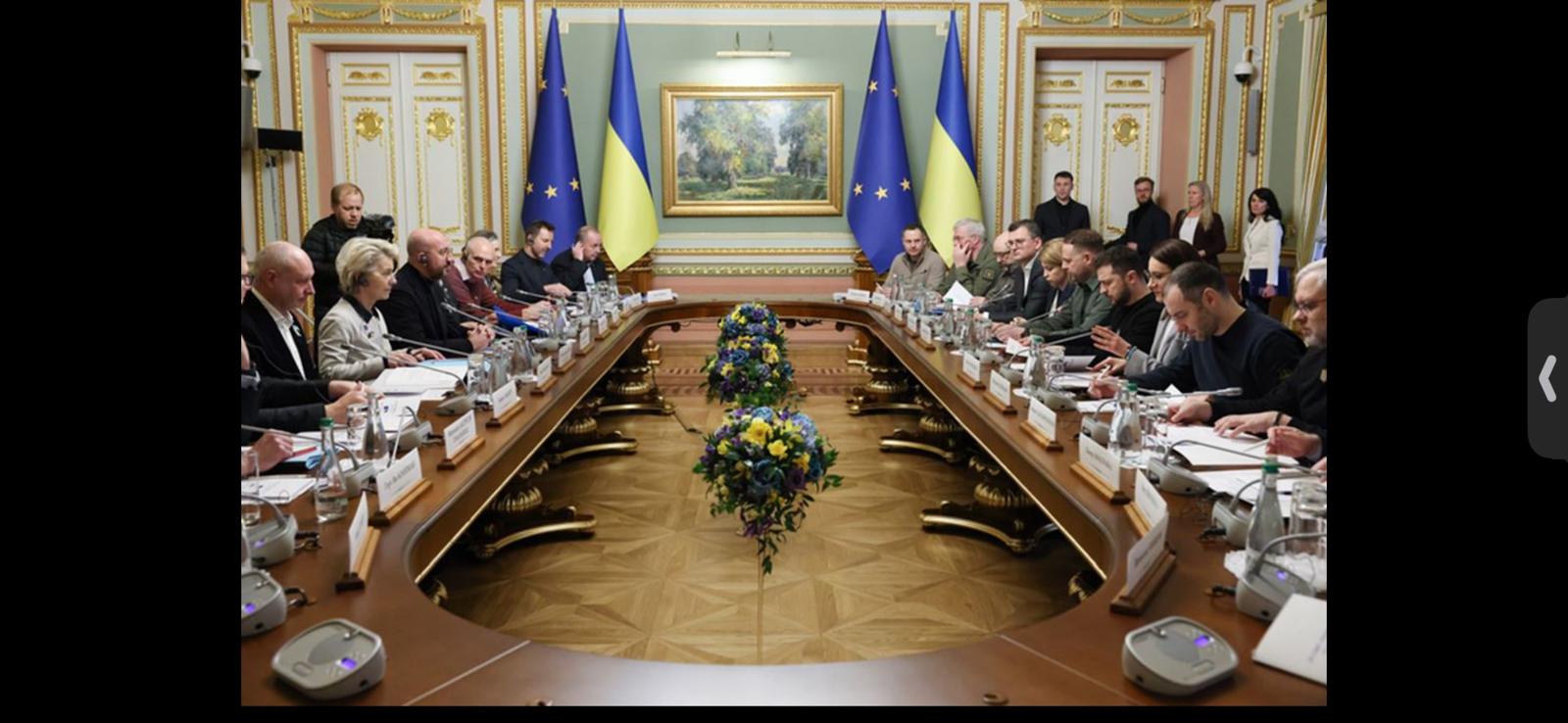
The European Union's decision to grant Ukraine a loan of approximately €90 billion, guaranteed by the EU's common budget, is not merely an economic measure. It is a geopolitical decision with explosive potential, whose consequences are far more difficult to control than officials publicly admit.
Officially, the European Commission and EU leaders have stated that these funds should ultimately be covered by Russia, in the form of war reparations. The narrative is simple: the aggressor will pay. The problem is that this logic works only under one scenario - a clear Russian defeat followed by acceptance of imposed conditions.
But what happens if that scenario never materializes?
The war in Ukraine shows no clear signs of ending quickly, and a total Russian defeat is far from guaranteed. Without a surrender or a peace agreement that explicitly includes reparations, there is no realistic mechanism to force Russia to pay these sums. No international court can automatically compel a nuclear power to comply if it refuses recognition.
In this context, the unavoidable question arises: who will actually pay the €90 billion?
The uncomfortable answer is: the EU member states - and ultimately, their citizens. The loan is backed by the EU budget, and if Ukraine cannot repay it, the financial burden will be redistributed through higher contributions, budget cuts, or additional debt. Declared solidarity thus becomes a long-term financial obligation, assumed without meaningful public consultation.
There is, however, a second and far more dangerous scenario: the use of frozen Russian assets to cover these costs. Although the EU has so far avoided outright confiscation, the option remains on the table. If, at some point, the Union decides to directly seize Russian assets, this will not be seen as a technical financial move, but as a direct hostile act.
The confiscation of a sovereign state's assets without a universally recognized international agreement sets an extreme precedent. From Moscow's perspective, such a decision could be interpreted as direct EU involvement in the conflict, crossing the line between indirect support and active confrontation. From there, the path toward major escalation - economic, political, or even military - becomes dangerously short.
This raises the question European officials are reluctant to ask openly:
can this chain of decisions lead to a much wider, even global conflict?
The European Union does not start a world war through an official declaration. It can, however, fuel one through incremental steps, each framed as "necessary," "temporary," or "inevitable." Massive loans, shared guarantees, transferred liabilities, and eventually direct confrontation over money and strategic interests.
The core issue is not whether Ukraine should be supported, but the absence of a clear plan for negative scenarios. What happens if Russia does not pay? What happens if the EU turns to frozen assets? Who assumes the risk of escalation? And, above all, who decided on behalf of European citizens that these risks are worth taking?
The €90 billion is not just a number. It is a symbol of the direction in which the European Union is heading: from an economic and political project toward a direct actor in a conflict with global potential. And when the stakes become war and peace, the final cost is always paid by citizens - not by those who sign the decisions.
844 Views
0
Comments
- Distribuie
- X / Twitter
- Distribuie
- Distribuie
- Distribuie
- Telegram
- Distribuie

0 Comments
No comments on this article yet. Be the first!