
Far from shore a wave mainly carries energy. Water particles move on nearly circular paths as the shape passes; the same mass of water does not usually travel all the way from the open sea to the beach.
When depth becomes small enough relative to wavelength, the motion begins to feel the seabed. Friction and geometry slow the propagation. The distance between crests shrinks, although the period stays roughly the same. Energy is compressed into a shorter length: the wave grows and steepens.
The base slows; the crest continues. When the ratio of height to depth is too large, the shape no longer holds. The crest falls forward, traps air and turns orderly motion into turbulence, foam, sound and heat. That is breaking.
The slope of the bed changes the look. A gentle slope often yields waves that spill gradually; a reef or steep bottom may dump the crest suddenly. Wind, tide and the offshore wave shape modify the result. There is no single “type” of break.
After breaking, water runs up the beach and returns. Currents and waves move sand and reshape the coast. Waves that look alike can carry very different forces. Rip-current areas demand caution; this article is not a swimming guide.
Local conditions can be more complex than the shallow-water sketch. The text describes the general mechanism of surface waves.
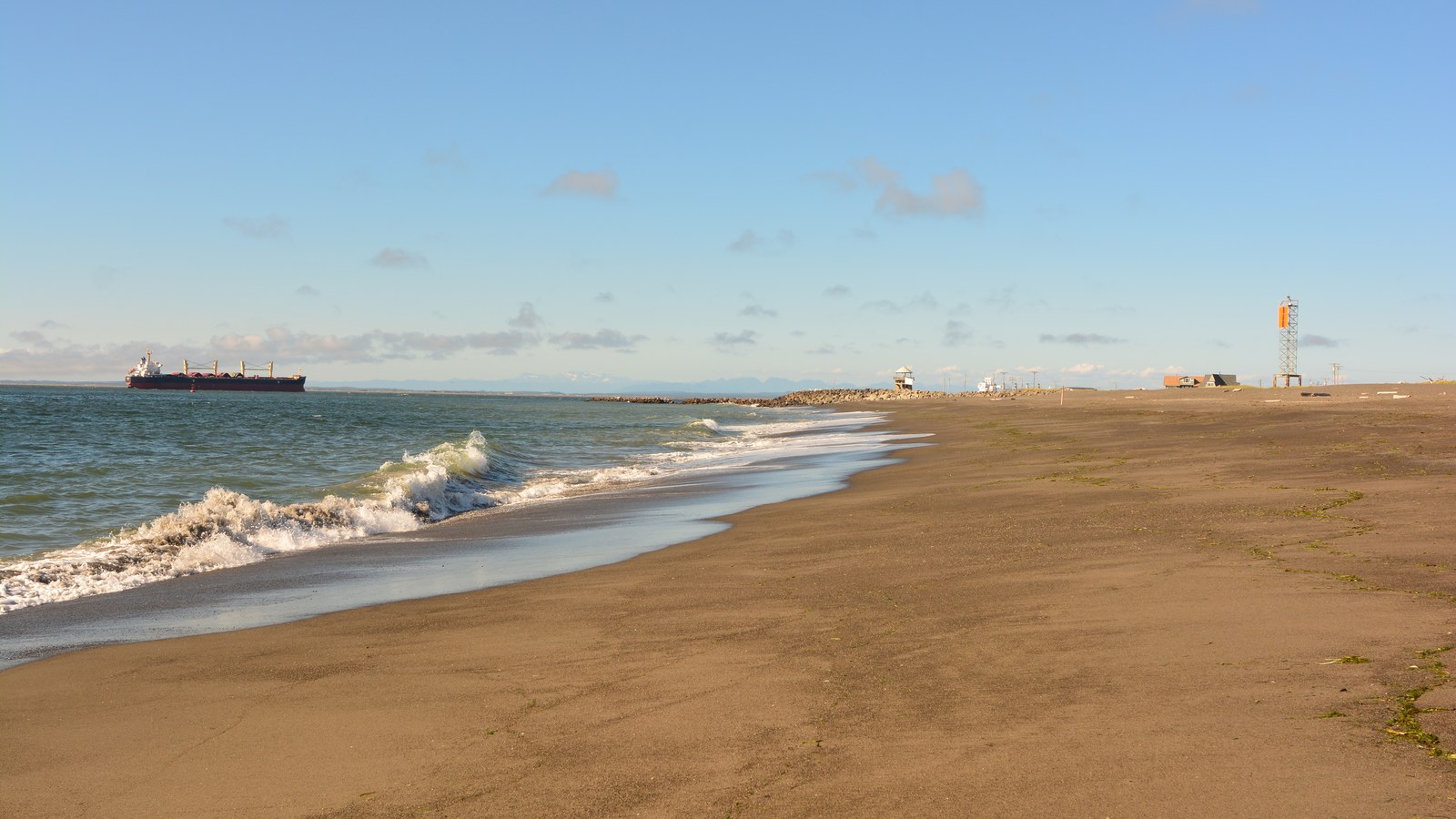
The photograph catches a crest before it falls, near shore. It illustrates the unstable shape, not a mathematical model and not a rescue warning.
Image: Joe Mabel, wave breaking on shore at Westport, Washington. Wikimedia Commons, CC BY-SA 4.0. Cropped to 16:9. Licence. Original file.
Sources consulted: NOAA Ocean Service — How do waves form?; National Weather Service — Beach Hazards and Rip Currents; Wave: shallow-water waves and breaking | Encyclopaedia Britannica.






0 Comments
No comments on this article yet. Be the first!