
On 16 September 1925, Riley B. King was born on a plantation in Mississippi. The world would come to know him as B.B. King, one of the most influential guitarists and singers in the history of the blues.
Today, 16 September 2026, marks 101 years since his birth.
The National Endowment for the Arts and the US National Park Service confirm the date and general location: a plantation in north-western Mississippi, in the area between Indianola and Itta Bena.
King’s childhood was marked by hard work and family instability. His parents separated when he was very young, and after his mother’s death he lived with relatives and worked in agriculture.
Music entered his life early. He sang gospel in church and listened to records by blues artists including Blind Lemon Jefferson and Lonnie Johnson. His uncle and other musicians in the community helped introduce him to the guitar.
As a teenager and young man, King worked on plantations and drove a tractor. With the money he earned, he bought instruments and began developing his style.
Bukka White, the celebrated blues guitarist and a relative of King, was another important influence. Gospel and rural blues gradually combined with the urban sound King would later develop.
During the 1940s, Riley King arrived in Memphis, Tennessee, one of the major centres of American blues. There he began performing and working in radio.
His nickname developed during this period. King worked as a presenter and performer at WDIA, an important radio station for African-American audiences. He became known as the “Beale Street Blues Boy”, later shortened to “Blues Boy” and then “B.B.”.
Memphis and Beale Street became inseparable from his artistic identity.
B.B. King was not known for virtuosity based on speed. The power of his playing came from expression. Sustained notes, string bending and his distinctive vibrato made the guitar sound almost like a second voice.
King influenced generations of blues and rock guitarists. Eric Clapton, Buddy Guy and many other musicians have spoken about his impact.
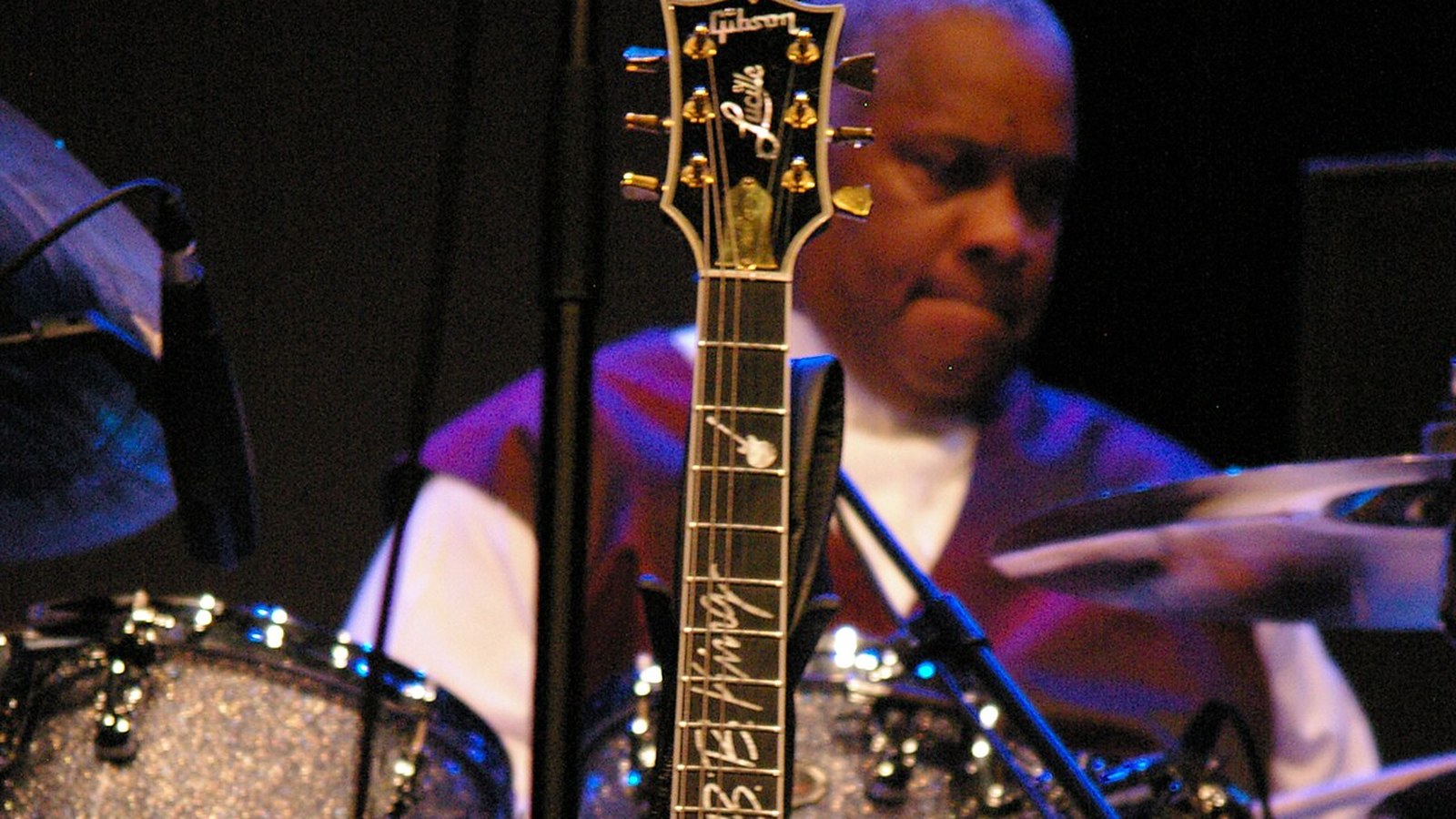
The guitar most strongly associated with B.B. King carried the name “Lucille”.
The story behind the name became part of blues legend. King recounted that during a performance in Arkansas, a fight caused a heating container to overturn and start a fire. After learning that the dispute had involved a woman named Lucille, he said he gave the name to his guitars as a reminder never again to risk his life in such circumstances.
The details should be presented as King’s own account, rather than as an independently verified incident report.
Over his career, B.B. King recorded hundreds of songs and performed an extraordinary number of concerts.
One of his defining recordings is “The Thrill Is Gone”, released at the end of the 1960s and becoming a major success. It earned him a Grammy and helped broaden his audience beyond traditional blues listeners.
Do not reproduce song lyrics in the article.
King became a global ambassador for the blues. He performed around the world and helped bring the genre to rock and pop audiences.
At the same time, he remained connected to the musical roots of the Mississippi Delta and Memphis.
His career crossed enormous changes in the music industry: from 78 rpm records and local radio to television, CDs, global touring and digital distribution.
The National Endowment for the Arts named him a National Heritage Fellow in 1991, one of America’s major honours for traditional and folk arts.
B.B. King received numerous Grammy Awards during his career and was inducted into the Rock and Roll Hall of Fame in 1987.
He also received the Presidential Medal of Freedom in 2006.
King’s importance cannot be measured by awards alone. His style became part of the vocabulary of electric blues guitar.
His vibrato, his use of space between phrases and the dialogue between his voice and guitar were imitated and reinterpreted by thousands of musicians.
King continued performing into old age. The image of him on stage with his guitar Lucille became one of the defining images of the blues.
B.B. King died on 14 May 2015 in Las Vegas at the age of 89.
His death prompted tributes throughout the music world, but his work remained alive through recordings and through his influence on other artists.
In Mississippi, his memory is preserved in places including the B.B. King Museum and Delta Interpretive Center in Indianola and sites connected with blues history.
His story is also part of the wider African-American cultural history of the twentieth century. The blues developed from the complex social, musical and historical experiences of African-American communities in the American South.
B.B. King took that tradition to international stages without losing its core identity.
One hundred and one years after his birth, his influence can still be heard in blues, rock, soul and almost every genre in which the electric guitar is used expressively.
There are guitarists who play more notes and guitarists who use more complicated techniques. Few, however, created an instrumental voice as immediately recognisable.
For B.B. King, a single note could say more than a flood of sound.
That is the legacy that keeps his name fundamental to the blues more than a century after his birth.
Photo: Werner100359 / Wikimedia Commons, CC BY 3.0. B.B. King with Lucille, 17 July 2009. This is not a photograph from 1925. Cropped to 16:9.
Source consulted: B.B. King | Rock & Roll Hall of Fame.





0 Comments
No comments on this article yet. Be the first!