


Researchers at the Duke Quantum Center, with the Joint Quantum Institute at the University of Maryland, published in Nature Physics on 23 September 2026 an experiment on a 13-ion quantum simulator. The platform reproduces string-breaking dynamics in a (1+1)-dimensional Z2 lattice gauge theory — not the early universe itself.
Ytterbium-171 ions sit in a linear trap. Lasers programme the interactions so that the energy between simulated charges grows with distance, like a taut string. When the tension crosses a threshold, charge pairs appear: in this model, an analogue of particle formation, not an observation of the Big Bang.
The team followed the dynamics after an abrupt increase in the tension of a simulated string between two static charges. Pairs appeared near the string edges and then spread into the bulk — a breaking mechanism, the authors write, distinct from the conventional Schwinger process. The finding stays in the one-dimensional Z2 model, not in (3+1)-dimensional QCD.
The relevant physics is simplified quantum chromodynamics: in high-energy collisions the “string” between a quark and an antiquark can break and produce hadrons. A full QCD simulator is still beyond present machines. The authors stress that this is a controlled prototype, with dynamics resolved in space and time.
Zohreh Davoudi of Maryland said it is “incredibly exciting” to investigate early-universe conditions in an atomic-scale machine, but that even slight insights from an out-of-equilibrium model will guide later work. The quote does not turn 13 ions into a miniature cosmos.
The result shows what trapped-ion simulators can do against classical methods, on models that are still simplified. The conclusions stay at the scale of a 13-spin chain. This account does not announce a universal quantum computer and does not copy figures from Nature.
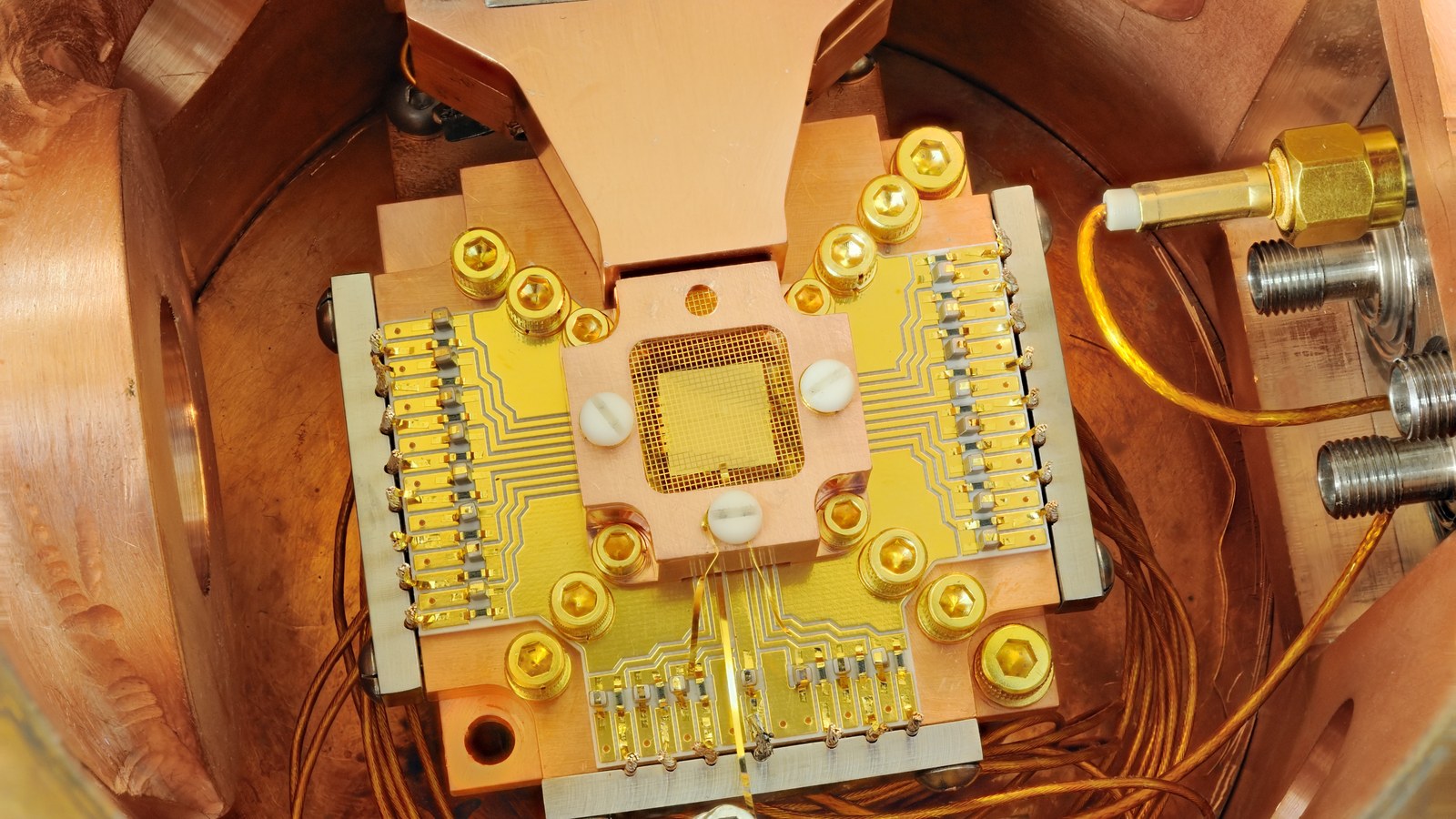
Image: NIST, ion trap for quantum computing, public domain, Wikimedia Commons. Laboratory hardware, not the 2026 Duke/Maryland experiment.
Source consulted: String-breaking dynamics in a quantum simulator — Nature Physics.











0 Comments
No comments on this article yet. Be the first!