
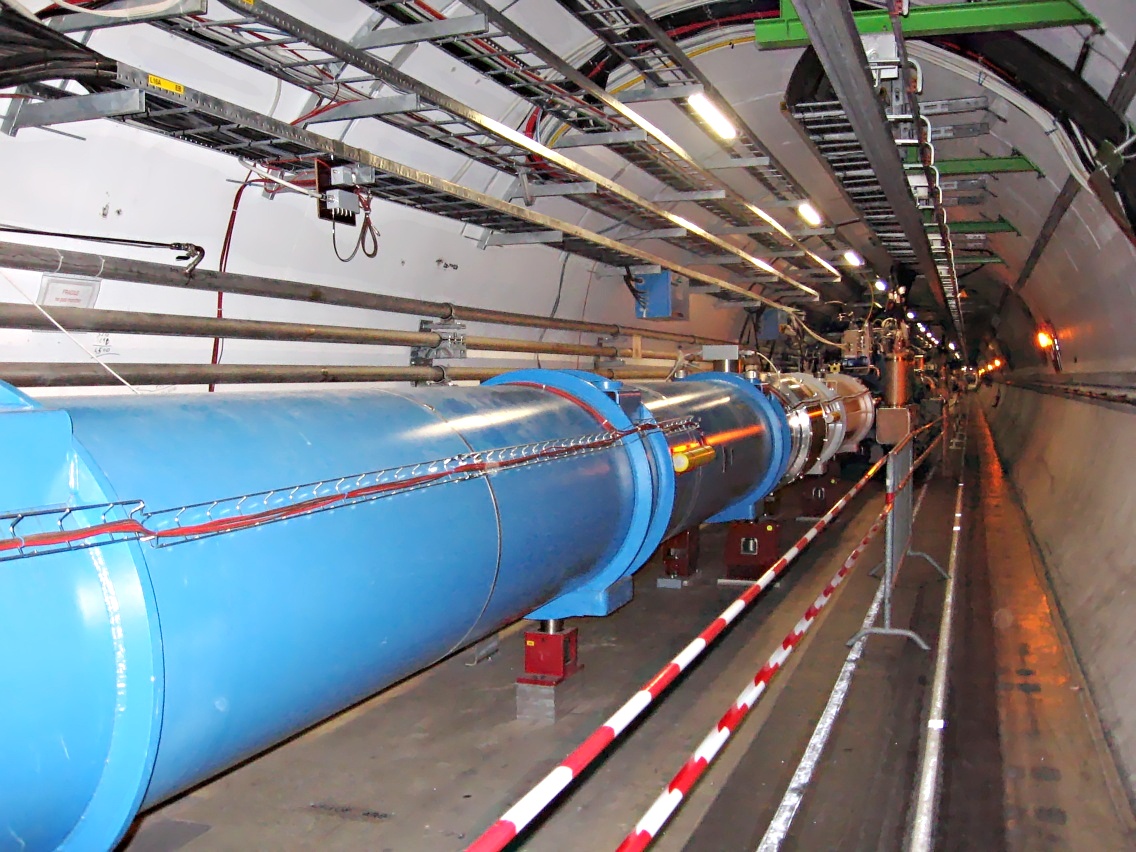
September 10, 2026 marks 18 years since the Large Hadron Collider (LHC), the largest and most powerful particle accelerator built at the time, achieved one of the decisive milestones in the beginning of its operation: the first proton beam was successfully sent around the accelerator ring. It was September 10, 2008, and the experiment coordinated by CERN marked the beginning of a new era in particle physics.
The Large Hadron Collider is located inside a circular tunnel approximately 27 kilometres in circumference, much of it around 100 metres underground, in the border region between Switzerland and France near Geneva. Its purpose is easy to describe but extraordinarily difficult to achieve: accelerating particles to speeds extremely close to the speed of light and producing controlled collisions. By examining what is created during these collisions, researchers can investigate the fundamental structure of matter and the laws governing the Universe.
The LHC, however, is much more than an accelerator. Huge experiments have been constructed at points where the particle beams intersect, including ATLAS, CMS, ALICE and LHCb. Their detectors record the traces created by collisions and generate enormous quantities of data that are analysed by researchers around the world.
The start-up on September 10, 2008 attracted international attention. On that day, the first proton beam successfully travelled around the entire accelerator ring. The achievement demonstrated that one of the most complex scientific facilities ever constructed could control and transport a particle beam through its enormous system of magnets and equipment. Only days after that success, however, the project encountered a serious problem. On September 19, 2008, an electrical fault in a connection between superconducting magnets caused significant damage and a helium leak. The accelerator had to be shut down for repairs and inspections.
The LHC subsequently returned to operation, with particle beams once again circulating through the accelerator in November 2009. The most dramatic confirmation of the facility's scientific potential would come several years later. On July 4, 2012, the ATLAS and CMS experiments at CERN announced the observation of a new particle consistent with the Higgs boson. The Higgs boson had been theoretically predicted almost half a century earlier and represented one of the essential missing pieces in the experimental confirmation of the Standard Model of particle physics.
The discovery was so significant that the 2013 Nobel Prize in Physics was awarded to François Englert and Peter Higgs for the theoretical mechanism associated with the existence of the particle. The LHC has continued to be upgraded and operated at increasingly high energies, allowing researchers to study not only the Higgs boson but also antimatter, quark-gluon plasma, differences between matter and antimatter, and many other fundamental questions.
One of the greatest challenges, however, remains the search for physics beyond the current Standard Model. Scientists know that although the model is extraordinarily successful, it does not explain everything. Dark matter, dark energy, gravity at the quantum level and the dominance of matter over antimatter in the Universe are among the major questions that remain unresolved. For this reason, every new period of operation at the accelerator is also a search for phenomena that current theories cannot explain.
The Large Hadron Collider is also the product of extraordinary international collaboration. Thousands of scientists, engineers, technicians and specialists from numerous countries participate in its experiments and supporting infrastructure. Eighteen years after the first beam was sent around the accelerator, the LHC remains one of the most remarkable machines ever built by humanity.
Underground, on the border between France and Switzerland, particles invisible to the human eye are accelerated to almost the speed of light and then made to collide. And from those microscopic collisions, humanity is attempting to answer enormous questions: what is the Universe made of, how does matter work, and what are the fundamental laws of reality?
Source consulted: The Large Hadron Collider | CERN










0 Comments
No comments on this article yet. Be the first!