
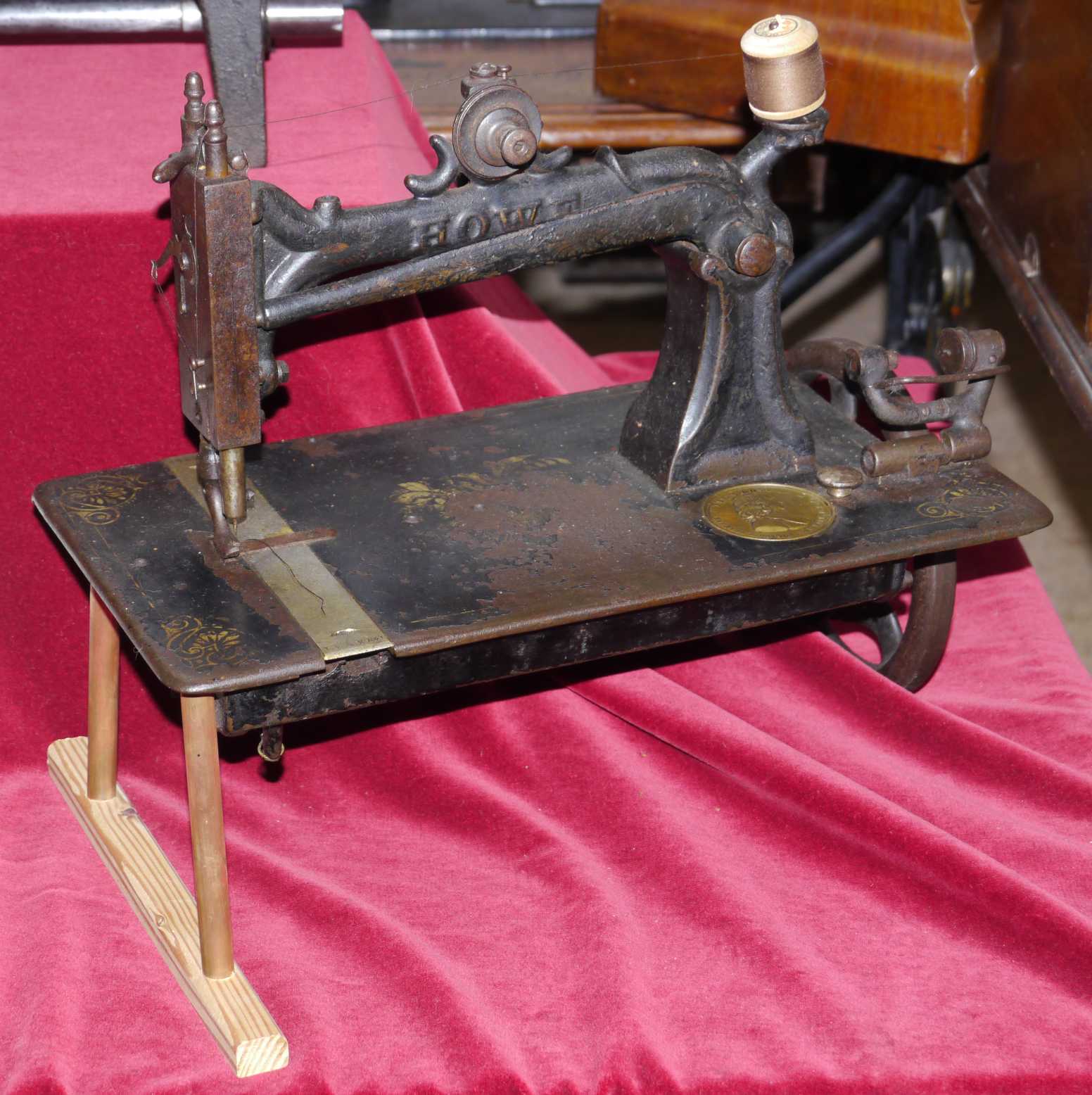
September 10, 2026 marks 180 years since one of the most important patents in the history of the sewing machine was granted. On this day in 1846, American inventor Elias Howe Jr. received U.S. Patent No. 4,750 for a machine capable of mechanically producing a strong seam using two threads.
The sewing machine, however, was not the invention of a single person. Numerous inventors had previously attempted to mechanise one of humanity's oldest activities: sewing textile materials. Among them was American inventor Walter Hunt, who had constructed a machine capable of producing a lockstitch during the 1830s but did not patent his invention at the time. Important attempts had also been made in Europe, including the machine developed by French tailor Barthélemy Thimonnier.
Elias Howe's contribution, however, would become one of the fundamental building blocks in the development of the modern sewing machine. The patent granted on September 10, 1846 described a system using two threads. One was carried through the fabric by a needle with its eye positioned near the point, while the second was carried by a shuttle. The two threads interlocked to create a strong seam suitable for mechanised production.
The principle may seem simple today, but in the nineteenth century it represented a major technological change. Hand sewing required a considerable amount of time. A machine capable of rapidly and consistently repeating the same stitch created the possibility of producing clothing and other textile goods at a speed that could not be achieved through manual labour alone.
Howe's path to success, however, was far from immediate. Although he had secured his patent, the inventor struggled to find buyers and investors. During the following years, other inventors and entrepreneurs developed their own versions of the sewing machine. The most famous of them would become Isaac Merritt Singer, who did not invent the sewing machine from scratch, but improved existing concepts and played a decisive role in turning the machine into a practical commercial product available to an increasingly large number of people.
The industry's rapid development also generated patent disputes. Different sewing machines increasingly combined technologies protected by patents belonging to several inventors. Eventually, several of these technologies were brought together under a shared licensing arrangement known as the "Sewing Machine Combination", one of the important early examples of a patent pool in American industrial history.
The impact of the sewing machine would extend far beyond the inventor's workshop. Clothing production accelerated, textile factories were able to manufacture goods on an increasingly large scale, and garments gradually became easier and cheaper to produce. Sewing machines later entered millions of homes, transforming both industry and domestic work. Mechanical machines were followed by electric models and eventually by computerised machines capable of automatically producing complex patterns, embroidery and thousands of programmed stitches.
Behind this evolution were the contributions of several inventors, and the patent obtained by Elias Howe on September 10, 1846 remains one of the key moments in that history. One hundred and eighty years later, the sewing machine may appear to be an ordinary object. In the nineteenth century, however, the mechanisation of sewing represented a profound change in the way people produced something every society needs: clothing.
Source consulted: U.S. Patent 4,750 — Improvement in Sewing-Machines (Elias Howe Jr., 1846) | Google Patents







0 Comments
No comments on this article yet. Be the first!