
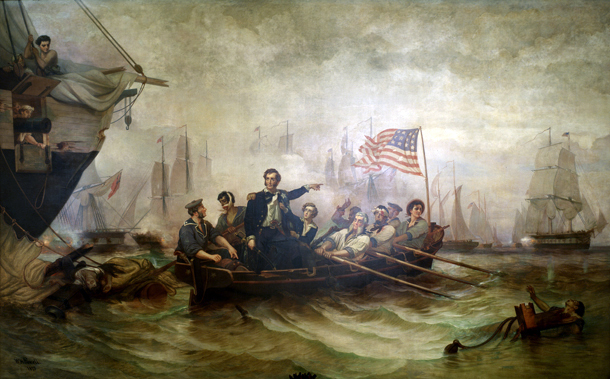
September 10, 2026 marks 213 years since the Battle of Lake Erie, one of the most important naval confrontations of the War of 1812 between the United States and Great Britain. The battle took place on September 10, 1813, in the western part of Lake Erie, near islands located in what is now the U.S. state of Ohio.
In only a few hours, an American fleet commanded by Oliver Hazard Perry succeeded in defeating and capturing the entire British squadron involved in the engagement. The victory gave the United States control of Lake Erie and significantly influenced the course of the war in the Great Lakes region.
To understand the importance of the battle, it is necessary to consider the wider context. The War of 1812 had begun the previous year between the young American republic and the British Empire. The causes of the conflict were numerous and included British trade restrictions, the seizure and forced recruitment of sailors from American vessels, as well as disputes surrounding United States expansion and the North American frontier.
Canada was then under British control, and the Great Lakes region had become one of the main strategic areas of the conflict. The lakes were far more than enormous bodies of water. At a time when overland roads were limited and difficult to use, control of the lakes allowed armies to transport soldiers, weapons, food and other supplies much more efficiently. Whoever controlled Lake Erie could directly influence military operations in the north-western theatre.
The Americans therefore began constructing a fleet at Presque Isle, present-day Erie, Pennsylvania. Command was given to the young naval officer Oliver Hazard Perry. Perry was only 28 years old at the time of the battle. On September 10, 1813, the British squadron under the command of Robert Heriot Barclay entered battle against the American forces.
Perry's flagship was USS Lawrence. Flying from its mast was a blue battle flag bearing the words "DON'T GIVE UP THE SHIP." The phrase honoured American Captain James Lawrence, who had been mortally wounded during a naval engagement several months earlier. During the battle, USS Lawrence came under extremely heavy fire. The ship was severely damaged, and a large proportion of its crew were killed or wounded. The American position appeared to be becoming critical.
Perry then made a decision that would become one of the best-known episodes in American naval history. He left Lawrence and, accompanied by several crewmen, crossed by small boat to USS Niagara, another American vessel that remained in fighting condition. Once aboard, Perry took command of the ship and returned to the centre of the engagement. USS Niagara broke through the British line and opened fire on the opposing vessels. The British squadron, already badly damaged and having lost key officers, could no longer continue the fight. Every British vessel involved in the battle was captured.
Following the victory, Perry sent American General William Henry Harrison a message that became famous: "We have met the enemy and they are ours." The victory on Lake Erie had major strategic consequences. The British lost control of the lake and were forced to abandon their position at Detroit. American forces commanded by William Henry Harrison were then able to advance into Upper Canada.
Several weeks later, on October 5, 1813, the Americans achieved another important victory at the Battle of the Thames. The Shawnee leader Tecumseh, who had built a confederacy of Indigenous peoples and fought alongside the British against American expansion, was killed during that battle. The War of 1812 would continue until 1815. The Treaty of Ghent, signed in December 1814, formally brought the conflict to an end without major territorial changes between the United States and the British possessions in North America.
The Battle of Lake Erie nevertheless remained one of the most important American victories of the war. Oliver Hazard Perry became a national hero, while the message he sent following the battle entered American military history and popular culture. Today, near Put-in-Bay, Ohio, stands Perry's Victory and International Peace Memorial, commemorating the American victory as well as the peace that later developed between the United States, the United Kingdom and Canada.
Two hundred and thirteen years after the confrontation, the Battle of Lake Erie remains an example of the strategic importance the Great Lakes played in shaping modern North America. On September 10, 1813, a naval battle lasting only a few hours changed control of an enormous lake and influenced the course of an entire military campaign.
Source consulted: Battle of Lake Erie | Wikipedia









0 Comments
No comments on this article yet. Be the first!