
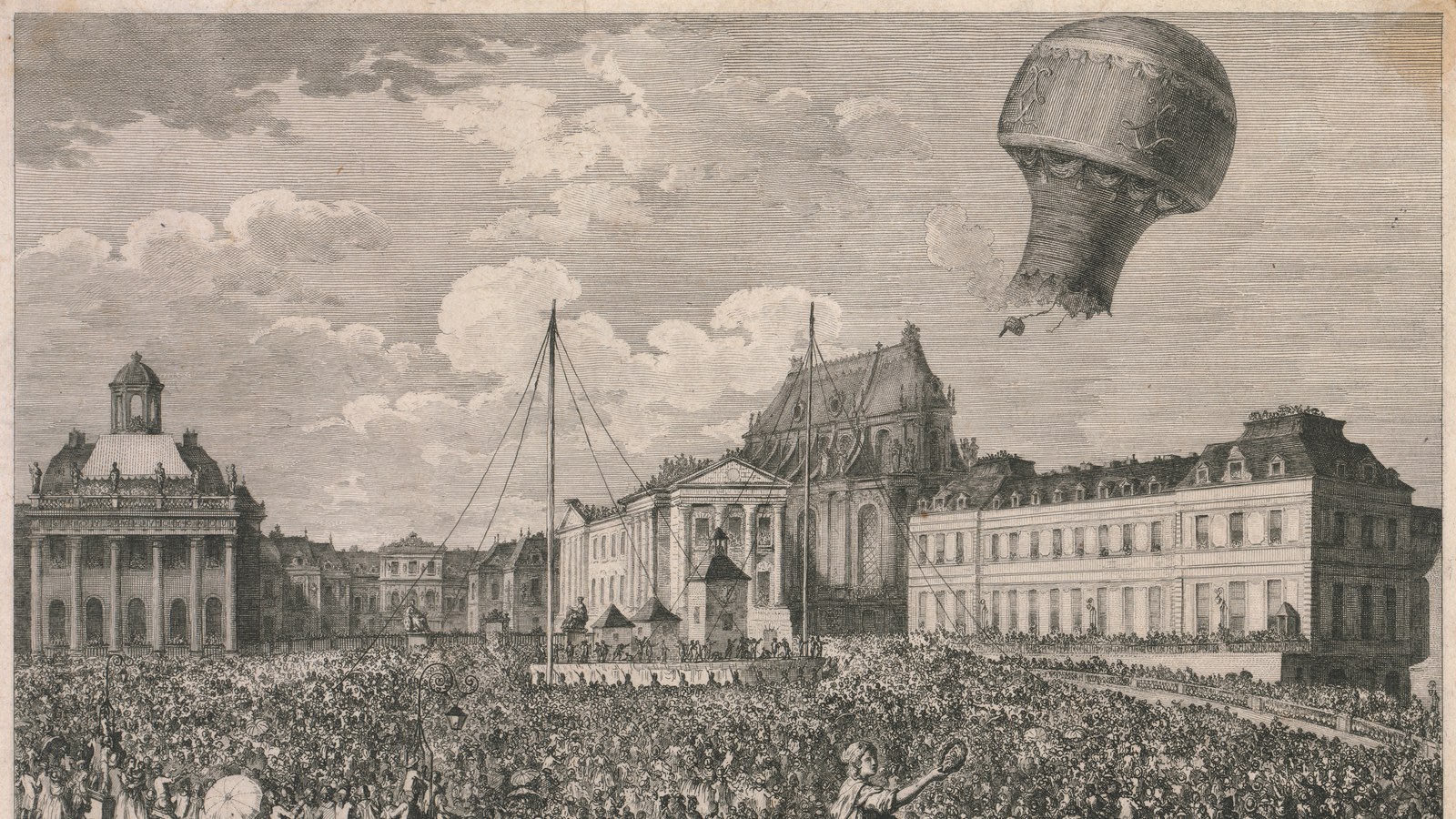
On 19 September 1783, in the forecourt of the Palace of Versailles, Joseph-Michel and Jacques-Étienne Montgolfier sent aloft a hot-air balloon carrying a sheep, a duck and a rooster. It was not the first human flight. It was a demonstration, before the court of Louis XVI, that living creatures could rise and come down again without vanishing.
The balloon, of fabric and paper, was inflated with heated air. Accounts speak of a few minutes of flight and a landing several kilometres away, near Vaucresson. Figures — eight minutes, 3.2 or 3.5 kilometres, hundreds of metres of altitude — vary from source to source and remain estimates, not a logbook.
Jean-François Pilâtre de Rozier was among the first to reach the landing. The animals survived; some reports mention an injured wing on the rooster, which witnesses attributed to a kick from the sheep on the ground, not to altitude. The Palace of Versailles notes that they were then kept at the Menagerie.
The experiment eased some of the fear that the air above was uninhabitable. In October the same Pilâtre de Rozier made tethered ascents. On 21 November 1783, with the Marquis d’Arlandes, the first free human flight followed, from the Château de la Muette, not from Versailles.
The Montgolfier brothers were not working with the modern physics of gases. Observation, repeated trials and a public demonstration turned a workshop in the Ardèche into a court spectacle. The first successful animal launch should not be confused with Charles’s hydrogen flight in August, nor with the human flight in November.
The 243rd anniversary is a landmark in aviation history, not a veterinary ethics lecture applied backwards. The animals were instruments of the experiment. That fact is worth stating, without rewriting the eighteenth century in today’s language.
The Palace of Versailles page and the Smithsonian archive keep the date, the place and the order of events. This account stays with those and leaves aside crowds counted by eye.
Image: engraving of the aerostatic experiment at Versailles, 19 September 1783 / Wikimedia Commons. A period illustration, not a photograph of the flight. Cropped to 16:9.
Source consulted: The first hot air balloon flight | Château de Versailles; The invention of the balloon | Smithsonian National Air and Space Museum.



0 Comments
No comments on this article yet. Be the first!