
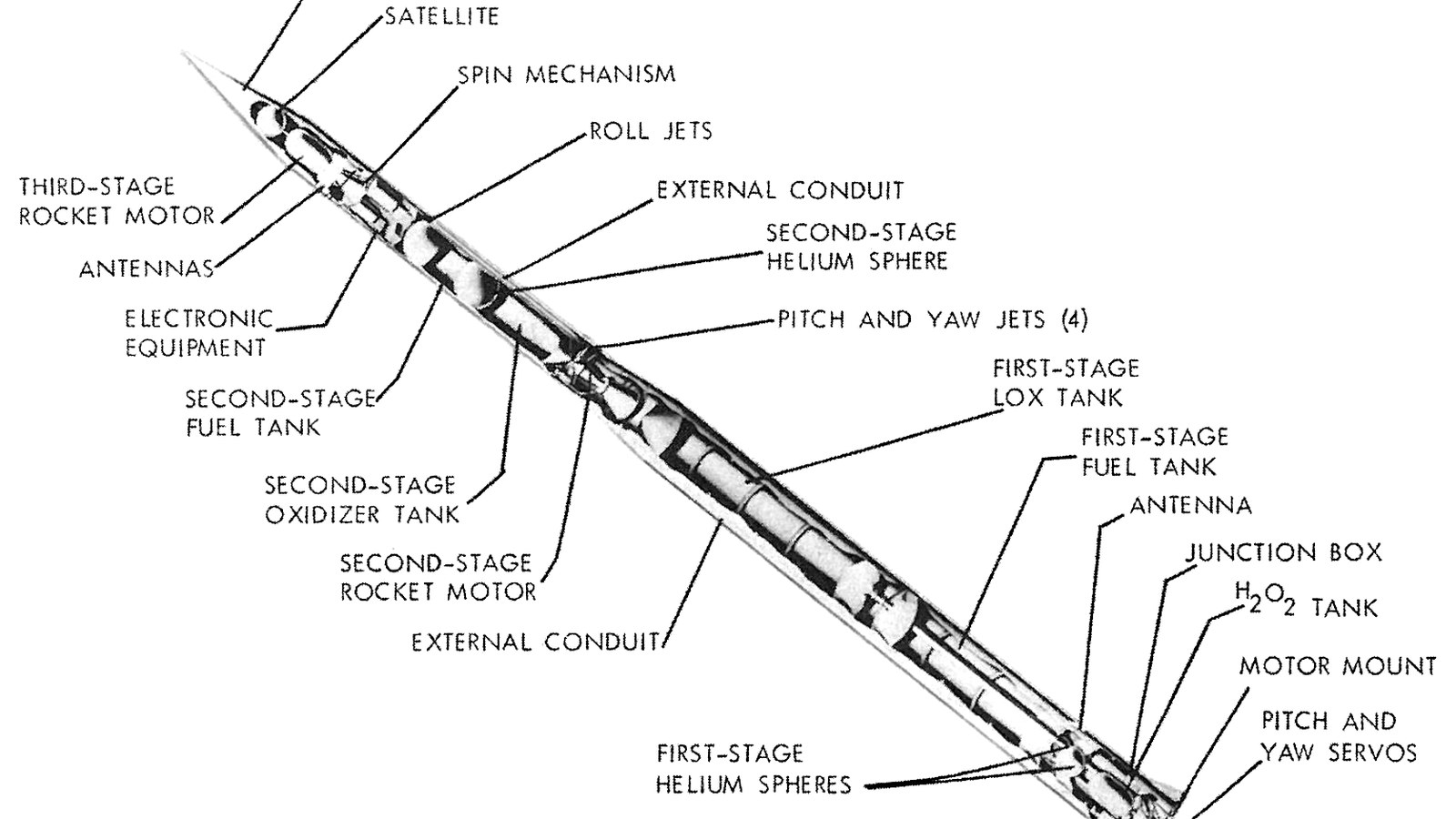
18 September 2026 marks 67 years since the scientific satellite Vanguard 3 launched from Cape Canaveral. NASA’s NSSDC catalogue lists it as 1959-007A. The mission should not be confused with the Vanguard TV3 failure of December 1957.
Project Vanguard began before NASA, at the Naval Research Laboratory. Vanguard 3 was a 50.8-centimetre magnesium sphere, with the magnetometer in a conical resin tube. Its aims included the Earth’s magnetic field, solar X-rays, upper-atmosphere density and micrometeoroids.
The launch, on a Vanguard rocket, was on 18 September 1959. The upper stage was left attached on purpose, to slow the tumble and spare the magnetometer. Data transmission lasted 84 days, until 11 December 1959. The satellite body remains in orbit; estimated orbital lifetime is measured in centuries, not in months of working electronics.
The programme is often remembered for the pad explosion of 1957. It also produced successes: Vanguard 1, from 1958, is still the oldest artificial object tracked in orbit. Vanguard 3 belongs to that experimental line, not to the myth of a single failure.
Every launch then taught tracking, telemetry and how instruments behaved under temperature and radiation. The data helped map the magnetic field over the area covered and count micrometeoroid impacts, according to NASA summaries.
This article does not credit the satellite with findings the NSSDC sheet does not support. It records the date, the shape, the transmitting life and the distinction from TV3.
Sixty-seven years on, Vanguard 3 remains an example of the early space age: a compact instrument, a long-lived orbit and electronics that fell silent after a few months.
Image: NASA, cutaway of the Vanguard rocket. Wikimedia Commons, public domain. Not a photograph of Vanguard 3 in orbit. Cropped to 16:9.
Source consulted: NASA NSSDC — Vanguard 3 (1959-007A); U.S. Naval Research Laboratory — Project Vanguard.








0 Comments
No comments on this article yet. Be the first!