
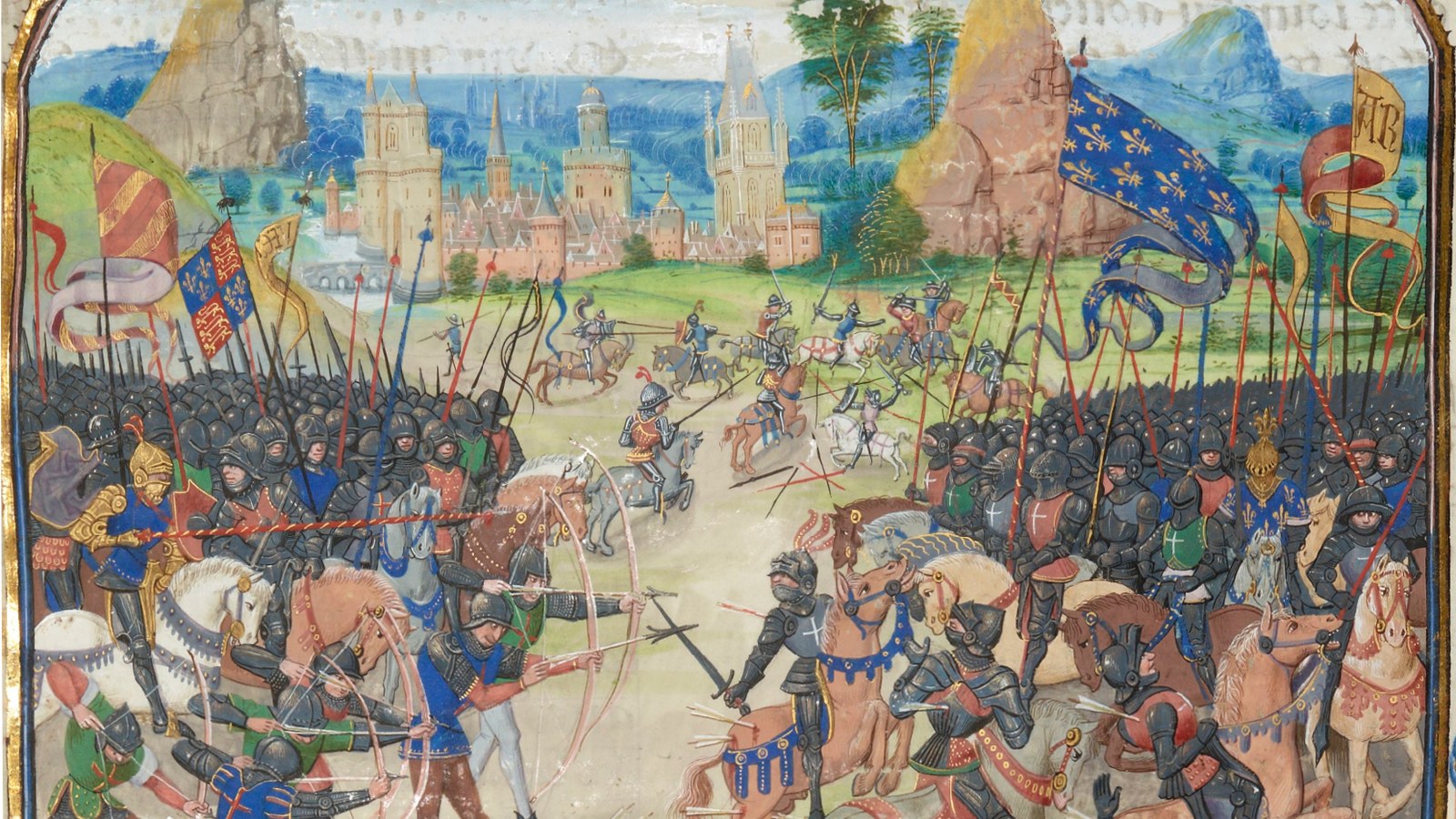
On 19 September 1356, south of Poitiers, the Anglo-Gascon army led by Edward of Woodstock defeated the forces of King John II of France. The date remains a landmark of the first phase of the Hundred Years’ War, not a set of troop numbers on which chronicles agree.
The campaign had begun as a raid from English-held Aquitaine into the French interior. When contact tightened near Poitiers, Edward held a defensive position. Archers, men-at-arms and the ground offset a numerical disadvantage; the battle was not a story about arrows alone.
French attacks failed to break the opposing formation. The king stayed in the field and was taken prisoner, together with his son Philip and part of the nobility around him. The capture of a monarch in combat was the political shock, more than a purely tactical reverse.
For France the aftermath was fiscal and institutional. The ransom, internal unrest and the continuation of the war weakened royal authority. The Treaty of Brétigny in 1360 temporarily granted England wide territorial gains; the conflict did not end there.
Figures for the dead and the captured vary from one source to another and are often inflated. This account does not treat them as a certain inventory. What stands is the place, the date, the commanders and the undisputed fact that John II left the field as a prisoner.
The 670th anniversary is a piece of military history, not a nationalist lesson. The 1356 battle should not be confused with the 732 encounter near Tours, sometimes also called Poitiers.
British archives and survey histories keep the campaign as an episode of the war between England and France. The present text stays with what can be supported without inventing exact orders of battle.
Image: miniature of the Battle of Poitiers / Wikimedia Commons. A period illustration, not a photograph of the 1356 fighting. Cropped to 16:9.
Source consulted: Battle of Poitiers | Encyclopaedia Britannica; The Hundred Years’ War | The National Archives.



0 Comments
No comments on this article yet. Be the first!