
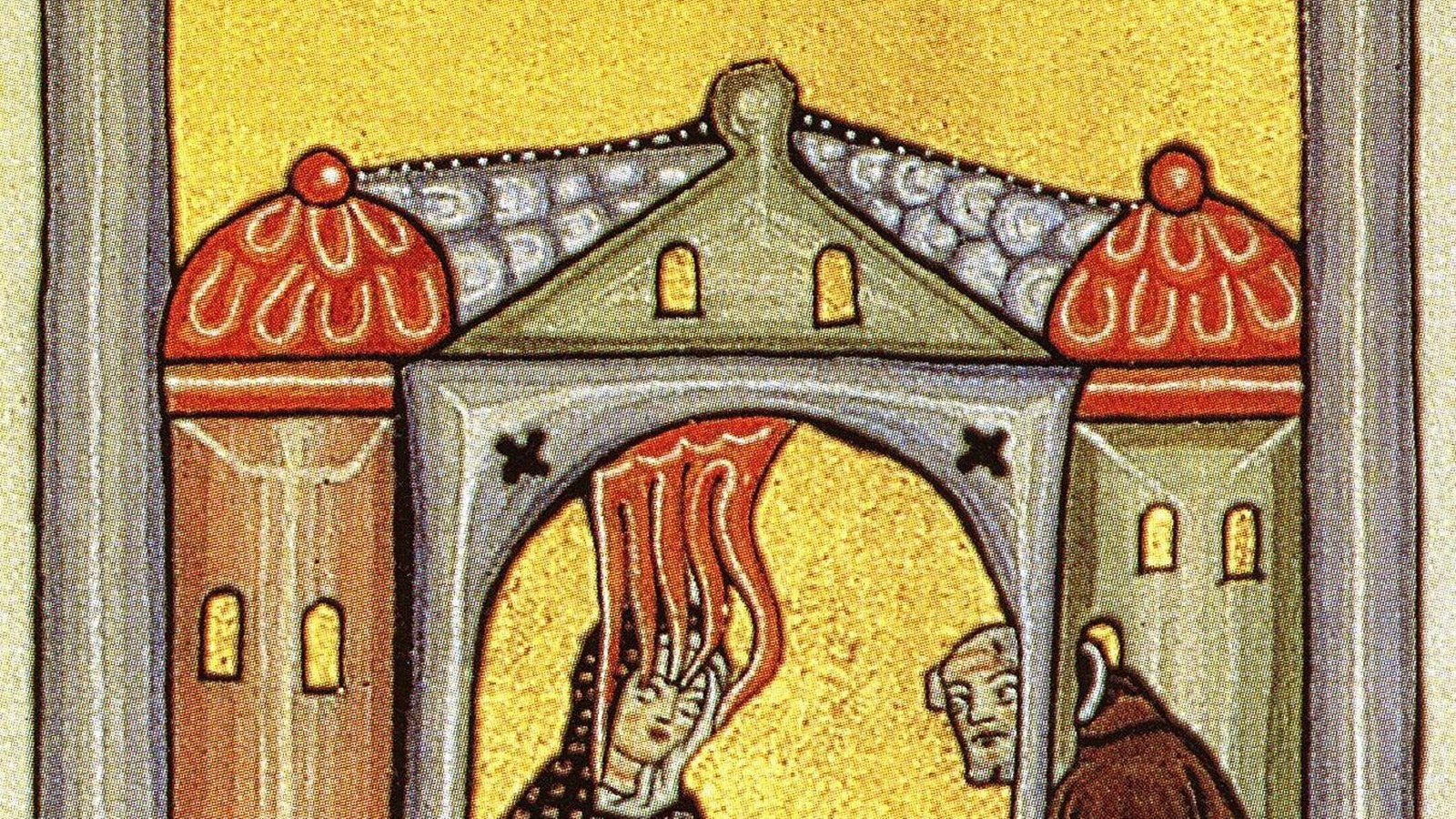
17 September 2026 marks 847 years since the death of Hildegard of Bingen, one of the most extensively documented women of the European Middle Ages. She died on 17 September 1179 after a life of monastic leadership, writing, composition and public correspondence.
She was born around 1098 into a noble family in the Rhineland. She entered religious life young and became the leader of the community of women at Disibodenberg. Around 1150 she founded a monastery at Rupertsberg near Bingen, and later a second community at Eibingen, on the opposite bank of the Rhine.
Her theological work is tied to visions she said she had experienced since childhood. Her first major work, Scivias, combines visionary description, religious reflection and illuminations. She also composed liturgical songs collected as Symphonia armoniae celestium revelationum, with expansive melodic lines unusual among surviving twelfth-century repertory.
She wrote about the natural world, plants, the human body and practices of care. Those texts belong to medieval knowledge and should not be presented as treatments validated by modern medicine.
Her correspondence reached popes, bishops, rulers and religious communities. She travelled to preach at a time when such a public role was rare for a woman. In 2012 Pope Benedict XVI extended her veneration to the universal Catholic Church and declared her a Doctor of the Church.
Eight hundred and forty-seven years after her death, Hildegard’s work continues to be performed and studied across religious history, music, literature and the history of ideas. 17 September 1179 marks the end of her life, not the beginning of a body of work that is still read and sung.
Image: miniature from the Rupertsberg Codex of Scivias, twelfth century. Public domain. Cropped to 16:9.
Source consulted: St. Hildegard | Encyclopaedia Britannica; Apostolic Letter proclaiming Hildegard a Doctor of the Church | Vatican.









0 Comments
No comments on this article yet. Be the first!