
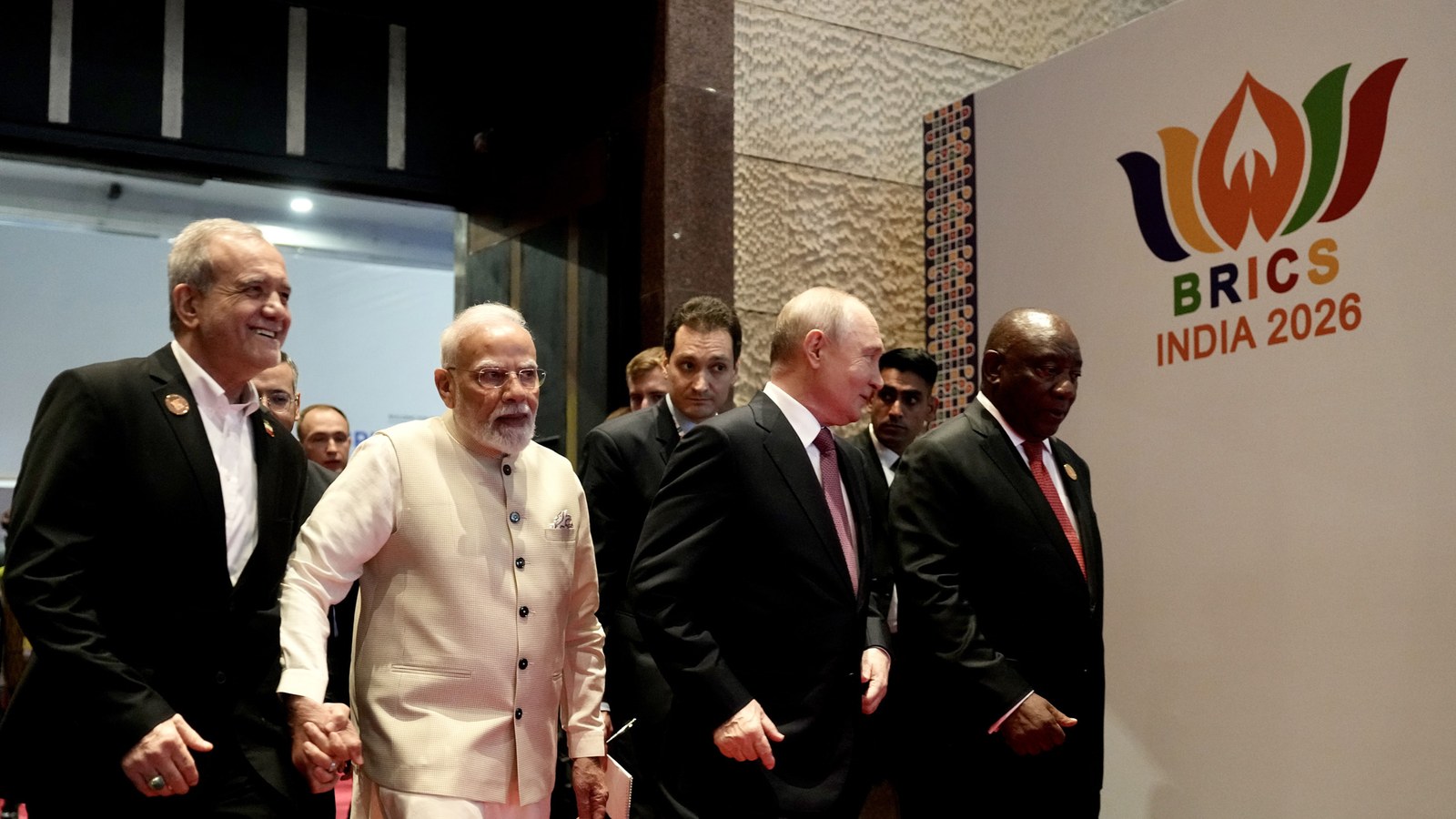
New Delhi is hosting one of the most important gatherings of major emerging economies this weekend. BRICS leaders have gathered in the Indian capital for the bloc’s annual summit on September 12 and 13, 2026 at Bharat Mandapam, against a backdrop of geopolitical tensions, trade disputes and debate over the future of international economic institutions.
The first day has already produced a significant result. Member states unanimously adopted the New Delhi Declaration, the joint statement of the 18th leaders’ summit, held under the theme “Building for Resilience, Innovation, Cooperation and Sustainability”. Prime Minister Narendra Modi announced the consensus. The meeting continues on Sunday, September 13; this article reports Saturday’s developments, not the outcome of the second day.
Ten members, divergent interests
BRICS has changed considerably from its original format. The group now brings together ten members: Brazil, Russia, India, China, South Africa, Egypt, Ethiopia, Iran, the United Arab Emirates and Indonesia. Egypt, Ethiopia, Iran and the UAE joined in 2024; Indonesia joined in 2025. Expansion has increased the population and economic weight represented by the bloc — estimates cited around the summit put that at more than 40% of the world’s population and nearly a quarter of the global economy — while placing countries with very different geopolitical and economic interests around the same table.
What the New Delhi Declaration says
A central question before the summit was whether the ten countries could agree a common text. They did so on Saturday. On the Middle East, the leaders express “deep concern” over the continued escalation of tensions in the Middle East/West Asia, call for “maximum restraint” and for actions that could further aggravate the situation to be avoided, and encourage dialogue and diplomacy. Elsewhere they reaffirm their commitment to the peaceful resolution of international disputes through dialogue, consultation and diplomacy. Those formulations follow the official declaration, not a second-hand paraphrase.
The adoption is also significant because BRICS includes both Iran and the United Arab Emirates, which occupy different positions in the current regional environment. Reuters noted that unanimity was not a given for that reason.
Iran and the UAE back the same document
Iran and the United Arab Emirates both supported the declaration. On the sidelines, Iranian President Masoud Pezeshkian and Abu Dhabi Crown Prince Sheikh Khaled bin Mohamed bin Zayed Al Nahyan, who is leading the UAE delegation, held high-level talks. Reports after the meeting said they discussed de-escalation, regional stability and prospects for peace. There has been no official announcement of a bilateral agreement between the two countries.
Modi, Xi and India–China relations
Chinese President Xi Jinping is in India for the summit — his first visit to the country in nearly seven years. On the sidelines, Narendra Modi and Xi discussed relations between the two Asian powers, strained in recent years by border disputes and economic mistrust. India’s Ministry of External Affairs said the leaders underlined the need to address the structural trade imbalance and supply-chain issues, and to facilitate meaningful, predictable market access. They reiterated that differences should not become disputes and that peace and tranquillity in the border areas remain an essential basis for the relationship. No border settlement has been announced.
Xi calls for a greater BRICS role
In Saturday’s session, Xi Jinping called on BRICS countries to play a greater role in promoting peace and addressing international challenges. He said the grouping should stand “on the right side of history” and steer the international order in a more just and equitable direction. China is due to assume the BRICS chairship in 2027 and host the 19th summit; the joint declaration extends full support to that presidency.
Trade, financial institutions and payments
India holds the BRICS presidency in 2026. For New Delhi, hosting at the same time leaders of countries with widely differing relationships with one another and with major Western powers is also a diplomatic opportunity. Economics is a major part of the agenda. The declaration voices concern over the proliferation of unilateral tariff and non-tariff measures that members consider inconsistent with World Trade Organization rules. Reform of the Bretton Woods institutions — the International Monetary Fund and the World Bank — remains a priority: the voices of emerging economies, members say, should better reflect their place in the global economy.
On the finance track, BRICS has for some time been examining ways to make cross-border payments among members faster and less expensive. The declaration notes the work of the BRICS Payment Task Force and discussions on the interoperability of payment systems and on settlements in local currencies. That is not a common “BRICS currency”; no such decision has been announced. The New Development Bank, the bloc’s development institution, remains a central instrument: it has financed tens of billions of dollars of infrastructure and development projects. Expansion gives the organisation more weight, but also makes consensus harder — a point Saturday illustrated by the fact that a joint text was nonetheless agreed.
The meeting is not over. Sunday, September 13, is the second day of the summit. A follow-up article will be warranted only if new decisions, additional documents or substantial announcements by leaders and the New Development Bank appear.
Photo: Prime Minister’s Office of India / Press Information Bureau, GODL-India licence. BRICS leaders at the Business Forum on the sidelines of the 18th BRICS Summit, Bharat Mandapam, New Delhi, 11 September 2026. The photograph is from this year’s official summit programme, not from an earlier edition. Source: Wikimedia Commons (PIB / PMO).
Source consulted: BRICS adopts joint declaration, urges 'maximum restraint' in Mideast (Reuters). Official text: New Delhi Declaration — Building for Resilience, Innovation, Cooperation and Sustainability (XVIII BRICS Summit, 12 September 2026).





0 Comments
No comments on this article yet. Be the first!