


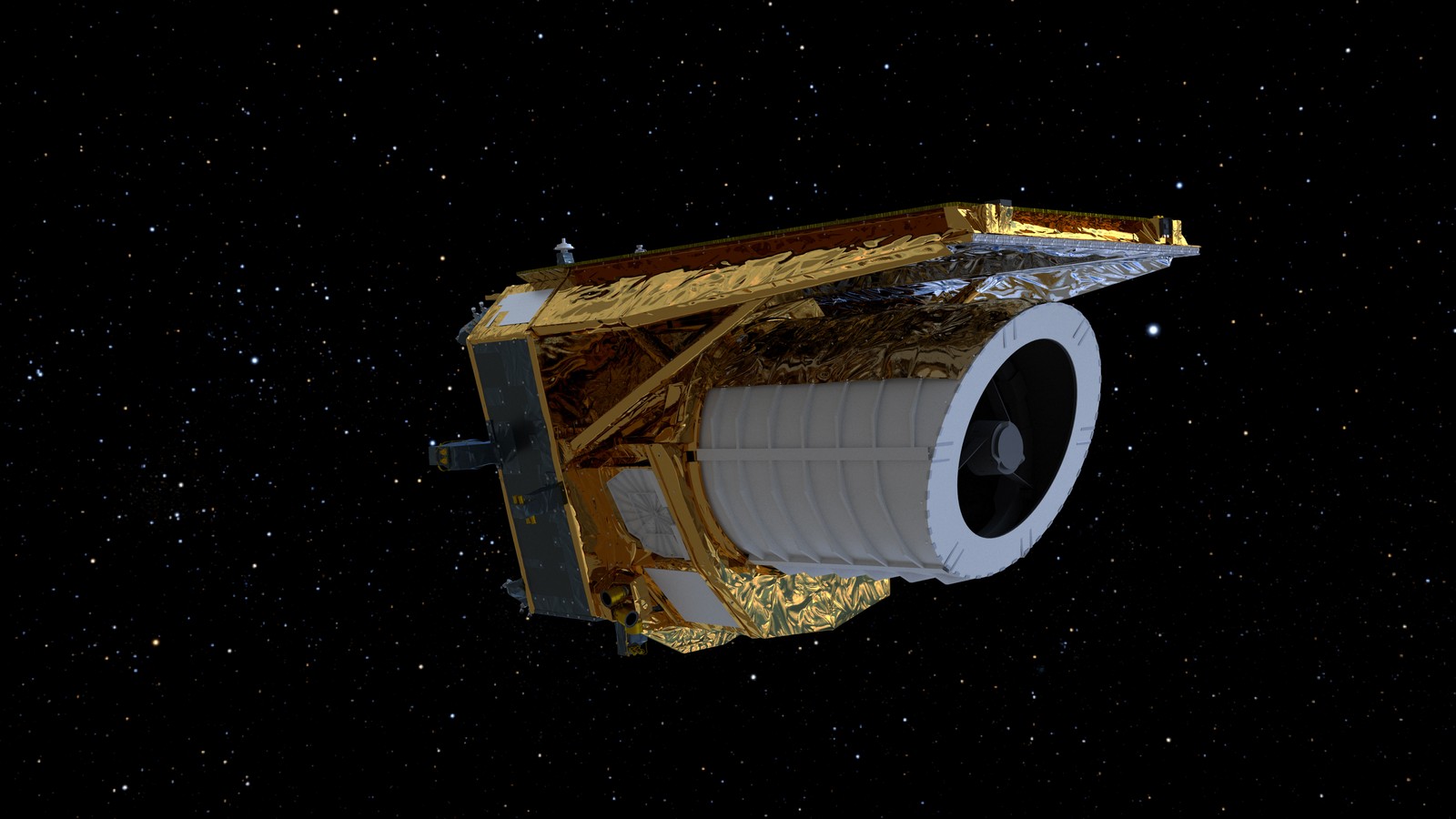
On Thursday 12 November the European Space Agency released the first major dataset from the Euclid telescope, called DR1-Foundation. It is about 13 months of observations: more than 900 million galaxies, across roughly 1,900 square degrees of sky, about 14 percent of the area the six-year mission plans to cover.
ESA says the images capture the light of more than a billion objects, over an area comparable to 9,500 full Moons, and that the volume comes to about 1.7 million gigabytes. It is the first substantial release since the launch in July 2023. Routine science observations began on 14 February 2024. The telescope sits about 1.5 million kilometres from Earth.
The mission is built to help make a three-dimensional map of the cosmos and to study two components astronomers do not see directly. In the picture used today, visible matter — stars, planets, galaxies — is about 5 percent of the Universe, dark matter about 27 percent, and dark energy about 68 percent. Those shares are not a new measurement announced on Thursday; they are the frame in which the data are read.
The catalogue includes about 15,000 strong gravitational-lens candidates and spectra for more than 160 million sources. On quasars the sources do not agree: AGERPRES, following AFP, wrote “more than 60,000 quasars”, while the ESA release speaks of more than 60 million candidates. Until that is corrected, the figure to use is ESA’s.
Marc Sauvage, an astrophysicist at the French CEA and in the Euclid consortium, told AFP that a human lifetime would not be enough to look through the galaxies one by one. Each object, he said, is marked by position, colour, type, shape, mass and distance. Eight scientific papers accompany the set.
Gravitational lenses are very massive objects, a galaxy or a cluster, which bend light coming from behind them. Sauvage noted that only part of a galaxy’s mass is visible; the rest, tied to dark matter, weighs heavily in forming these lenses. Looking far means looking back in time. Euclid has found very old quasars and faint structures, traces left when large galaxies absorb smaller ones. Models predicted more such remnants than had been seen; Sauvage says the observations are starting to meet the theory.
The data are open to researchers. The next batch, on the dark Universe, is due in mid-2027. Sauvage said the indicators are good. That does not mean the mission has already earned its nickname, “detective of the dark Universe”.
Image: Wikimedia Commons — illustration of the Euclid space telescope (ESA, CC BY-SA 3.0 IGO).
Sources consulted: The Euclid space telescope lays the foundation of a map of the Universe — AGERPRES; Euclid lays the foundation for its best-ever 3D map of the Universe — ESA.









0 Comments
No comments on this article yet. Be the first!