
A phone does not ask a GPS satellite where it is, and the constellation does not track that handset individually. Satellites broadcast radio signals continuously. The receiver in the device listens and calculates its own position.
The message includes a precise transmit time and orbital data. Comparing that time with reception, the device estimates travel duration. Multiplying by the speed of light gives a pseudorange — a distance also affected by the phone’s clock error.
One range places the receiver on an imaginary sphere. More satellites narrow the intersection. Signals from at least four satellites are normally needed: three for coordinates and one to correct the clock, which is far less precise than the atomic clocks in orbit.
American GPS is a utility with three segments: satellites, control stations and receivers. By design the constellation has 24 operating satellites; in practice more navigation satellites circle Earth. Modern phones may also use Galileo, GLONASS or BeiDou. Extra constellations often mean a faster fix.
Buildings, mountains and indoor spaces block or reflect weak signals. Reflections lengthen the path and add error. The atmosphere, satellite geometry and interference also matter. Accuracy may be a few metres under open sky and much worse among buildings.
For a quick start, a phone combines GNSS with mobile networks, Wi-Fi, motion sensors and maps. Those aids do not replace the satellite principle, but they help when the sky is partly hidden. Sending the result to an app is a separate step, governed by permissions.
GPS names the American system; GNSS is the general term. Real accuracy depends on the device, the surroundings and how many constellations are used.
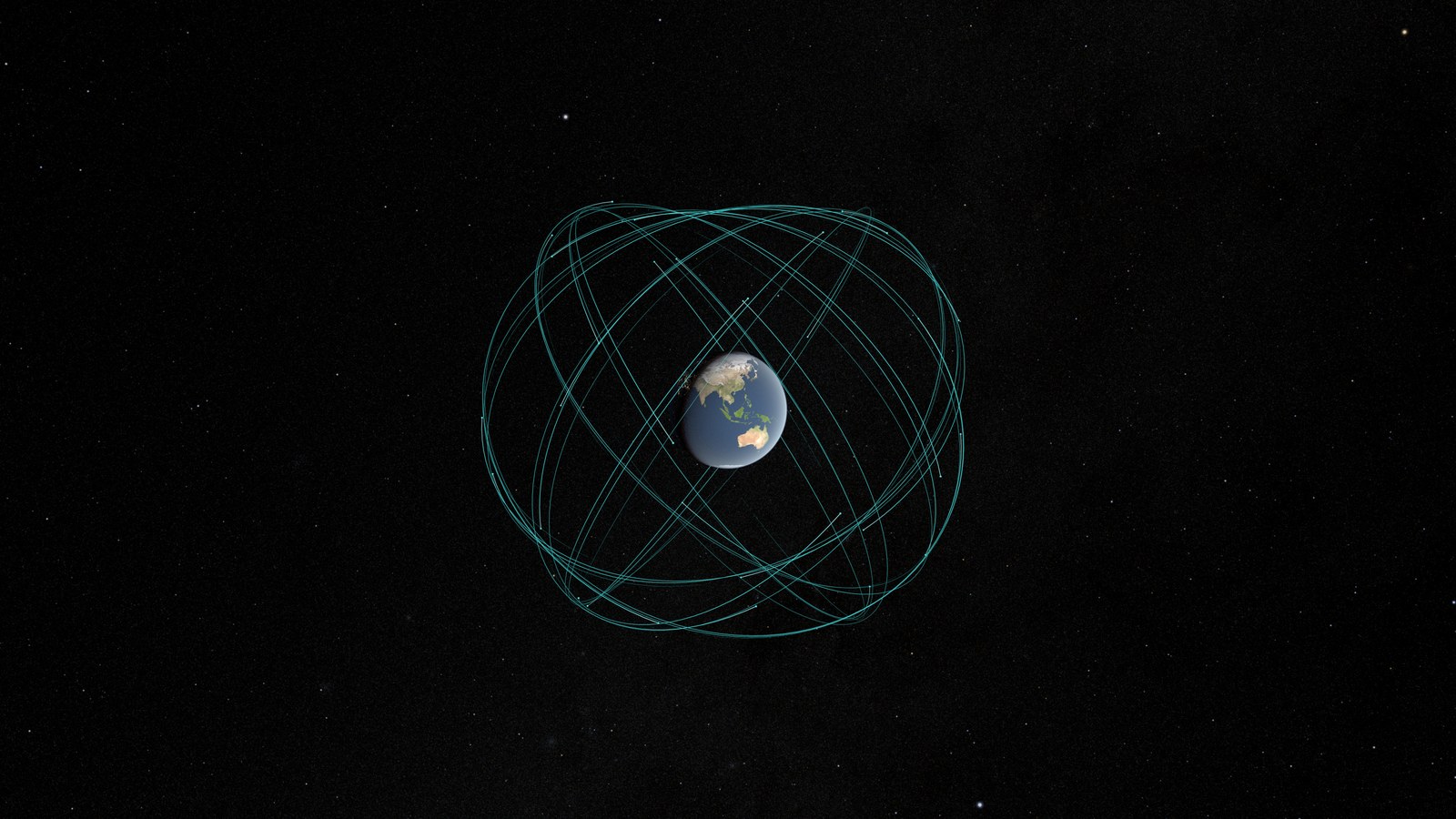
Image: NASA Scientific Visualization Studio / Kel Elkins (Science and Technology Corporation). GNSS fleet visualization, not a phone photograph. Public domain. Cropped to 16:9. Licence. Original file.
Sources consulted: NASA Space Place — How Does GPS Work?; GPS.gov — GPS; EUSPA — Galileo.






0 Comments
No comments on this article yet. Be the first!