


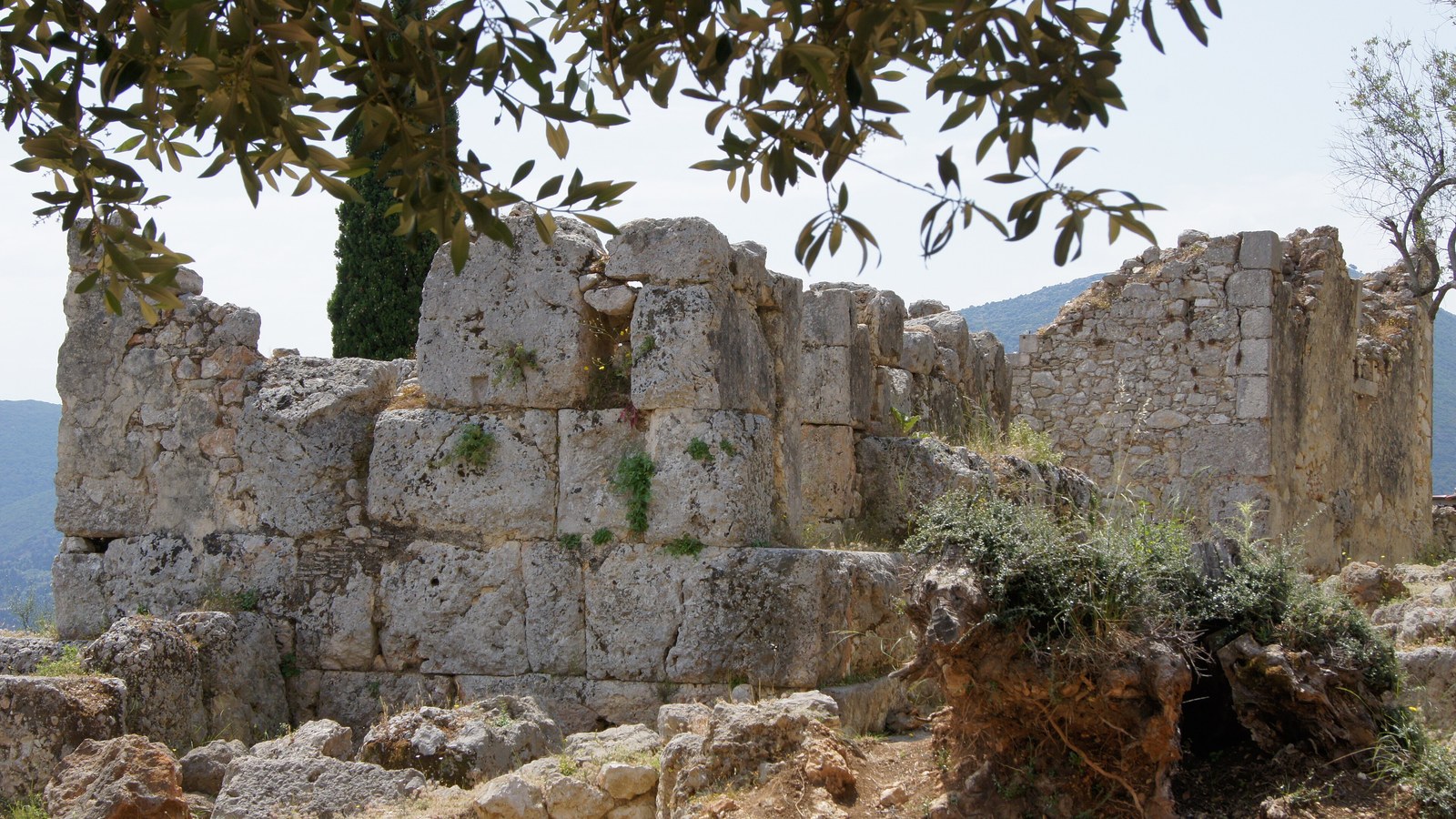
Greece’s Central Archaeological Council unanimously approved, on Monday, 20 October, the updated plan for the Agios Athanasios site in northern Ithaca. The place is known as the School of Homer. The approval opens the way for an archaeological park. It is not a park already open to visitors.
The site sits on the eastern slope of Exoghi, among olive trees and stone terraces. The University of Ioannina dug here between 1994 and 2012. Thanasis Papadopoulos and Litsa Kontorli-Papadopoulos speak of an acropolis-like complex from prehistory. Habitation, they say, begins in the Middle Helladic and runs through the Mycenaean period. It stayed in use into Hellenistic times, with a tower. In the Roman period the area was a cemetery. The name “School of Homer” is tradition, not a proven school of the poet.
The main entrance is moved to about 30 metres from the so-called Mycenaean fountain, not the 6 metres of the old proposal. A small guard post, an accessible toilet, the existing car park with compacted earth. An earth path, with a stretch of gradient for people with disabilities. Two benches, four signs. Light works, as the culture ministry asked.
At the meeting it was said the site is not yet sufficiently excavated. More digging is needed before the remains can be fully shown. eKathimerini reported the vote on 21 October. Politic.gr gave Monday’s details.
KAS recently also approved the delimitation of the site. That is planning paper, not a ribbon-cutting.
A plan approved. The park is not open.
Image: Praxinoa, supposed remains of the palace of Odysseus, Ithaca, May 2011, CC BY-SA 3.0, Wikimedia Commons; the ruins, not a photograph of the 20 October 2026 KAS meeting.
Sources consulted: Greece approves plans to open the Homeric School archaeological site - eKathimerini, 21 October 2026; KAS approved the study for Agios Athanasios, Ithaca - Politic.gr, 21 October 2026.











0 Comments
No comments on this article yet. Be the first!