


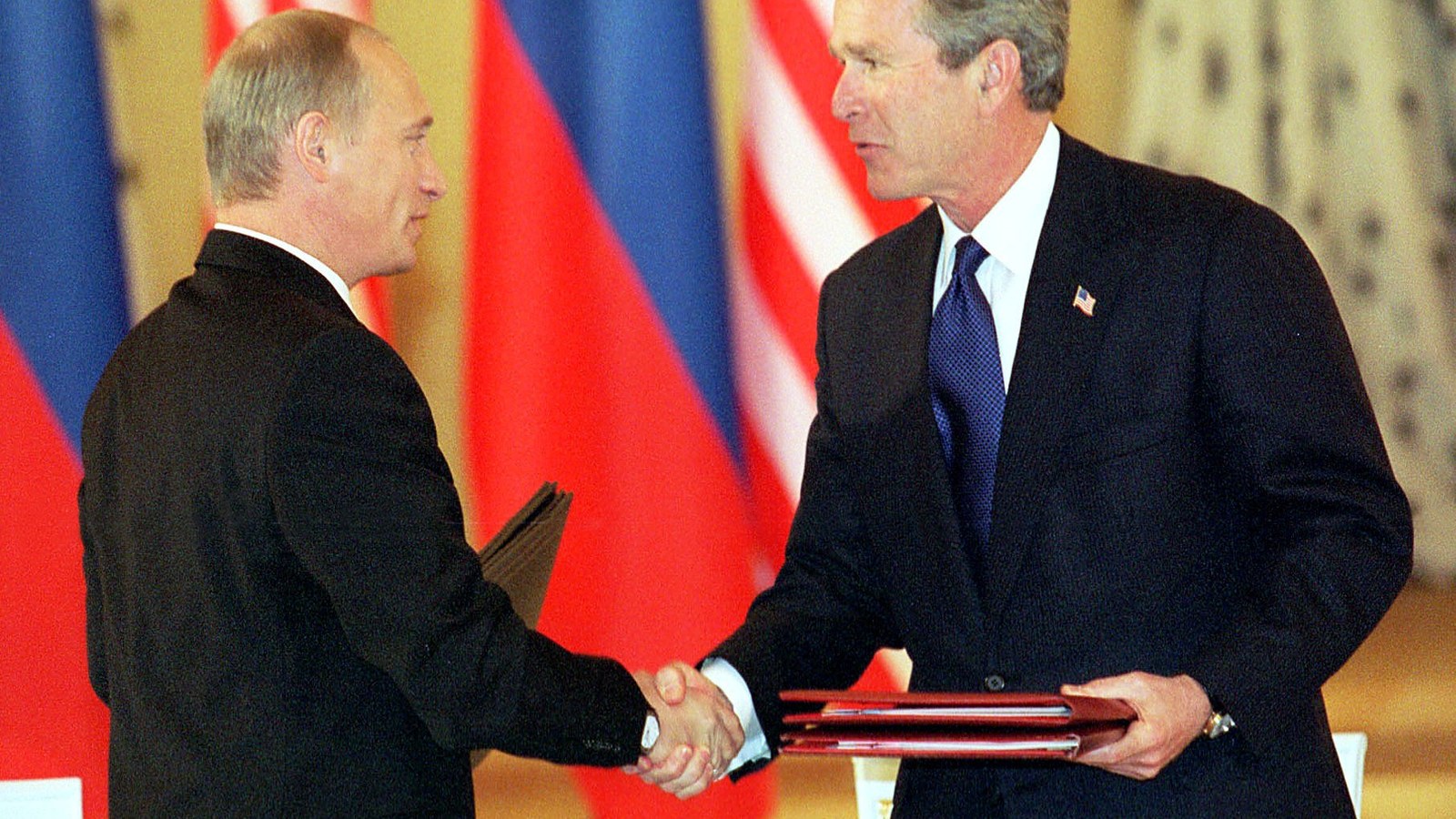
George W. Bush and Vladimir Putin signed, on 24 May 2002, in Moscow, the Treaty Between the United States of America and the Russian Federation on Strategic Offensive Reductions, also known as the Treaty of Moscow or SORT. Two copies, English and Russian, equally authentic. It entered into force on 1 June 2003, after ratification by the Senate and the Duma. This is not the 1920 Treaty of Moscow, with Georgia.
Article I: each party shall reduce and limit strategic nuclear warheads, as stated by the presidents on 13 November 2001 (and by Putin again on 13 December), so that by 31 December 2012 the aggregate number does not exceed 1,700-2,200 for each. Each party determines for itself the composition and structure of its strategic offensive arms, within the aggregate limit. Unlike START I, the cap is on operationally deployed warheads, not on declared means of delivery.
Article II: START I remains in force in accordance with its terms. Article III: a Bilateral Implementation Commission, at least twice a year. Article IV: ratification; in force until 31 December 2012, with extension or supersession; withdrawal on three months written notice. Article V: registration with the United Nations under Article 102 of the Charter.
The Duma delayed: worries about funding, about systems not yet at the end of their lives, about the American potential to upload reserve warheads. Dmitry Rogozin wanted a postponement because of the invasion of Iraq; the final vote nevertheless passed, with nearly a third against. Critics noted the lack of verification, that warheads need not be destroyed, and that the deadline coincided with expiry.
It was superseded by New START on 5 February 2011. Bush said it liquidated the Cold War legacy of nuclear hostility. The cover is the two presidents shaking hands, with the treaty folders, at the Kremlin on the day of signature; the Commons scan of SORT is too small.
Sources: Strategic Offensive Reductions Treaty; Treaty Between the United States of America and the Russian Federation on Strategic Offensive Reductions.











0 Comments
No comments on this article yet. Be the first!