


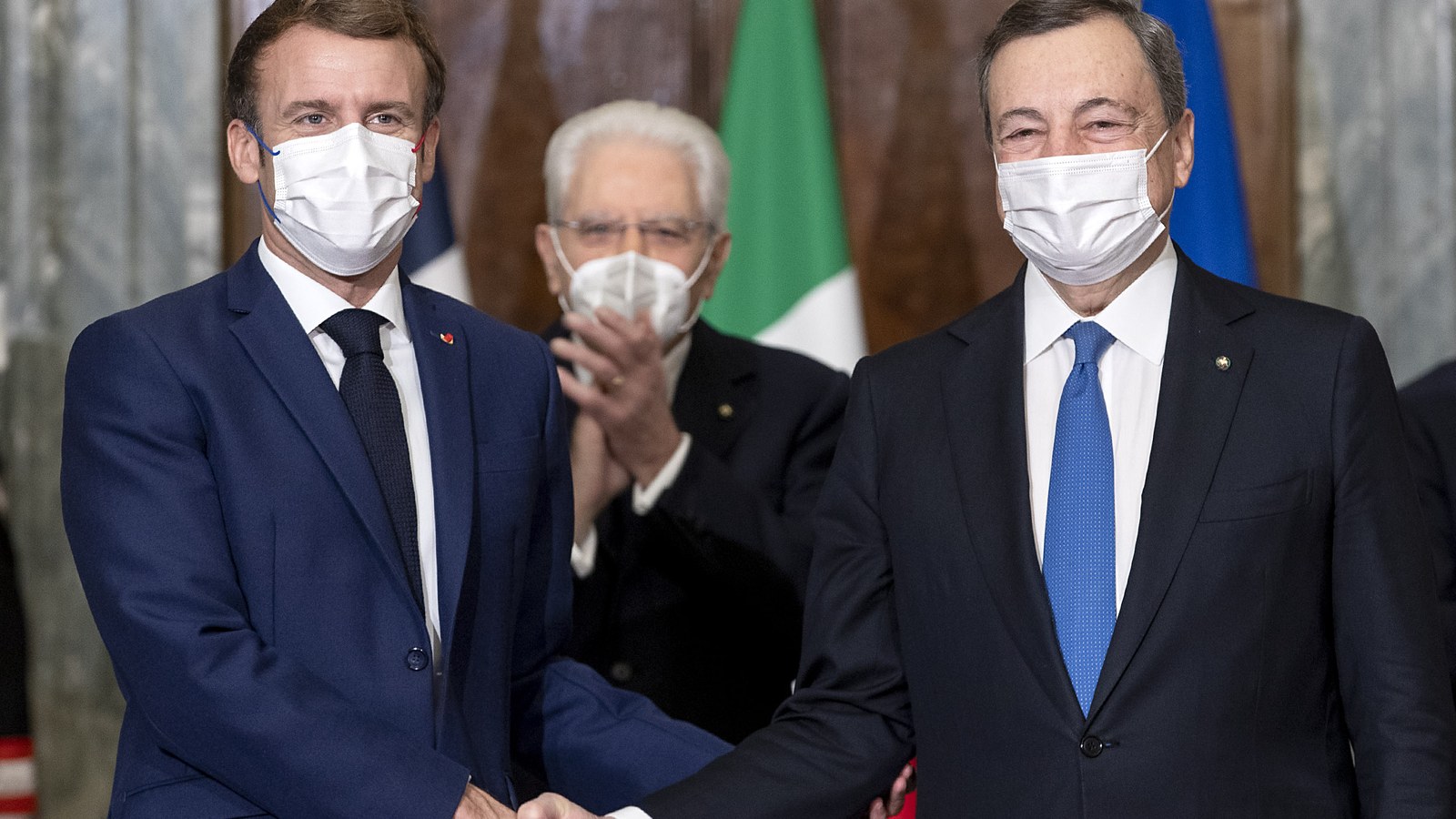
On 26 November 2021, at the Quirinal Palace in Rome, French President Emmanuel Macron and Italian Prime Minister Mario Draghi signed the Treaty between the French Republic and the Italian Republic for Enhanced Bilateral Cooperation. For France the Prime Minister, Jean Castex, and the Minister for Europe and Foreign Affairs, Jean-Yves Le Drian, also sign. Two originals, French and Italian, equally authentic. Twelve articles. Article 12(2): it takes effect on the first day of the second month following receipt of the last notification that internal procedures have been completed. Entry into force: 1 February 2023. Indefinite duration. Either Party may denounce it with twelve months’ notice through the diplomatic channel; it then ceases to be valid six months after receipt of that notice. Italian President Sergio Mattarella was present at the ceremony.
The preamble: the Charter of the United Nations, the Treaty on European Union, the Treaties of Rome of 25 March 1957 and the Rome Declaration of 25 March 2017. The Mediterranean as a crossroads; the Alpine arc; the Single Market and the four freedoms; multilateralism. The Parties reaffirm their will to strengthen European defence and the posture of the Atlantic Alliance. By virtue of Article 5 of the North Atlantic Treaty and Article 42(7) of the TEU, they afford each other assistance in the event of armed aggression on their territories.
Article 1, foreign affairs: regular consultations, joint positions, structured cooperation between missions in third countries and at the main international organisations. The Mediterranean: security, socio-economic development, human rights, and the exploitation of irregular migration. Joint initiatives on the African continent, with particular attention to North Africa, the Sahel and the Horn of Africa. Article 2, security and defence: the Franco-Italian Defence and Security Council, capability cooperation, defence industry, PESCO and the European Defence Fund, space for security and defence, and facilitating transit and stationing of the other Party’s armed forces. Article 3: consultations before major European deadlines; where appropriate and within the EU treaties, wider use of qualified majority voting in the Council.
Article 4: the Schengen area, a thorough reform of European migration and asylum policy on shared responsibility and solidarity, and a Franco-Italian operational unit in support of law-enforcement forces. Article 5: an annual consultation forum on macroeconomic and industrial policy; digital sovereignty, 5G and 6G, artificial intelligence, cloud. Article 6: the European Pillar of Social Rights after the Porto Summit of 8 May 2021; climate neutrality by 2050; a particularly sensitive sea area in the north-western Mediterranean. Article 7: the Ariane and Vega launchers and the European spaceport at Kourou.
Article 8: ESABAC, the Franco-Italian University, Erasmus+ and Horizon Europe. Article 9: a Franco-Italian Youth Council and a “Franco-Italian civic service”, on the basis of the cultural convention signed in Paris on 4 November 1949. Article 10: a Cross-border Cooperation Committee, meeting at least once a year. Article 11: an annual intergovernmental summit, a roadmap, a member of one government sitting in the other State’s council of ministers at least once a quarter, and a joint strategic committee of the foreign-ministry secretaries-general. Italy authorised ratification by Law No. 90 of 12 July 2022.
Quirinal Palace, Rome. Emmanuel Macron and Mario Draghi at the signing. Presidenza della Repubblica, Wikimedia Commons.
For context: Quirinal Treaty. The text: Traité entre la République française et la République italienne pour une coopération bilatérale renforcée.











0 Comments
No comments on this article yet. Be the first!