


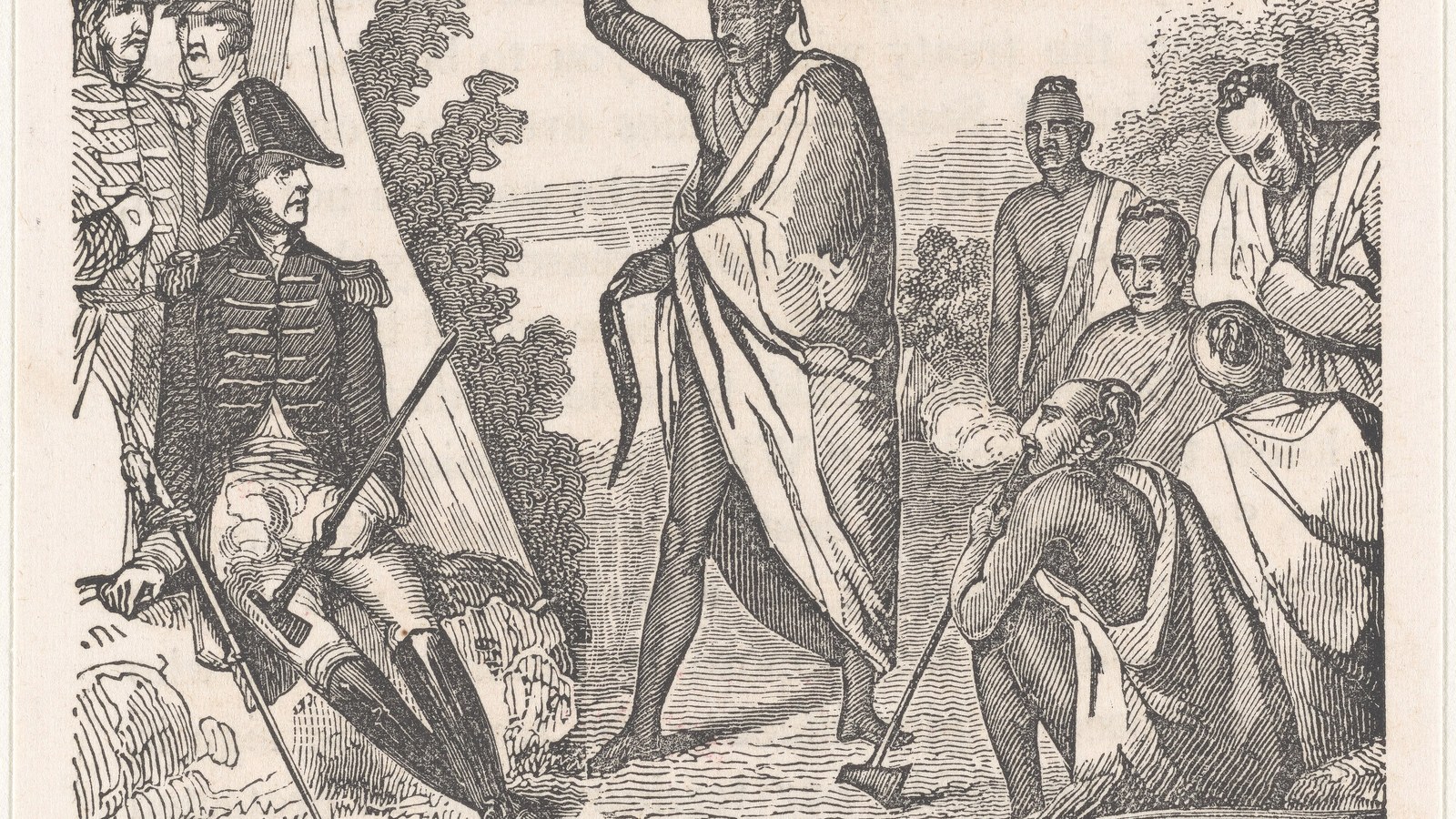
Andrew Jackson, major general of the Seventh Military District, concluded at Fort Jackson, near Wetumpka, Alabama, on 9 August 1814, the Articles of agreement and capitulation with the chiefs, deputies and warriors of the Creek Nation: nine articles, 7 Stat. 120. Signatories: Tustunnuggee Thlucco, speaker for the Upper Creeks; Tustunnuggee Hopoiee, speaker of the Lower Creeks; William McIntosh, major of Coweta; dozens more chiefs from 28 towns. Present: Benjamin Hawkins, federal agent; Return J. Meigs; Robert Butler. Proclamation, 16 February 1815. The style is a military capitulation; the Creek party is the National Council, an American ally, not the Red Sticks beaten at Horseshoe Bend on 27 March.
The preamble cites Fort Mims, the mouth of Duck River and the Treaty of New York of 1790. Jackson demands an equivalent for the war’s expenses by cession. Kathryn Braund, for the National Park Service: nearly 22 million acres, mainly west of the Coosa, the nation’s new western boundary, and along the Alabama, a Tennessee–Gulf artery. Creek allies objected that only a faction had attacked; Jackson held them responsible for failing to stop the Red Sticks. Shelocta did not obtain milder terms.
Article 1: a line from the eastern bank of the Coosa, where the Cherokee southern boundary crosses it, down the Coosa to the Woetumka falls, then meridians to Ofucshee, the Tallapoosa, Summochico on the Chattahoochee and the Georgia line. Reservations of one mile square for friendly chiefs and warriors with improvements in the ceded tract, so long as they and their descendants occupy them. Article 2 guarantees the territory east and north of the line. Article 9 adjusts the Kennards settlement, on Kitchofoonee and Flint.
Article 3: no intercourse with any British or Spanish post; traders only with a presidential licence. Article 4: military posts, trading houses, roads in the guaranteed territory and free navigation. Article 5: surrender of persons and property taken from citizens, friendly Creeks, Cherokees, Chickasaws, Choctaws; restoration to submitted Red Sticks. Article 6: surrender of the “prophets” and instigators. Article 7: rations until the corn crop. Article 8: permanent peace with the United States and with the three neighbouring nations.
This is not the Peace of Ghent of 24 December, not New York 1790, not Indian Springs 1825 and not Cusseta 1832. Menawa fled to Florida, to the Seminole. Jackson moved on towards New Orleans. The cession on the Spanish Florida border, contested for generations; the Indian Claims Commission, in 1962, authorised nearly four million dollars for about nine million acres. The cover is the 1814 cession map.
Sources: Treaty of Fort Jackson; Treaty with the Creeks, 1814 (Kappler; 7 Stat. 120).











0 Comments
No comments on this article yet. Be the first!