


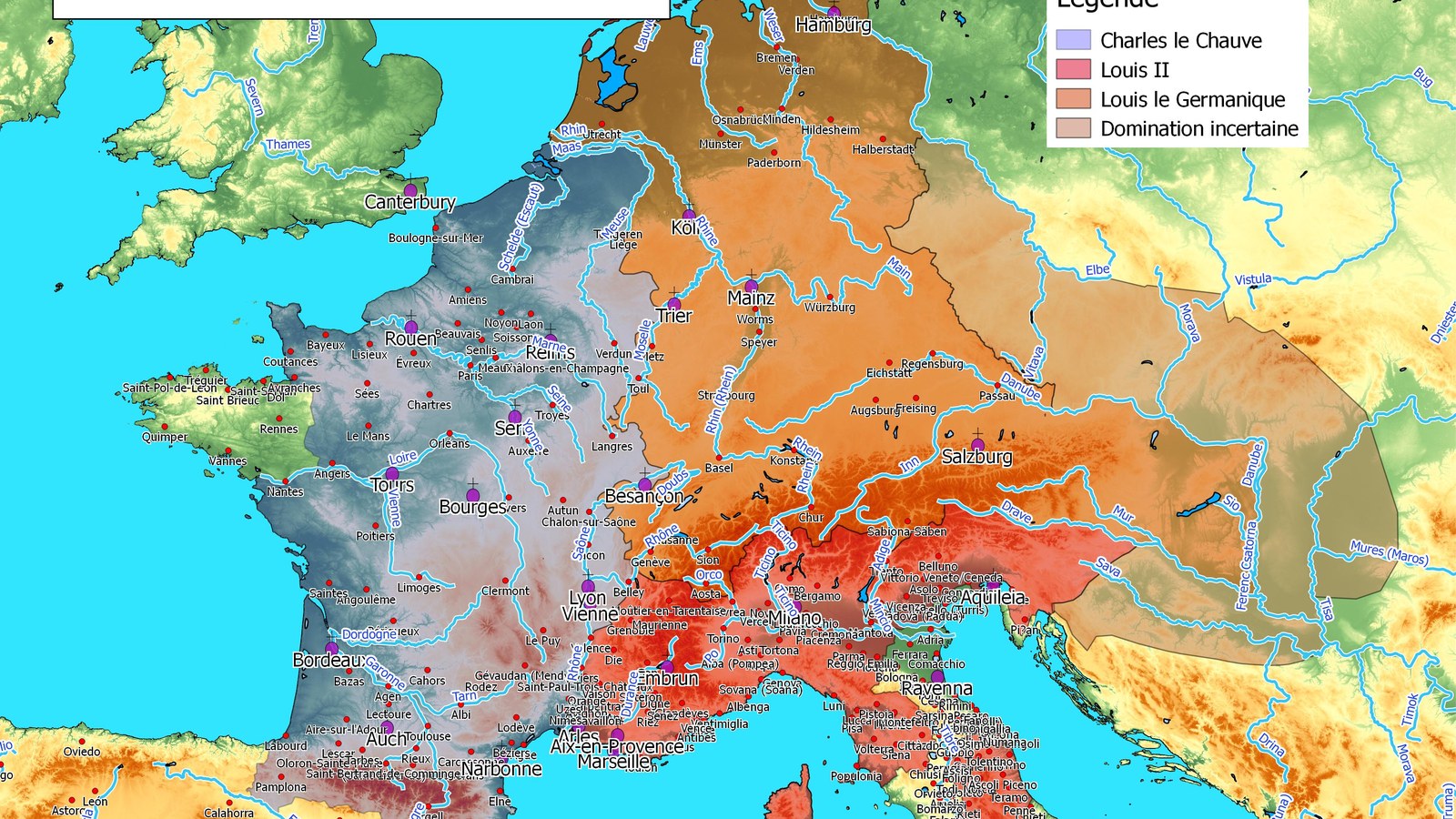
Charles the Bald, king of West Francia, and Louis the German, king of East Francia, made at Meerssen (Latin Procaspis, on the Meuse), on 8 August 870 (6 Idus Augusti, Charles’s 33rd year, indiction 3), the Divisio regni Lotharii: the partition of Lothair II’s realm. It is not a tripartite act. Louis II of Italy, the dead king’s brother and emperor, does not sign; the campaign against the Emirate of Bari kept him away, and the uncles took the Lotharingian inheritance. The Latin text, preserved in the Annales Bertiniani and in Migne, lists bishoprics, abbeys and counties, not a line drawn on a map.
Lothair II had died without legitimate children; the illegitimate son, Hugh, did not succeed. Charles had crowned himself at Metz in 869; the Metz agreement of 868 bound him to share. The Treaty of Prüm of 855 had given Lotharingia to Lothair II and Italy to Louis II; Meerssen replaces, in the north, the Verdun partition of 843 for the northern half of Middle Francia, from the North Sea to the Rhône valley.
Louis’s share: Cologne, Trier, Utrecht, Strasbourg, Basel; the abbey of Aachen; the counties of Testribant, Betuwe, Hamaland; the districtus of Aachen and Maastricht; five Ripuarian counties; two thirds of Lothair’s Frisia. An addition “for the keeping of peace and charity”: Metz with the abbeys of Saint Peter and Saint Martin and the Moselle county; from the Ardennes, from the source of the Ourthe between Bislane and Tumbas to its mouth in the Meuse, plus the abbeys of Prüm and Stavelot. Joint missi were to fix the line towards the Bidgau.
Charles’s share: Lyon, Besançon, Vienne, Tongeren, Toul, Verdun, Cambrai, Viviers, Uzès; Nivelles, Lobbes, Saint Servatius at Maastricht, Mechelen; four counties in Brabant and four in Haspengau; the western part of Maasgau and Liugas, this side of the Meuse; one third of Frisia. The line runs, in the main, along the Meuse, Ourthe, Moselle, Saône and Rhône. The Frisian coast under Viking control is divided only on paper.
This is not Verdun 843, not Prüm 855, and not Ribemont 880, by which the whole of Lotharingia passed to East Francia. After Louis the German died, Charles attacked eastern Lotharingia and was beaten by Louis the Younger at Andernach in 876. The cover is a map of the Frankish kingdoms in 870, after Meerssen.
Sources: Treaty of Meerssen; Divisio regni Lotharii.











0 Comments
No comments on this article yet. Be the first!