


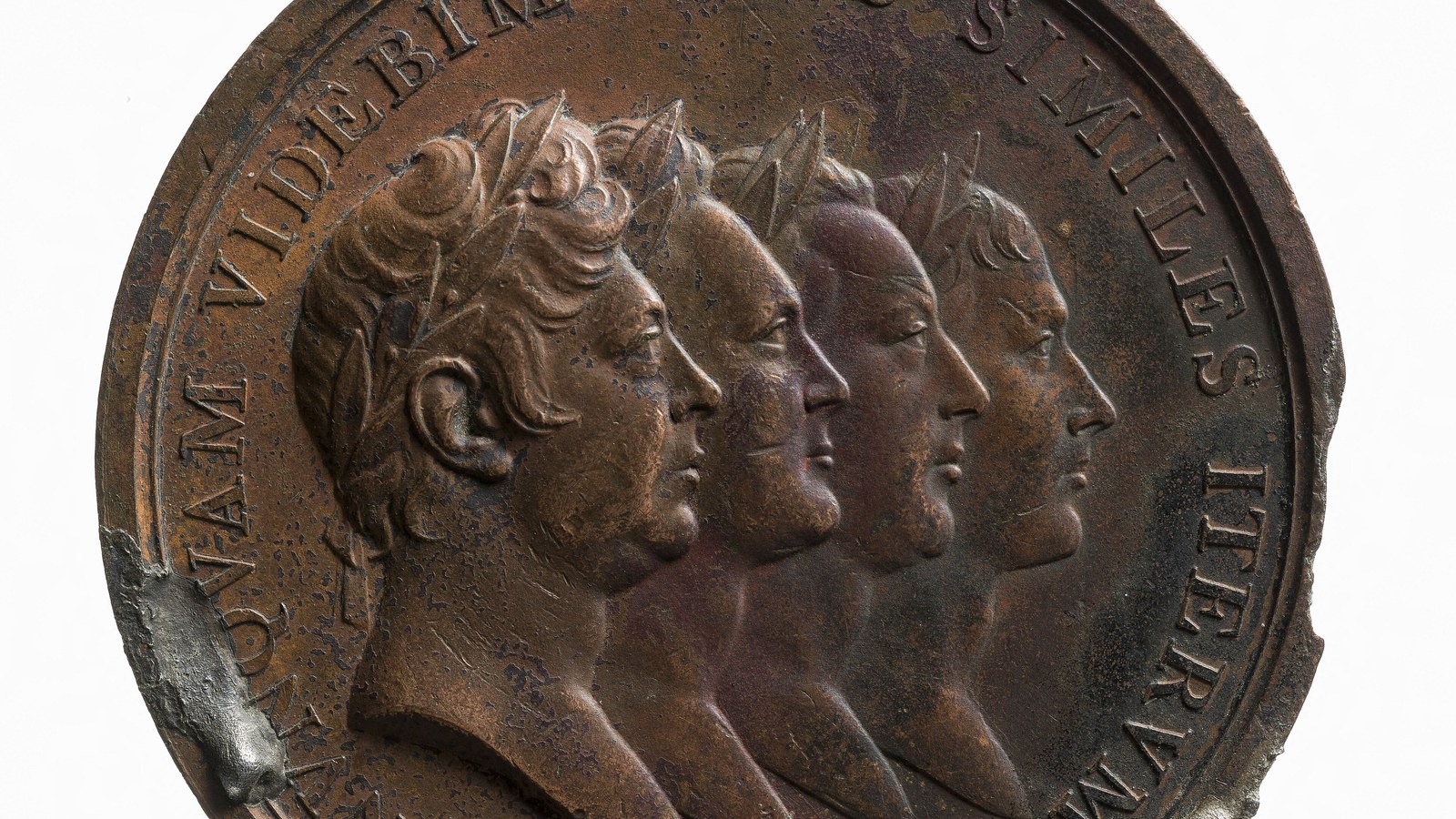
Napoleon abdicated on 6 April. The armistice, on 23 April, between Charles, Count of Artois, lieutenant-general of the kingdom, and the allies. The definitive treaty of peace and amity was signed on 30 May 1814, in Paris. For Louis XVIII, king of France and of Navarre: Charles-Maurice de Talleyrand-Perigord, prince of Benevento. For Great Britain: Castlereagh, Aberdeen, Cathcart and Charles Stewart. Not one common act of the coalition, but separate treaties with each ally. Portugal and Sweden signed; Spain ratified in July. Austria: Metternich and Stadion. Russia: Razumovsky and Nesselrode. Prussia: Hardenberg and Humboldt.
Article I: perpetual peace. Article II: France retains its limits as they existed on 1 January 1792, plus the increase in Article III. Landau, with its radius, remains French; cantons of Saarbruck; Chambery and Annecy, with exceptions; Avignon and the Comtat Venaissin are assured. Monaco is restored to its footing before 1792. The Thalweg of the Rhine is the main stream. Article V: navigation of the Rhine is free; the congress shall extend the principle.
Article VI: Holland, under the House of Orange, with an increase of territory; the German states independent and united by a federative bond; Switzerland, independent, shall govern herself; Italy, beyond what reverts to Austria, shall be composed of sovereign states. Article VII: Malta belongs in full sovereignty to His Britannic Majesty. Article VIII: French colonies of 1792 restored, except Tobago, St Lucia, the Isle of France (Mauritius) with Rodrigues and the Seychelles, ceded to Britain; the part of Santo Domingo from Basel 1795 restored to Spain. Article IX: Guadeloupe restored to France, with Sweden's consent.
Article XXXII: within two months, plenipotentiaries to Vienna, for a congress to complete the treaty. Additional Article I, with Britain: France engages that the slave trade shall cease definitively in five years; in the interval no merchant shall import or sell slaves except in the colonies of the state of which he is a subject. This is not the abolition of slavery.
This is not the second Treaty of Paris, of 20 November 1815, after Waterloo, and not 1763 or 1898. The cover is Edward Thomason's medal for the May peace; the Stassen print is a late reconstruction.
Sources: Treaty of Paris (1814); Definitive Treaty of Peace, concluded at Paris on the 30 day of May, 1814.











0 Comments
No comments on this article yet. Be the first!