
A rainbow is not an object hanging in the sky. It appears when sunlight meets many water droplets, with the observer standing with the Sun behind and rain or spray ahead. Without that geometry the spectrum stays invisible.
As light enters a drop it slows and changes direction: refraction. Colours separate slightly because wavelengths bend by different amounts — dispersion. A reflection from the back of the drop, then a second refraction on the way out, send some of the light back toward the eye.
For the primary bow, the most concentrated rays arrive at about 40–42 degrees from the point opposite the Sun, depending on colour. The angle is approximate: it varies with wavelength and, more weakly, with drop size. The colours form a continuous spectrum, not bands cut with a ruler.
All droplets at the right angle make an imaginary cone with its tip at the observer’s eye. The cone’s intersection with the curtain of drops is a circle. From the ground the horizon usually hides the lower half, so we see an arc. From an aircraft, with droplets below as well, the circle can be almost complete.
Each person sees their own rainbow. Rays reaching one pair of eyes come from different drops than those seen a step away. The “same” bow is a coincidence of angles, not a shared object.
A second, higher and fainter bow appears when light reflects twice inside the drop. The colour order is reversed. The darker region between the two bows is Alexander’s band.
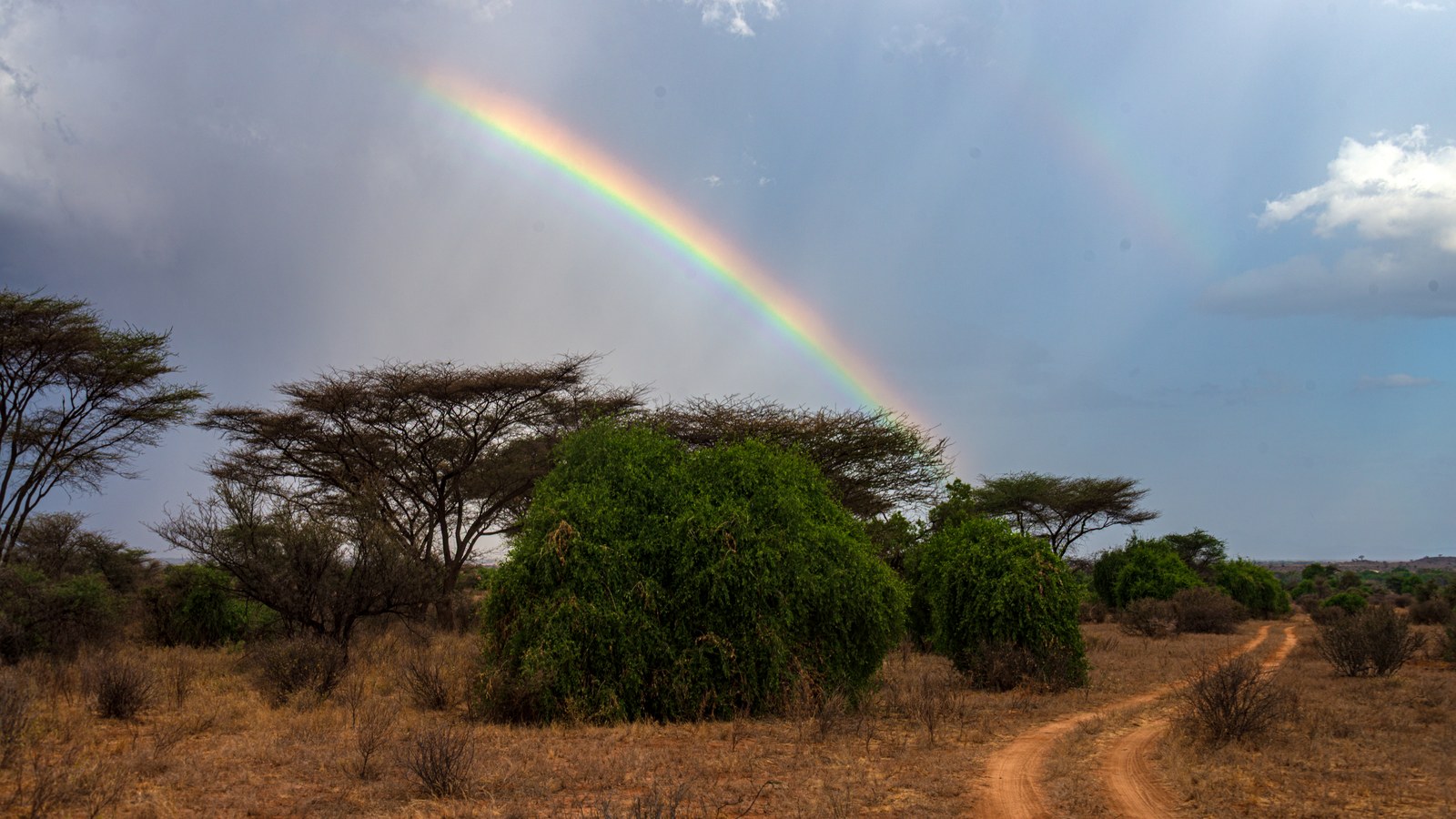
A landscape photograph shows an arc above the horizon, not a 360-degree circle and not the Sun in frame: the Sun must be behind the camera. The image illustrates the shape, not a laboratory experiment.
Image: Daniel Case, rainbow over Samburu National Reserve, Kenya. Wikimedia Commons, CC BY-SA 4.0. Cropped to 16:9. Licence. Original file.
Sources consulted: NOAA SciJinks — What Causes a Rainbow?; Met Office — Rainbows; Rainbow | Encyclopaedia Britannica.





0 Comments
No comments on this article yet. Be the first!