
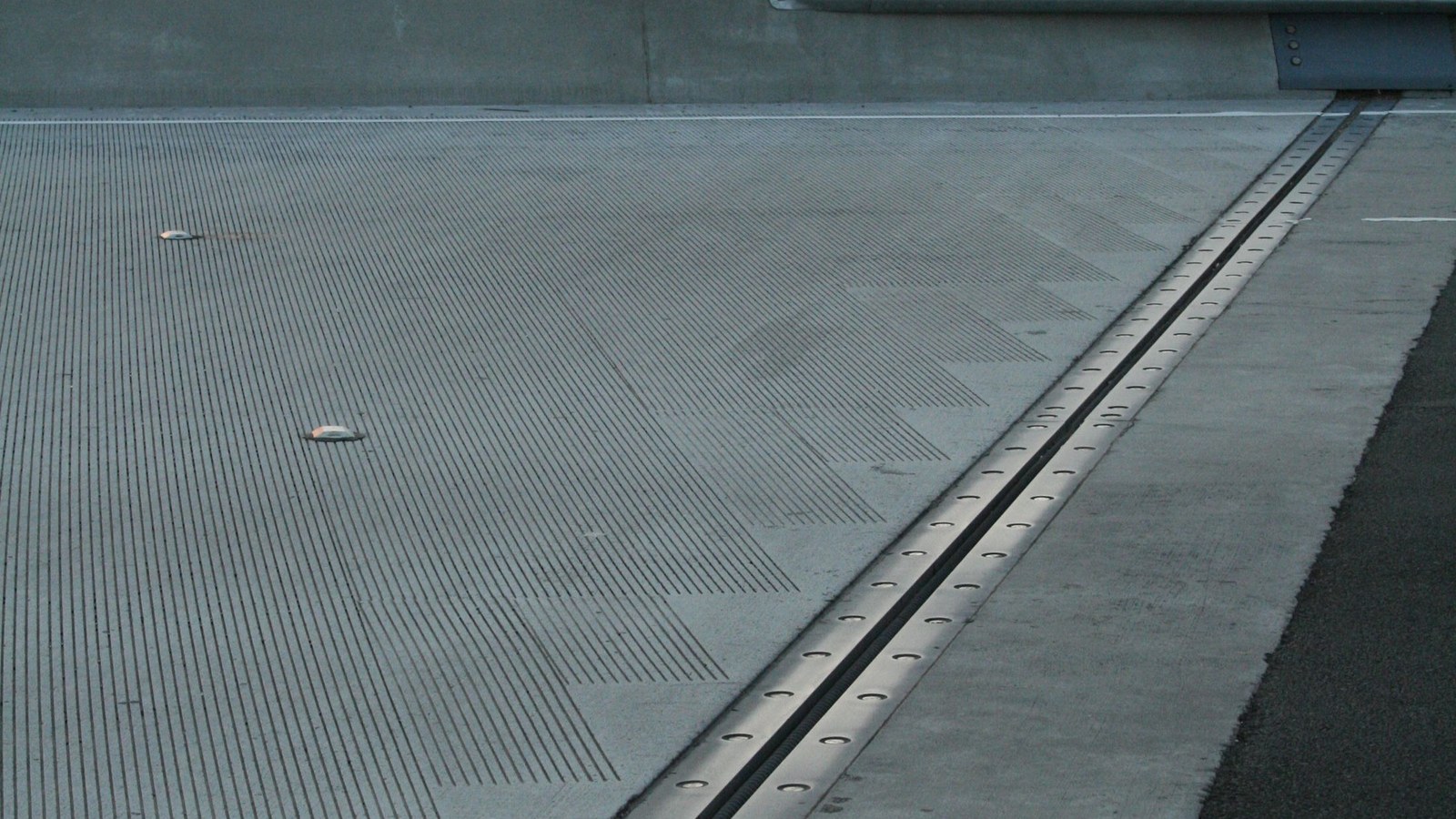
The short noise at the end of a bridge is often an expansion joint. It looks like a break in the asphalt, but it is a structural part. Steel and concrete lengthen in heat and shorten in cold. Across a long span the change adds up to centimetres, sometimes more, depending on length, material and the design temperature range.
If the deck were locked, thermal movement would load the bearings and connections. Cracks or distortion can follow. The joint lets the ends move together or apart in a controlled way while still carrying wheel loads.
Bridges also move for other reasons: traffic, wind, long-term shrinkage of concrete, settlement, sometimes earthquakes. Engineers combine those effects for each site. Bridge manuals, from FHWA to the British DMRB, treat joints as items to maintain, not as decorative details.
Water and de-icing salts that pass a worn joint attack the reinforcement. Failed seals, corrosion and debris jam the movement. Periodic inspection therefore matters more than how the line in the pavement looks.
Not every bridge uses the same joints. Some integral structures cut their number by letting abutments take the movement. The choice depends on length, climate, traffic and whole-life cost.
This article does not give dimensions for a particular bridge. Each design calculates its own play.
The joint remains a planned gap: expansion, load and sealing, not a fault in the asphalt.
Image: bridge expansion joint, 4 July 2008 / Ildar Sagdejev, Wikimedia Commons. A deck detail, not an unnamed local bridge. Cropped to 16:9.
Source consulted: Thermal expansion | Encyclopaedia Britannica; Bridge Preservation Guide | U.S. Federal Highway Administration.









0 Comments
No comments on this article yet. Be the first!