
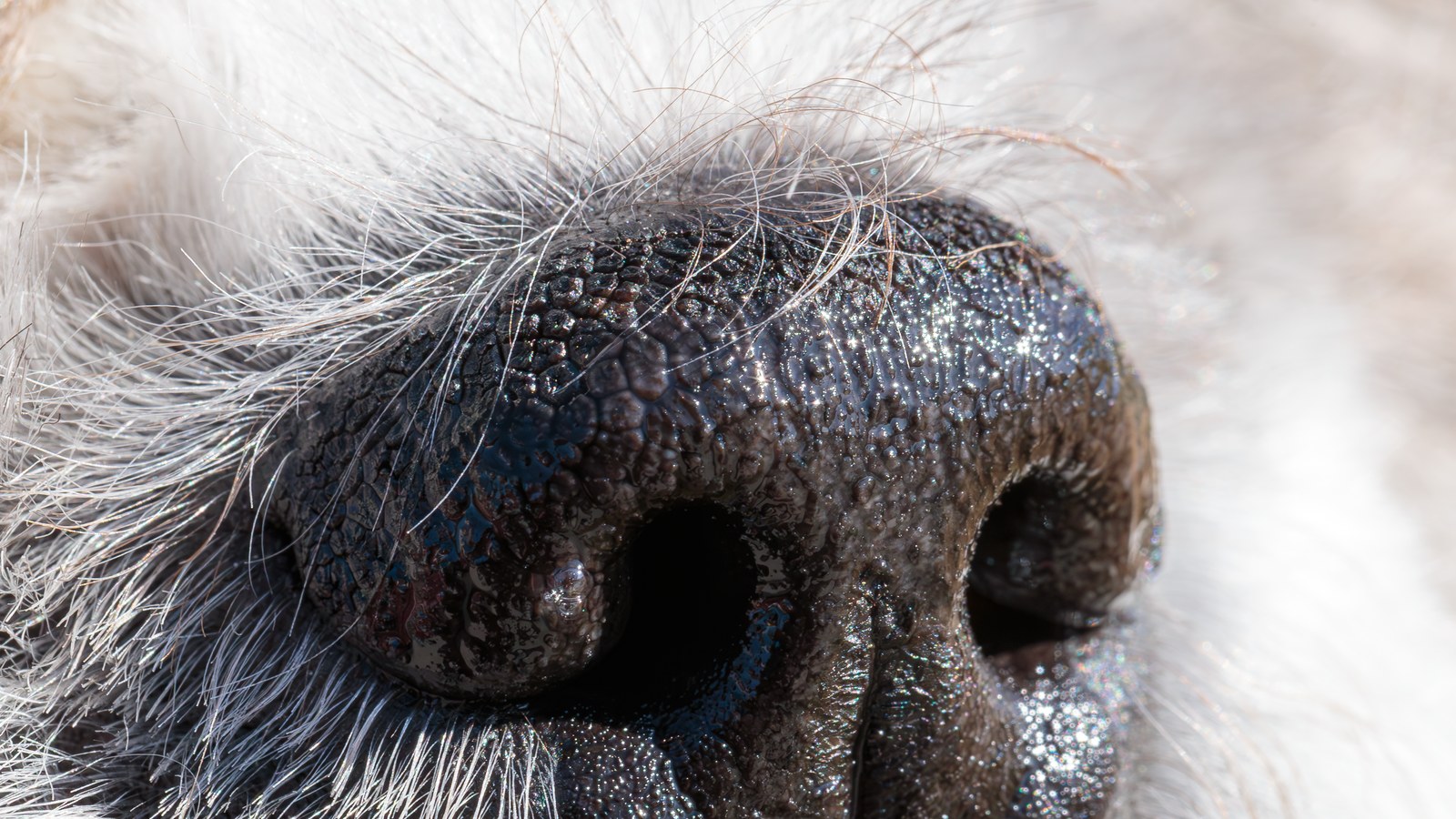
A cold, wet nose is often taken as proof that a dog is healthy. Reality is narrower: a healthy animal may briefly have a warm or dry nose, and a sick one may still have a moist nose. Moisture alone is not a medical test.
The lining produces a thin film, and some of it reaches the outer surface. Dogs lick their muzzles to clean them and to carry odor molecules toward the mouth, where the vomeronasal organ can help with chemical analysis.
A moist surface traps and dissolves airborne molecules more readily, and those then reach olfactory receptors. A dog’s sense of smell does not rest only on that film, however, but also on many receptors, nasal anatomy and brain processing.
Evaporation from the nose may add a little heat exchange. Dogs regulate temperature mainly by panting and other mechanisms. The nose is not their principal radiator.
Sleep, dry air, sun, exercise or mild dehydration can change the look for a few hours. Some breeds are prone to crusting. Appetite, energy, breathing and how long a change lasts matter more.
Coloured or bloody discharge, painful cracks, pigment loss, swelling, laboured breathing or persistent dryness warrant a veterinary check. Human creams should not go on the nose without advice: some ingredients are toxic if licked.
This is information, not a diagnosis. Nose condition should be read with the rest of behaviour, not instead of it.
Image: Metography, canine nose. Wikimedia Commons, CC BY-SA 4.0. Cropped to 16:9. Licence. Original file.
Sources consulted: American Kennel Club — Why Are Dogs’ Noses Wet?; VCA Animal Hospitals — A dry nose is not proof of illness.









0 Comments
No comments on this article yet. Be the first!