
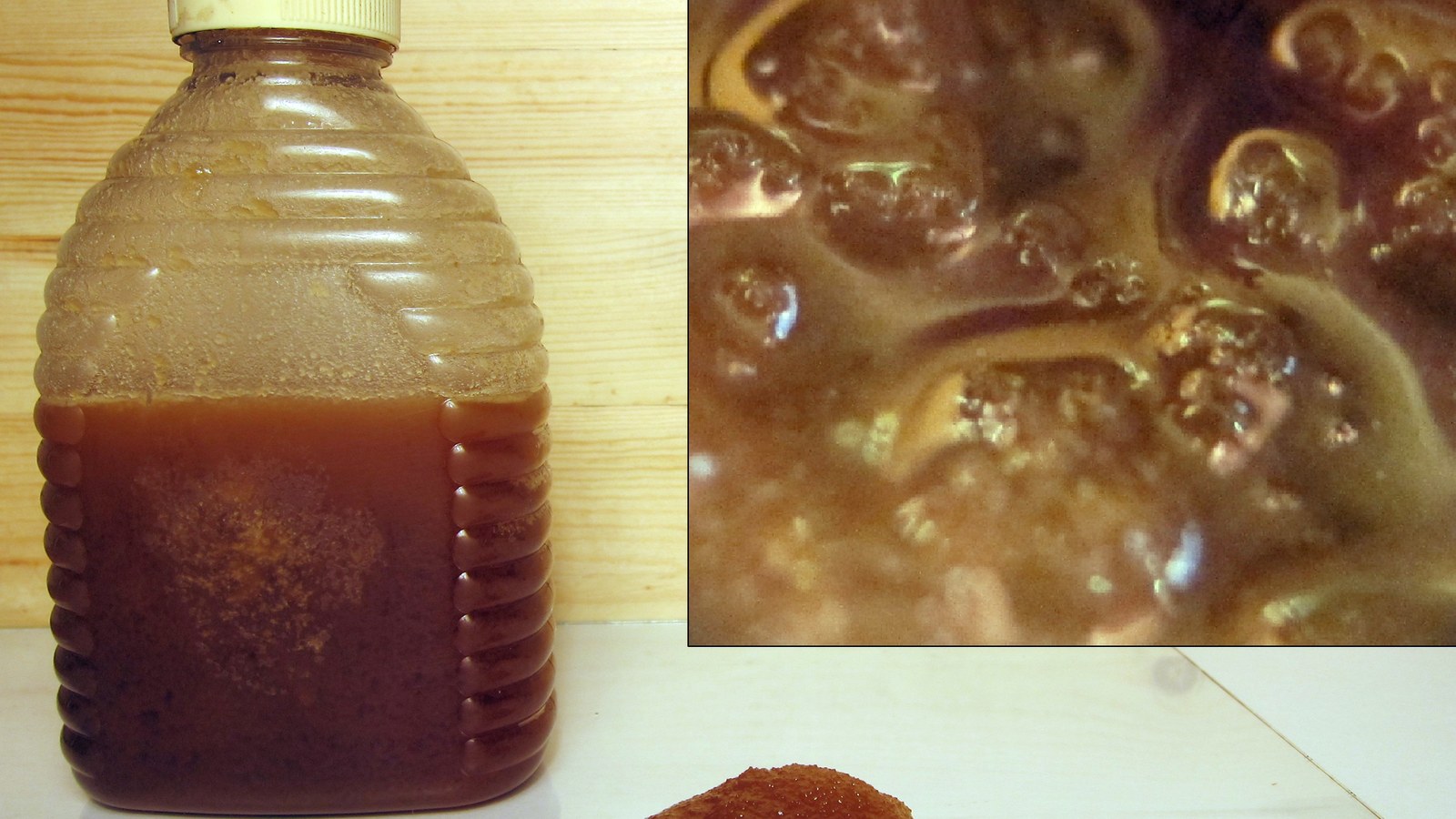
Clear honey can turn cloudy or almost solid. The change is often taken as spoilage or proof the product is fake. In reality, crystallization is normal: honey is a saturated sugar solution with little water. Glucose is less soluble than fructose and can leave the solution, forming crystals that spread through the jar.
The glucose–fructose ratio depends on the floral source. Some varieties granulate quickly; others stay liquid for a long time. Pollen, fine particles and existing crystals provide starting points. Temperature changes the speed and size of the grains.
Crystallization does not cancel the product’s basic qualities and does not by itself prove spoilage. Fermentation is a different process: too much water or moisture entering the container. A sour smell, foam and gas point to fermentation, not mere crystals.
To liquefy it, stand the jar in a warm-water bath and stir slowly. Boiling is unnecessary: excess heat changes the aroma. Keep the lid fitted so water does not enter.
Honey must not be given to children under 12 months, whether liquid, crystallized or used in a recipe. It can contain Clostridium botulinum spores that an infant’s gut cannot safely handle. That specific risk is not the same for older children and healthy adults.
So the grains are sugar physics, not an automatic verdict of spoilage.
Image: Zaereth, crystallized honey (jar and close-up). Wikimedia Commons, CC0. Cropped to 16:9. Licence. Original file.
Sources consulted: National Honey Board — FAQ (crystallization); NHS — Foods to avoid giving babies and young children.










0 Comments
No comments on this article yet. Be the first!