
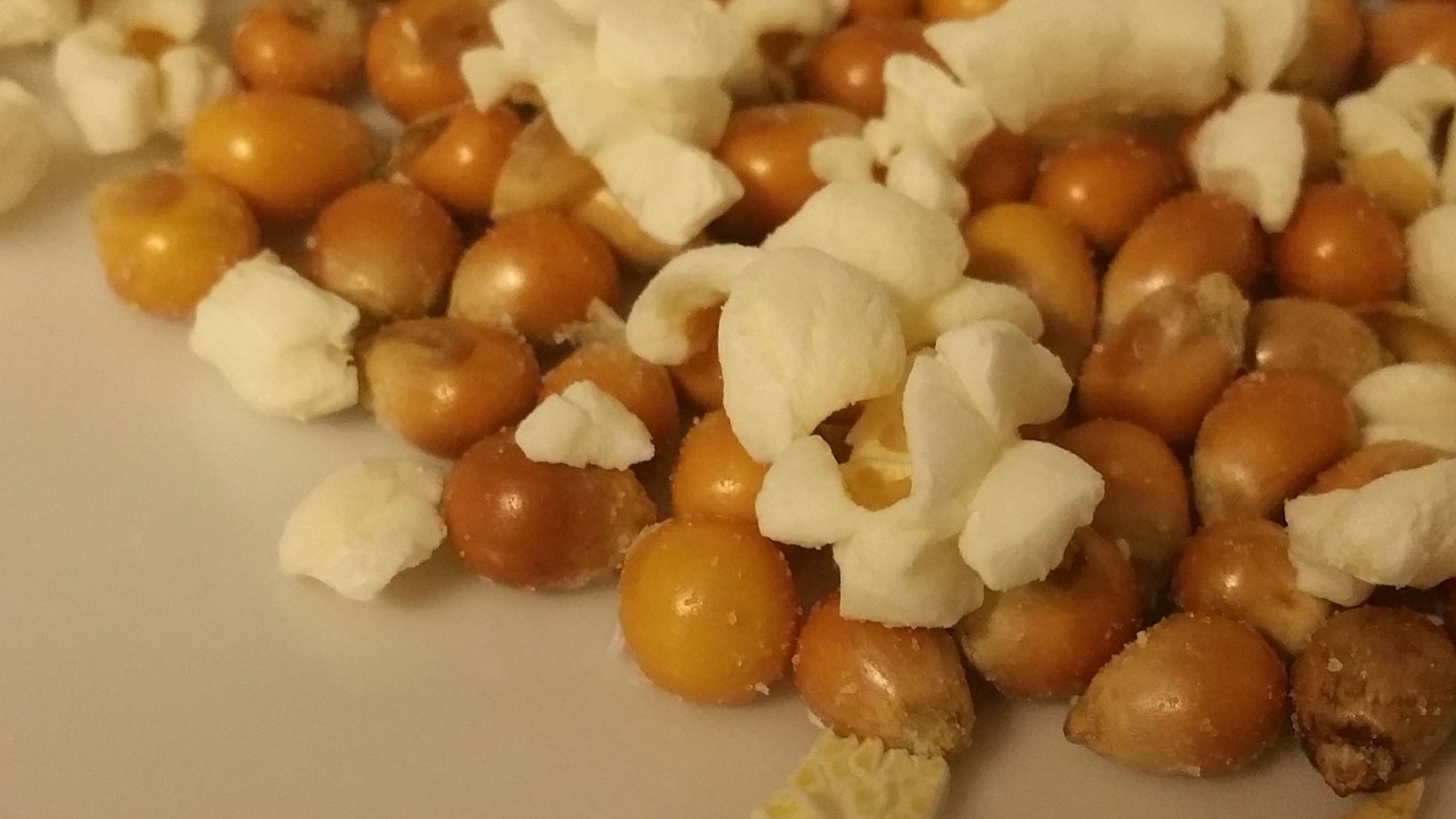
Not every maize variety turns into popcorn. Popping corn, Zea mays everta, has a hard, nearly airtight pericarp and an endosperm rich in glassy starch. A little water remains in the kernel, often around 14 percent by mass when the grain is fit to pop.
On heating, the water becomes steam but cannot leave through the hull. The kernel behaves as a pressure vessel. The starch softens and gelatinises. A study in the Journal of the Royal Society Interface places the critical temperature near 180 °C, when stress in the pericarp exceeds its strength.
When the hull fails, pressure drops at once. Steam and expanded starch rush out; the white mass is the kernel turned inside out, not an added ingredient. The starch foam cools immediately and sets into the familiar irregular flake. The “pop”, according to the same measurements, comes mainly from the release of vapour, not only from the crack of the hull.
Kernels that stay whole often have a crack that vents steam, are too dry or too wet, or were heated unevenly. A pericarp damaged in processing lets pressure leak before the burst.
A pan lid should not be sealed airtight: steam must escape. Hot oil burns. In a microwave oven, only packaging declared suitable by its maker should be used.
Temperature and yield vary with variety and method. This article explains the mechanism, not a kitchen recipe and not a swelling record.
The references remain the chemistry of the pericarp and the physics of a pressure vessel: water, steam, about 180 °C, expanded starch.
Image: kernels and flakes / Wikimedia Commons. Unpopped and expanded kernels, not a laboratory photograph of the pericarp. Cropped to 16:9.
Source consulted: Popcorn: critical temperature, jump and sound | Royal Society Interface; What’s under the shell of this popular snack? | Purdue Agriculture.









0 Comments
No comments on this article yet. Be the first!