
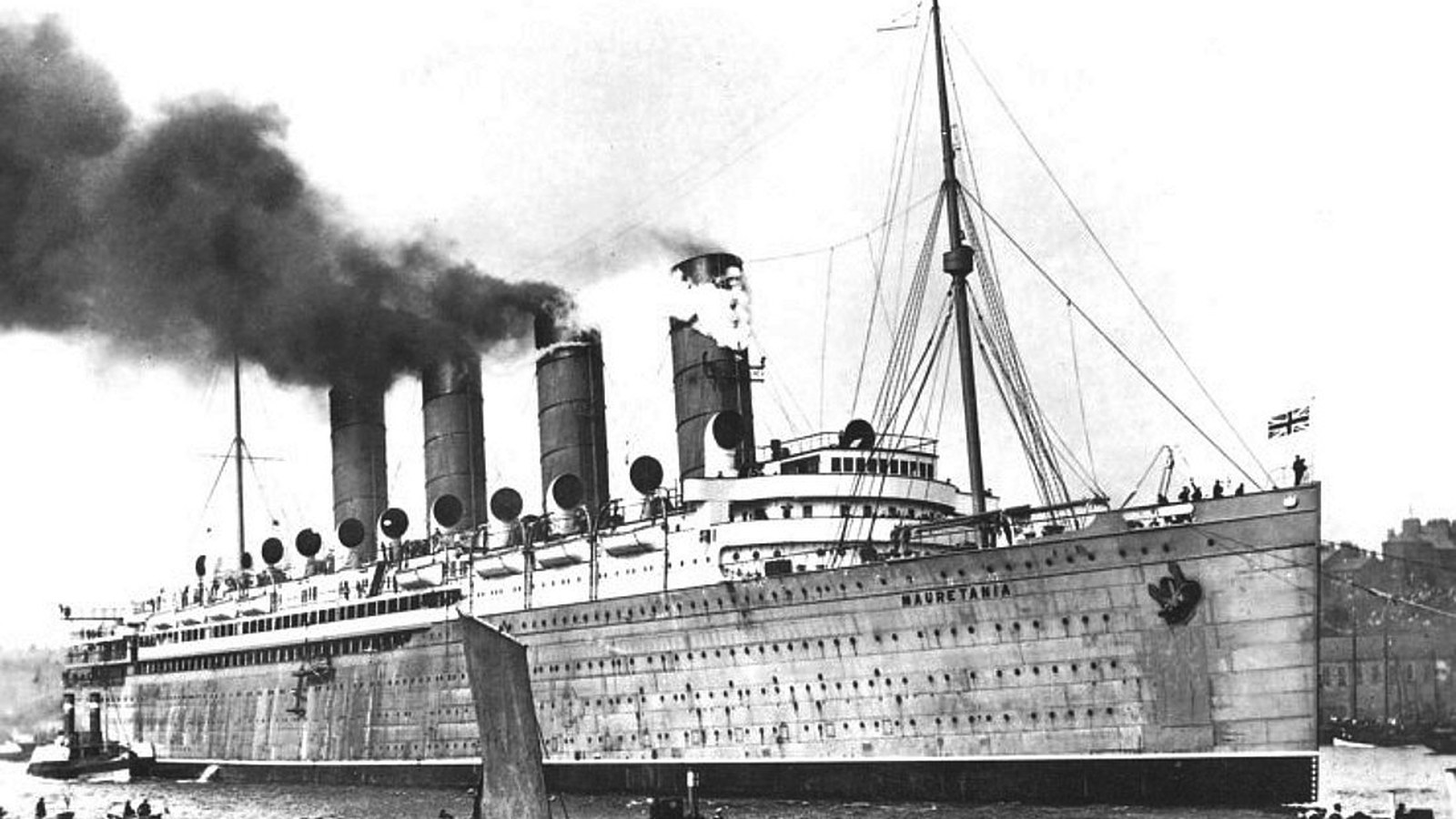
On 20 September 1906, at Swan Hunter & Wigham Richardson’s Wallsend yard on the River Tyne, Cunard launched the liner RMS Mauretania. The Duchess of Roxburghe named the ship. Crowds lined the bank; the day remained in Tyneside memory as a yard event, not a crossing.
Mauretania was the sister of Lusitania, built on the Clyde. Leonard Peskett’s design answered German competition on the Atlantic and received British government support, tied to mail speed and wartime utility. It is not the RMS Mauretania launched in 1938.
At launch she ranked among the largest moving structures yet built. She used Parsons steam turbines on a scale unprecedented for an ocean liner. Vibration on trials forced aft strengthening and redesigned propellers before she entered service.
She left Liverpool on 16 November 1907 on her maiden voyage. On the return from New York in December she took the eastbound Blue Riband. The westbound record followed in the 1909 season. She held both transatlantic speed records for about twenty years.
In the First World War she served as a hospital ship and troop transport. She later returned to civilian service. She was withdrawn in 1934, after the Cunard–White Star merger, and broken up in 1935–1936.
The Wallsend launch ties engineering, migration, class luxury and Edwardian naval rivalry. Turbines, the Tyne and the Blue Riband are enough names. Trial speeds remain period figures, not a single inventory.
The 120th anniversary is maritime history. Photographs, models and objects in Tyne & Wear archives keep the ship better than nostalgia. The 1906 Mauretania must not be confused with her later namesake.
Image: RMS Mauretania on the River Tyne, 1907, unknown author, public domain, Wikimedia Commons.
Source consulted: Mauretania — Co-Curate, Newcastle University.




0 Comments
No comments on this article yet. Be the first!