
17 September 2026 marks 18 years since the International Astronomical Union assigned the name Haumea to a body beyond Neptune and classified it among the dwarf planets. The announcement was made on 17 September 2008. Before the official name, the object was known by the provisional designation 2003 EL61.
It had been observed several years earlier, and the circumstances of the discovery produced a dispute between teams in the United States and Spain. The name comes from Haumea, the Hawaiian goddess of childbirth and fertility, following the convention of using creation-related mythological names for this category of objects.
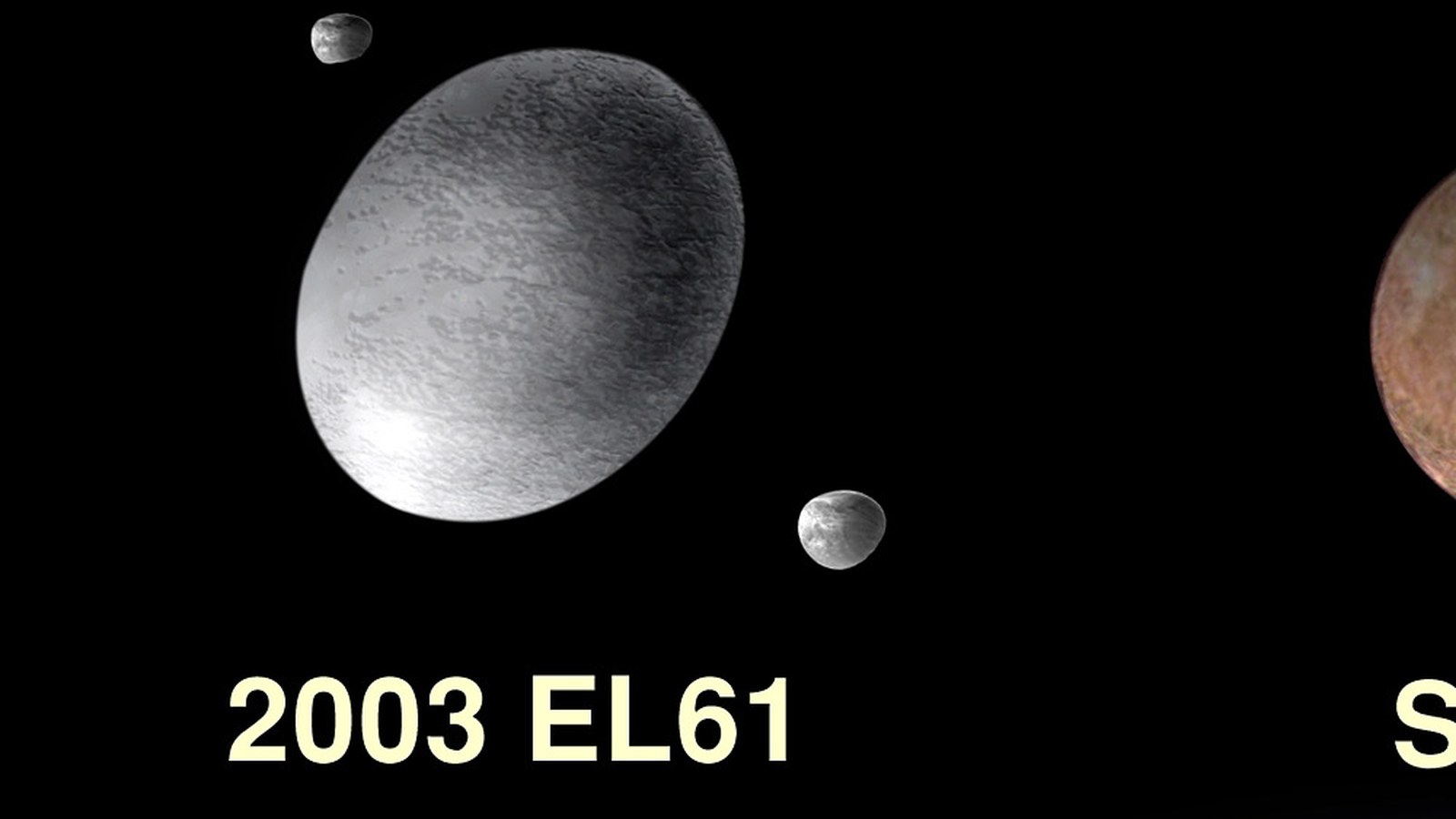
Haumea lies in the Kuiper Belt. One orbit around the Sun takes about 284 Earth years. It rotates extremely rapidly, on a timescale of about four hours. That motion contributes to its elongated shape, unlike the nearly spherical image associated with many planetary bodies.
It has two known moons, Hiʻiaka and Namaka, named after daughters of the goddess Haumea. In 2017 astronomers announced a ring, identified during a stellar occultation. It was the first ring confirmed around a trans-Neptunian object.
Dwarf-planet status does not mean a smaller conventional planet, but a category defined by IAU criteria. The cover is a NASA artist’s illustration of 2003 EL61, the elongated body later named Haumea, not a close-up photograph.
Eighteen years after being named, Haumea remains one of the most unusual known bodies in the outer Solar System, precisely because of its rotation, shape and satellite system.
Image: NASA illustration of Kuiper Belt objects; the elongated body labelled 2003 EL61 is Haumea. Public domain. Not a close-up photograph. Cropped to 16:9.
Source consulted: Fourth dwarf planet named Haumea | IAU; Haumea | NASA Science.










0 Comments
No comments on this article yet. Be the first!