
On 20 September 1839 the Hollandsche IJzeren Spoorweg-Maatschappij opened the first public railway in the Netherlands, between Amsterdam and Haarlem. 20 September 2026 marks 187 years since that ceremonial run. Until then the country relied on canals, towpaths and stagecoaches; the train introduced a pace that water could not match.
The route, about 16 kilometres long, largely followed the Haarlemmertrekvaart. Departure was from the temporary d’Eenhonderd Roe station, then outside Amsterdam’s walls. The locomotives De Arend and De Snelheid, built in England by R. B. Longridge, hauled the train. Regular service began a few days later, on 24 September.
The track used a Dutch broad gauge of 1,945 mm, thought to be safer. Conversion to the 1,435 mm standard gauge came only in 1866, when the network had to align with neighbouring countries. The distinction matters: the 1839 opening should not be described as if today’s rails were already in place.
Scepticism was real. In the same year a boiler had exploded on a train in the Ghent area, and many asked whether the novelty was worth the risk. Speed — around 38–40 km/h on the first run, against about 14 km/h for a stagecoach — soon proved persuasive. The line was later extended towards Leiden, The Hague and Rotterdam, the core of today’s Old Line.
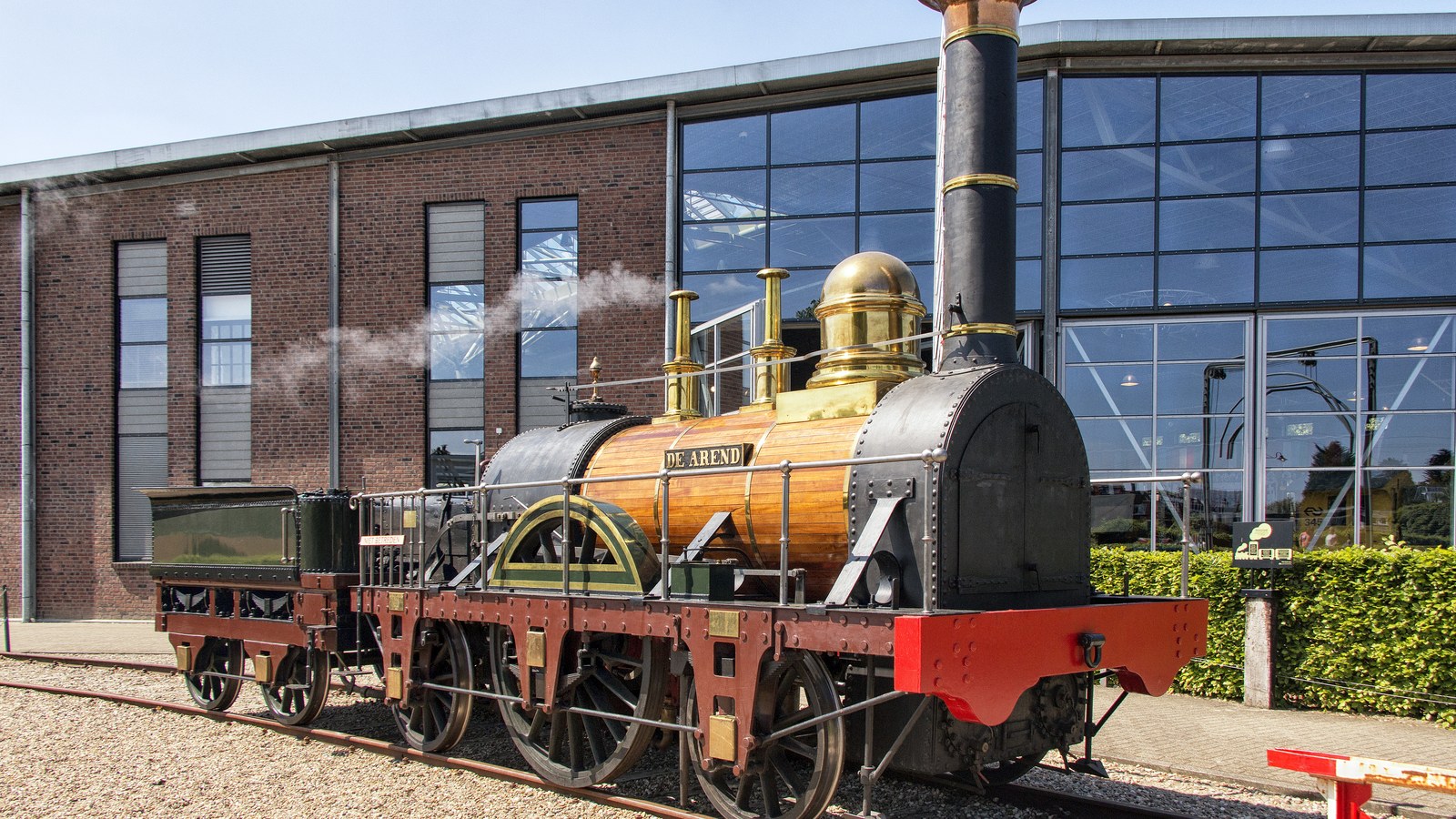
Museum pieces are not the original locomotive. De Arend was scrapped in 1857. The 1938 replica at the Spoorwegmuseum in Utrecht was built in NS workshops for the centenary. Photo credits must say replica, not the 1839 original.
The anniversary marks the start of Dutch rail mobility, not the myth of a finished network. Canals did not vanish overnight. The train did, however, change distances between Holland’s cities and helped prepare one of Europe’s densest railway systems.
Image: Roel Hemkes / Wikimedia Commons, CC BY 2.0. 1938 replica of locomotive De Arend, Spoorwegmuseum, Utrecht, 24 May 2015. The 1839 original was scrapped in 1857. Cropped to 16:9.
Source consulted: The first railway | Canon van Nederland; De Arend | Het Spoorwegmuseum.





0 Comments
No comments on this article yet. Be the first!