
18 September 2026 marks 207 years since the birth of French physicist Jean-Bernard-Léon Foucault, known for the experiment that makes Earth’s rotation visible. Foucault was born in Paris in 1819. He began medical studies but turned to experimental physics after finding he could not work at a patient’s bedside.
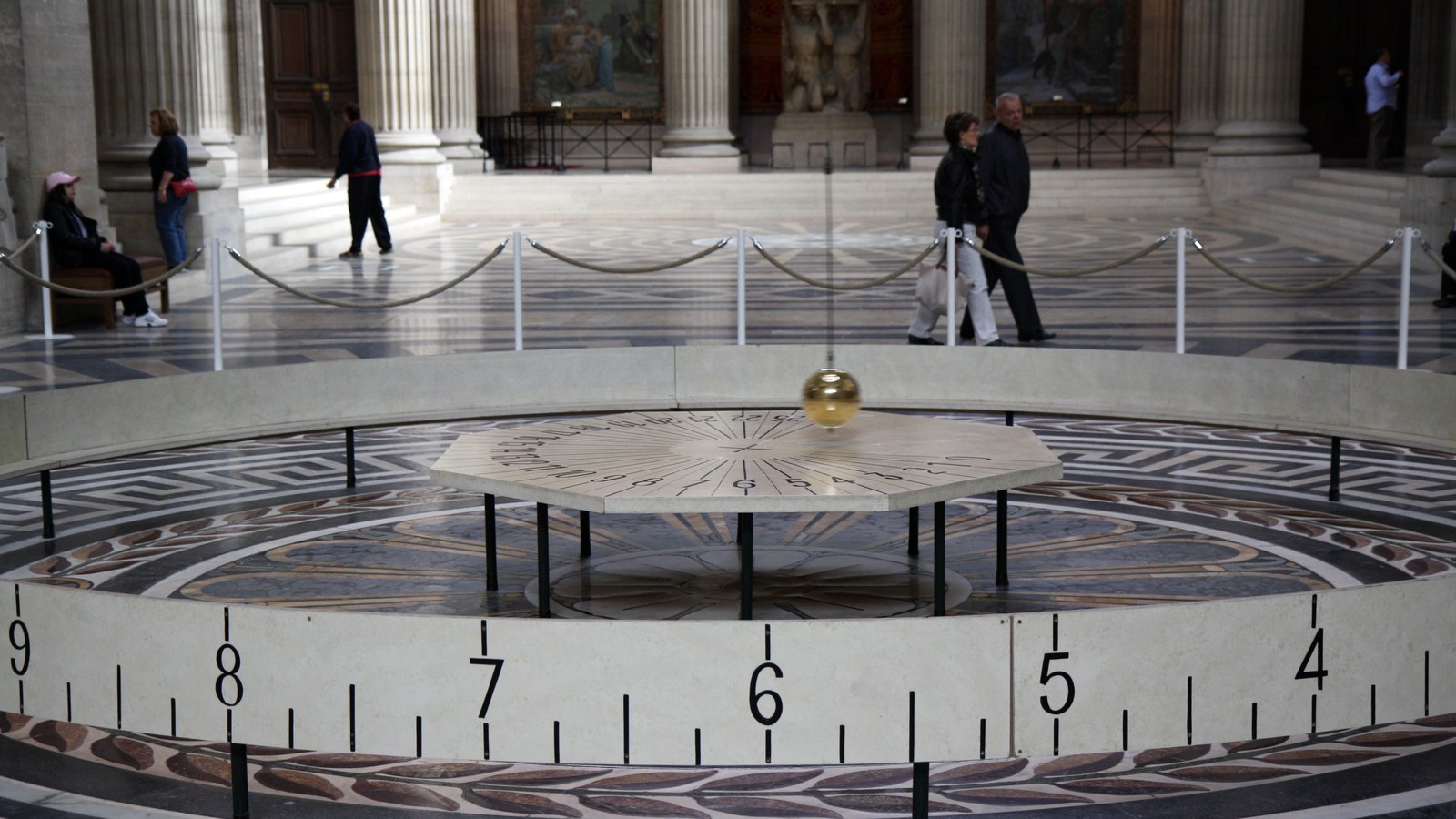
In January 1851 he built, in the basement of his house, a pendulum whose plane of oscillation remains nearly fixed in space while Earth rotates beneath it. The public demonstration at the Paris Observatory, and later at the Panthéon with a long cable hung beneath the dome, turned a result in mechanics into a scientific spectacle that visitors could watch.
The pendulum does not “prove first” that the planet rotates. The idea of Earth’s rotation was already part of astronomy; Foucault’s achievement was to make the motion observable in a room, without a telescope. The time taken for the plane to return to its original position depends on latitude: 24 hours at the poles, and none at the equator.
In 1850 he had shown, with a rotating mirror, that light travels more slowly in water than in air, a result compatible with the wave theory. He developed the gyroscope as another demonstration of inertia relative to space, measured the speed of light with remarkable accuracy for the period and improved telescope mirrors. Eddy currents in metals still bear his name.
Napoleon III created a physicist’s post for him at the Imperial Observatory. He was elected to the French Academy of Sciences in 1865. He died in Paris in 1868, aged 48; biographers link his decline to long laboratory exposure to chemicals, including mercury.
Foucault pendulums now hang in museums and universities. They recall an 1851 experiment, not the discovery that Earth turns — a fact known long before him.
Image: Olga Khomitsevich, Foucault pendulum at the Panthéon, Paris. Wikimedia Commons, CC BY 2.0. Cropped to 16:9. Licence. Original file.
Sources consulted: MacTutor History of Mathematics — Léon Foucault; Encyclopaedia Britannica — Léon Foucault.







0 Comments
No comments on this article yet. Be the first!