
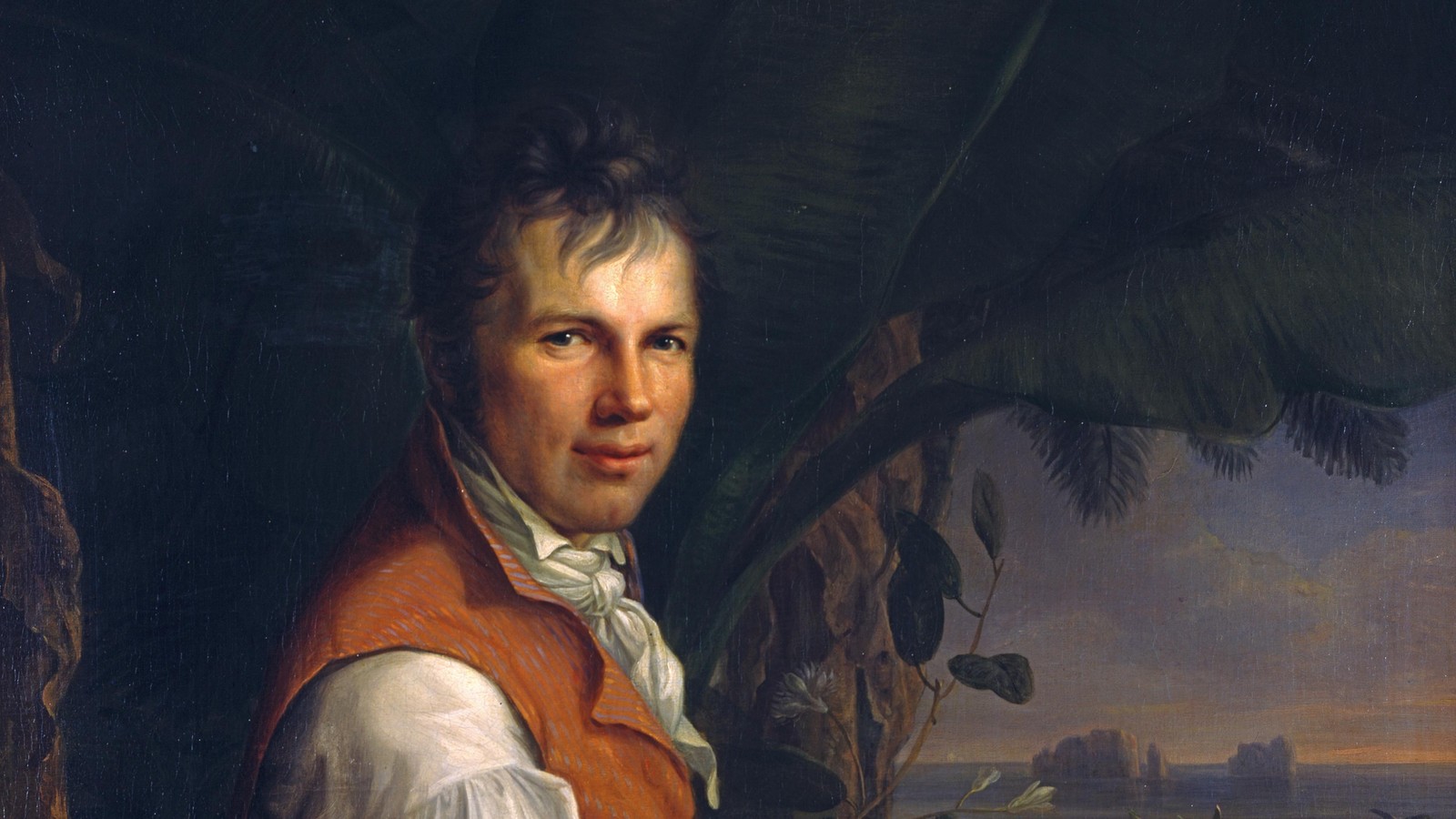
Alexander von Humboldt was born in Berlin on 14 September 1769. In 2026 it is 257 years since the birth of one of the most influential naturalists and explorers of the nineteenth century. The Prussian scholar studied plants, volcanoes, climate, magnetism, geography, astronomy, geology, zoology and the relationship between people and the natural environment.
His most lasting contribution can be summed up in an idea that now seems obvious: nature should not be studied as a collection of separate parts, but as a system in which everything is connected. The Alexander von Humboldt Foundation presents him as a nature researcher, explorer and cosmopolitan, and his Latin American journey (1799–1804) was celebrated in his own time as a second scientific discovery of South America.
Born in Berlin
Humboldt was born in the Kingdom of Prussia, into a well-to-do family. His elder brother, Wilhelm von Humboldt, became an important intellectual figure in his own right, known for work in linguistics, education and university reform. Humboldt University in Berlin today bears the name of both brothers.
From mining to exploration
Alexander studied at several European institutions, including the natural sciences, mining and geology. He worked for several years as a Prussian mining official. The post let him observe geology, working conditions, ventilation, miners’ safety and the formation of rocks. In 1796 he described a breathing apparatus and a safety lamp for miners — a documented episode from his mining service, not a later popular legend.
After his mother’s death, and once he was financially independent, he began to plan a major scientific expedition. Several projects failed because of the wars in Europe. He finally obtained permission from King Charles IV of Spain to explore the Spanish territories in America.
Aimé Bonpland and the Americas, 1799–1804
He was joined by Aimé Bonpland, a French physician and botanist. They left Europe in 1799. The expedition lasted about five years, until 1804. They travelled through regions that are now Venezuela, Colombia, Ecuador, Peru, Mexico and Cuba. They collected plants, minerals, meteorological data, magnetic measurements, geographical observations, information about animals and notes on local societies and economies. The work was not Humboldt’s alone: Bonpland and numerous local collaborators and guides made the fieldwork possible.
One of the best-known journeys was the exploration of the Orinoco system. Humboldt and Bonpland studied the link between the Orinoco and the Amazon through the natural Casiquiare canal. The existence of that hydrographic connection had been reported before; their observations helped to document it scientifically.
Chimborazo and nature as a system
In 1802 Humboldt and his companions tried to climb Chimborazo, in present-day Ecuador. At the time many Europeans regarded the mountain as one of the highest, if not the highest, known peaks in the world. The party did not reach the summit. They did, however, reach an altitude of more than 5,800 metres, one of the greatest then documented by Europeans. Sources differ on the exact figure; the wording here is deliberately cautious.
On the slopes Humboldt saw that vegetation changed with altitude, temperature and climate. He began to compare mountain zones with geographical latitudes. The approach contributed to biogeography and plant geography and helped prepare the ground for modern ecology. He did not “invent” ecology; his ideas fed those disciplines.
One of the celebrated images is the Naturgemälde (in the French version, the Tableau physique): a representation of Chimborazo in which the distribution of plants is tied to altitude, temperature, pressure, humidity and other variables. Humboldt was trying to show, in a single picture, how an ecosystem works.
People, climate and the current that bears his name
In Venezuela he observed the effects of deforestation, agriculture and the alteration of watercourses on humidity, soil, water retention and the local climate. He was among the first scholars to describe systematically how human activity can modify the environment and the local climate. He did not “discover global warming” — that would be anachronistic. Smithsonian Magazine notes, however, that his maps and ideas remain relevant for scientists studying the effects of climate change.
His name is also linked to the Humboldt Current, a cold ocean current along the west coast of South America, also known as the Peru Current. Local populations and navigators knew it long before. Humboldt measured it and described it in a European scientific context; he did not “discover” it.
The United States, Paris, Cosmos
In 1804, at the end of the American journey, Humboldt visited the United States. The Smithsonian American Art Museum documents a stay of exactly six weeks and meetings with President Thomas Jefferson and the artist Charles Willson Peale. The conversations included geography, science, Mexico, trade, politics and exploration. Humboldt held detailed information about the Spanish territories in America.
He was a critic of slavery and of colonial systems that exploited people and resources. The Smithsonian museum places him among figures who inspired a network of people who would go on to condemn slavery. The stance matters also for his relationship with the United States, where slavery still existed.
After his return he settled for a long period in Paris, where he organised and published the expedition’s data, working with scientists, artists, cartographers, botanists and geologists. He sent thousands of plant species and other materials to institutions in Paris, Berlin and Madrid. In 1829, at nearly 60, he took part in an expedition through the Russian Empire, the Urals, Siberia and Central Asia, with fresh observations on geology, magnetism, climate and mineral resources. The Foundation notes that he reached almost to the Chinese border.
In his later years he concentrated on Kosmos / Cosmos. The aim was a unified description of nature and the universe. The first volumes appeared from 1845. The work combined astronomy, geology, geography, biology, climatology, the history of science and the observation of nature. The Smithsonian American Art Museum describes him as one of the most influential figures of the nineteenth century: he published more than 36 books, travelled across four continents and wrote well over 25,000 letters.
Darwin, the name on the map, and 257 years
One of his readers was Charles Darwin. The Darwin Correspondence Project shows that the Personal Narrative fuelled Darwin’s ambition to travel as a scientist and that the book was aboard HMS Beagle. The influence was intellectual and methodological — the blend of exploration, observation and the description of nature. Humboldt did not “give” Darwin the theory of evolution.
His ideas are also often discussed in connection with Henry David Thoreau, John Muir, Ralph Waldo Emerson and Simón Bolívar. We do not turn later admiration or reading into undocumented personal relationships. On the map, the name Humboldt appears on mountains, rivers, bays, towns, counties, parks, species and institutions — including the Humboldt Current, Humboldt County, Humboldt Bay and the university in Berlin. There are astronomical objects that bear his name as well.
Alexander von Humboldt died on 6 May 1859 in Berlin, aged 89. He would have turned 90 in September. Two hundred and fifty-seven years after his birth, the instruments have changed: satellites track the climate, computers process huge volumes of data. The central idea remains current: climate shapes vegetation; vegetation shapes water and soil; relief shapes climate; people alter the environment; a change in one part of the system can have consequences in another. That is why Humboldt continues to be read as a precursor of the modern way of studying the planet.
Image: portrait of Alexander von Humboldt painted by Friedrich Georg Weitsch in 1806, Alte Nationalgalerie, Berlin. Public-domain reproduction via Wikimedia Commons.
Source consulted: Alexander von Humboldt Foundation; Smithsonian American Art Museum; Smithsonian Magazine; Darwin Correspondence Project: Alexander von Humboldt; Encyclopaedia Britannica.

0 Comments
No comments on this article yet. Be the first!