
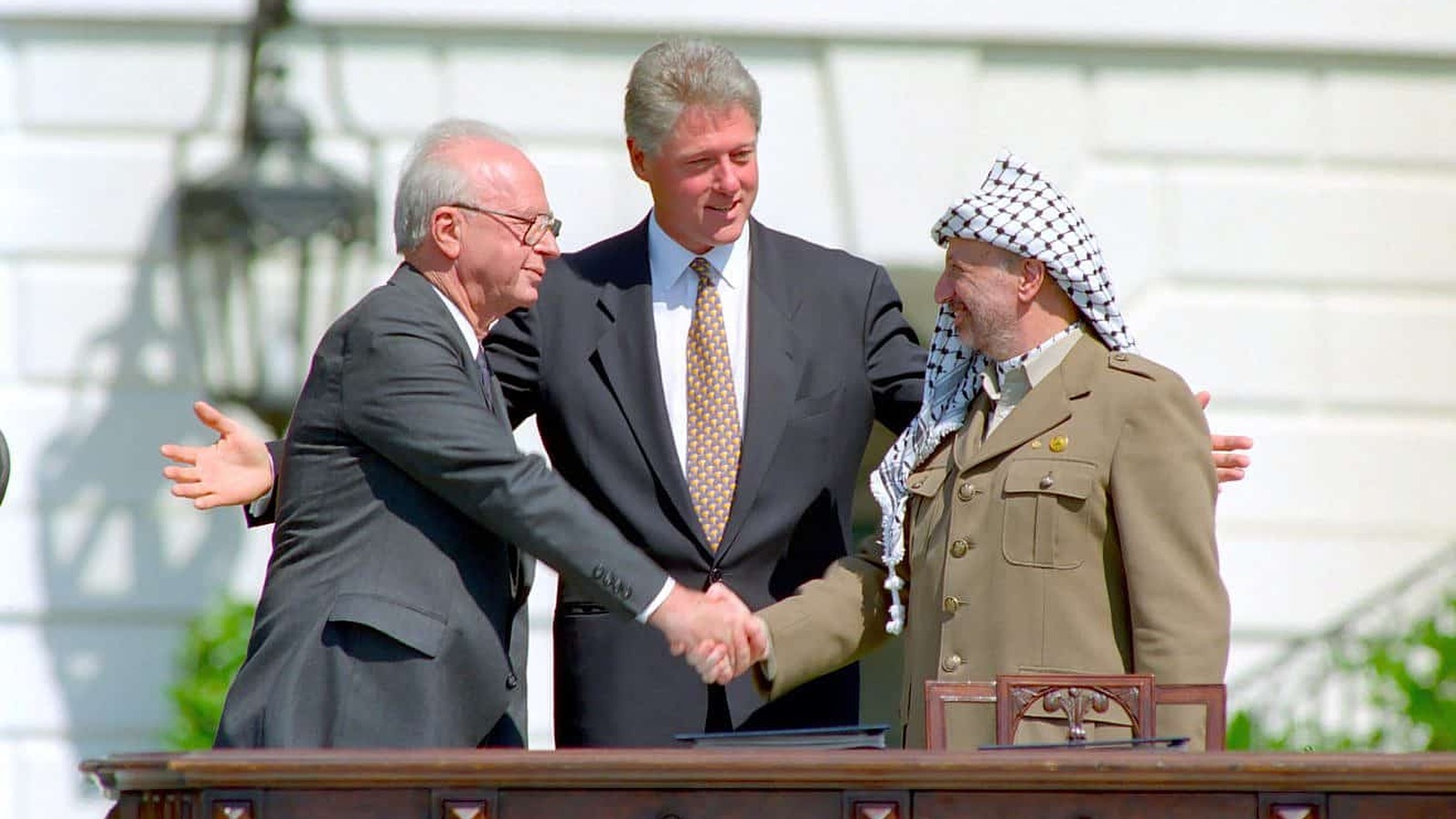
On 13 September 1993, on the White House lawn in Washington, one of the best-known diplomatic ceremonies of the late twentieth century took place. 2026 marks 33 years since the signing of the Declaration of Principles on Interim Self-Government Arrangements, commonly known as the Oslo Accord or the Oslo Accords.
Who signed, and who shook hands
The document was signed by Mahmoud Abbas, a negotiator for the Palestine Liberation Organization, and by Shimon Peres, Israel’s foreign minister. The witnesses were U.S. Secretary of State Warren Christopher and Russian foreign minister Andrei Kozyrev. The ceremony is remembered above all for the handshake between Yitzhak Rabin and Yasser Arafat in the presence of President Bill Clinton. Rabin and Arafat took part in the ceremony and politically represented the two sides; the formal signatures on the declaration are those of Peres and Abbas.
Secret talks in Norway
The agreement had been prepared through secret discussions in Norway, running in parallel with the official diplomatic track that began after the Madrid Conference. The United States did not lead the initial secret negotiations. The State Department’s Office of the Historian notes that the Clinton administration was briefed but made little effort to get involved in them; it later invested time and resources in implementation.
Mutual recognition, not a final treaty
In the Oslo process Israel recognised the PLO as the representative of the Palestinians. The PLO recognised Israel’s right to exist in peace and officially renounced terrorism. The declaration provided for a Palestinian Authority to assume certain governing responsibilities in the West Bank and Gaza Strip over a five-year interim period. It was not a final peace treaty. The hardest issues — borders, refugees, the status of Jerusalem, security and permanent relations — were left for later talks.
Hope, then crisis
After decades of conflict the ceremony raised hopes that direct talks might produce a lasting political settlement. The Rabin–Arafat–Clinton image became one of the emblems of the 1990s. The process continued with further agreements, including the Taba agreement known as Oslo II in September 1995. The early hopes did not become a final deal. Attacks, confrontations and disputes over territory, borders and Jerusalem followed. Yitzhak Rabin was assassinated in November 1995 by an Israeli extremist opposed to the accords. By the time Clinton left office, the Office of the Historian writes, the peace process had run aground and a new round of Israeli-Palestinian violence had begun.
Thirty-three years later
The 2026 anniversary is treated here as diplomatic history, not as a claim that the accords resolved the conflict. The Oslo Accords created institutions and mechanisms that deeply shaped Israeli-Palestinian relations, but they did not produce the permanent peace agreement anticipated in 1993.
Photo: Vince Musi / The White House, 13 September 1993. Work of the U.S. federal government, public domain. Wikimedia Commons file. Cropped to 16:9.
Sources consulted: The Oslo Accords and the Arab-Israeli Peace Process (U.S. Department of State, Office of the Historian); Remarks at the Signing Ceremony for the Israeli-Palestinian Declaration of Principles (13 September 1993).


0 Comments
No comments on this article yet. Be the first!