
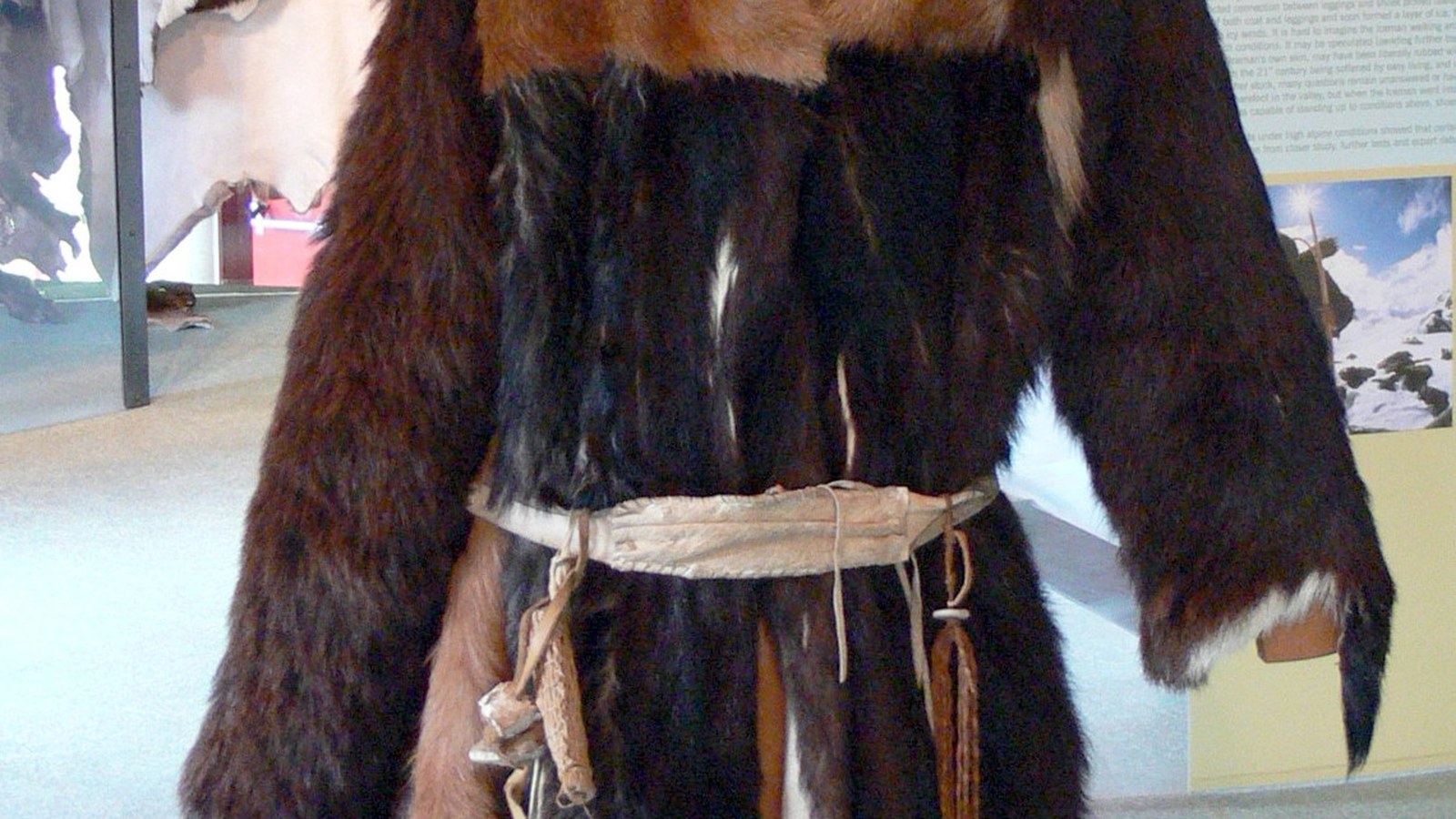
On 19 September 1991, German hikers Helmut and Erika Simon saw, near the Tisenjoch pass in the Ötztal Alps, the upper part of a body protruding from the ice. The first assumption was a recent mountaineering accident, not a Copper Age mummy.
Analysis dated the death to around 3300 BCE. Ice and the mountain microclimate had preserved the body for about 5,300 years. With it came a copper-bladed axe, an unfinished bow, arrows, a dagger, clothing of hide and plant fibre, and birch-bark containers.
Laboratories have read his last meal, tattoos, joint wear and genetic material. An arrow wound in the left shoulder and other injuries shifted interpretation towards a violent death. The exact sequence of an attack cannot be reconstructed with certainty; the attacker’s identity lies outside what can be demonstrated.
Ötzi is kept at the South Tyrol Museum of Archaeology in Bolzano, in a chamber that mimics glacier conditions. The find still generates research, including work on microorganisms and conservation methods.
The site sits on the ridge between Italy and Austria; the border dispute of the time has been settled administratively, and the mummy remained in Bolzano. The 35th anniversary marks the discovery, not the “solving” of a biography.
This article does not fill the gaps with a prehistoric crime novel. Ötzi remains an exceptional source on diet, mobility and technology, not a closed criminal file.
Image: reconstruction of Ötzi’s clothing, Archeoparc / Wikimedia Commons. A museum display, not the preserved body in Bolzano. Cropped to 16:9.
Source consulted: The discovery | South Tyrol Museum of Archaeology; Ötzi the Iceman | South Tyrol Museum of Archaeology.





0 Comments
No comments on this article yet. Be the first!