
Italo Calvino died in Siena on 19 September 1985, after a cerebral haemorrhage. He was 61. Born on 15 October 1923 in Santiago de las Vegas, Cuba, to an Italian family and raised in Sanremo, he became one of the most translated Italian prose writers of the twentieth century.
In the war he joined the anti-fascist resistance. His debut, The Path to the Nest of Spiders (1947), belongs to the neorealist climate; he later moved away from conventional realism towards fable, allegory and experimental narrative. He worked in Turin for Einaudi and, with Elio Vittorini, edited the magazine Il Menabò.
The Our Ancestors trilogy — The Cloven Viscount, The Baron in the Trees, The Nonexistent Knight — uses fantastic situations to examine freedom, identity and responsibility. Invisible Cities turns imaginary conversations between Marco Polo and Kublai Khan into a meditation on memory and space. If on a winter’s night a traveler makes reading the novel’s subject.
The lectures prepared for Harvard appeared posthumously as Six Memos for the Next Millennium; he had finished five. Romanian titles sometimes vary from one edition to another; the reference remains the Italian corpus.
The 41st anniversary is a literary marker, not a festival obituary. Calvino should not be reduced to a single “magic” novel; his path runs through resistance, publishing and experiment.
Treccani and Britannica fix the dates of birth and death. This text does not reproduce protected covers and does not claim a single Romanian edition.
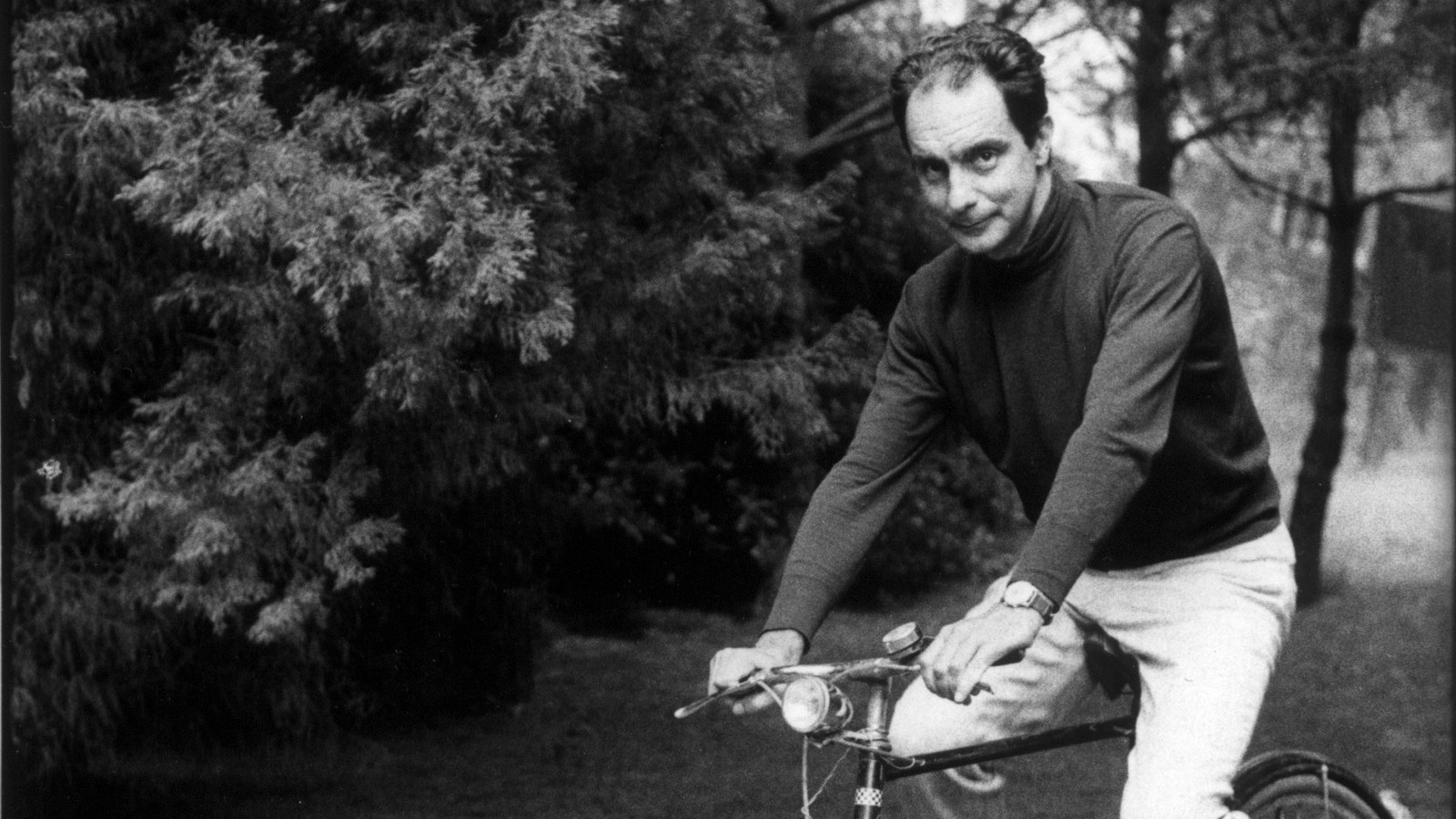
Image: Italo Calvino on a bicycle / Wikimedia Commons, public domain. An informal portrait, not protected book covers. Cropped to 16:9.
Source consulted: Italo Calvino | Encyclopaedia Britannica; Italo Calvino | Treccani.







0 Comments
No comments on this article yet. Be the first!