
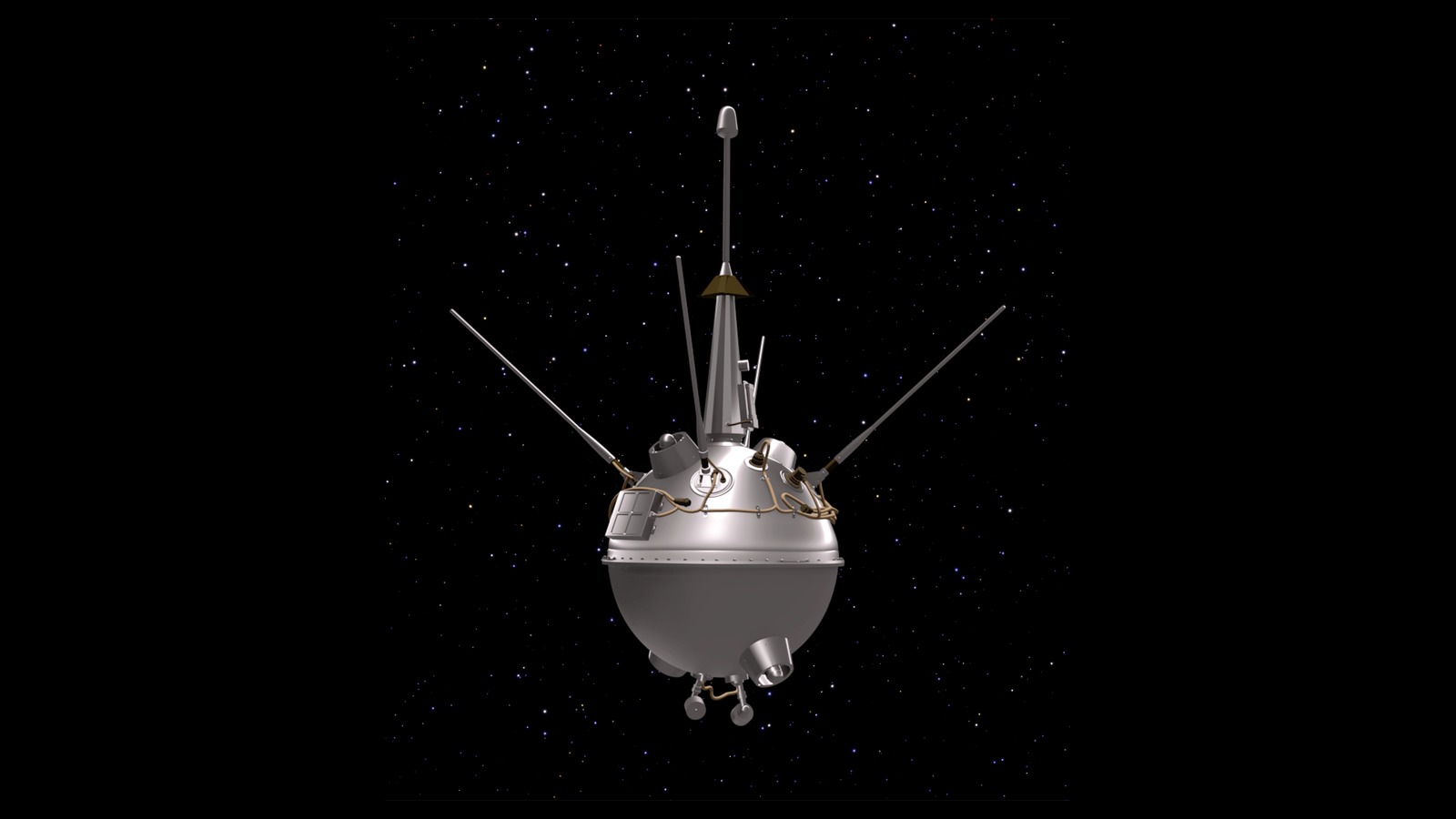
Long before a human stepped onto the Moon, a small Soviet probe achieved what until then had belonged almost exclusively to literature and imagination: an object built on Earth reached another celestial body. On the night of 13–14 September 1959, Luna 2 struck the lunar surface. In 2026, 67 years have passed since that moment. The probe became the first human-made object to reach the Moon and the first object of human origin to make contact with another celestial body.
13 or 14 September?
There is an apparent difference among sources over the exact date. It is not a contradiction about the mission, but a time-zone effect. NASA’s NSSDCA catalogue records the radio signal ceasing at 21:02:23 Universal Time on 13 September 1959 — 00:02:23 on 14 September in Moscow. Jodrell Bank Observatory in the United Kingdom announced the same time: 21:02:23 UT. Some Soviet and Russian chronologies give 00:02:24, still on 14 September, Moscow time. NASA’s table of deep-space robotic firsts dates the event 14 September 1959. NASA’s article “60 Years Ago: Luna 2 Makes Impact in Moon Race” refers to 13 September. Some NASA lunar-exploration chronology tables place the impact at about 22:02 UT, still on the 13th. Western chronologies therefore usually use 13 September (Universal Time); Soviet sources and some NASA firsts tables use 14 September. In both cases it is the same impact.
Launch: an impact mission, not a landing
Luna 2 was launched on 12 September 1959, at 06:39:42 UT, from Tyuratam (today Baikonur Cosmodrome). It was part of the Soviet Union’s first attempts to explore the Moon. The mission was designed for a direct impact with the lunar surface. It was not a controlled landing. The probe had no landing gear, no system for a gentle descent and no prospect of surviving contact with the ground. The NSSDCA catalogue notes that Luna 2 itself had no propulsion systems. The aim was for the probe to reach the Moon and to transmit scientific data during the flight. The spacecraft mass was 390.2 kilograms. NASA describes the vehicle as virtually identical to Luna 1.
A direct trajectory to the Moon
The probe was sent on a direct trajectory. After about a day and a half of flight, Luna 2 reached its destination. NASA places the impact in a region between Mare Imbrium and Mare Serenitatis, about 160 miles — roughly 257 kilometres — from where Apollo 15 would land 12 years later. The NSSDCA catalogue describes the point as being in the Palus Putredinis region, east of Mare Serenitatis, near the Aristillus, Archimedes and Autolycus craters, very roughly estimated at 29.1 degrees north latitude and 0 degrees longitude. About 30 minutes after the probe, the rocket’s upper stage also impacted the Moon, at an unknown location.
Humanity’s first contact with another celestial body
The mission’s importance goes beyond simply reaching the Moon. Until then, no human-made object had physically arrived on another celestial body. Luna 2 was not the first object to reach space — Sputnik 1 had orbited Earth two years earlier — and it was not a satellite. It was a lunar probe. It showed that it was possible to escape Earth’s gravity, to calculate a trajectory toward another body, to track a probe at hundreds of thousands of kilometres and to hit a target beyond Earth. It was an essential step toward lunar orbit, robotic landings and, eventually, the crewed Apollo missions.
It was not the first attempt
Luna 2’s success did not come at the first try. Both the Soviet Union and the United States had already been through several failed or only partly successful launches. NASA notes that the first three Soviet attempts in 1958 ended in launch failures. In January 1959 the Soviets launched Luna 1. It had been intended to hit the Moon, but missed the target. Even so, Luna 1 became the first human-made object to reach the speed needed to escape Earth’s gravity and to enter a trajectory around the Sun. NASA Science records it as the first probe to reach escape velocity, on 2 January 1959. Luna 2 succeeded where its predecessor had failed. NASA also mentions a failed Soviet launch in June 1959, before the September success.
Scientific instruments
Luna 2 carried instruments to measure the space environment. The NSSDCA catalogue lists scintillation and Geiger counters, a magnetometer and micrometeorite detectors. NASA describes a set of experiments for radiation, magnetic fields and meteorite impacts. Data obtained as the probe approached the Moon indicated that the Moon had no strong global magnetic field like Earth’s. NASA also notes that the instruments detected no lunar radiation belts similar to Earth’s Van Allen belts.
The sodium cloud
During the flight, the upper stage associated with the mission released about one kilogram of sodium. The NSSDCA catalogue dates the release at 18:42:42 UT on 12 September 1959. The sodium formed a luminous cloud, described as bright orange, which could be tracked by ground observatories. The experiment helped researchers study the trajectory, the behaviour of gases in space and the spread of matter in a vacuum. NASA places the release at a distance of about 97,000 miles from Earth. Such experiments were valuable at a time when space exploration was still in its infancy.
Soviet symbols on the Moon
Luna 2 also carried metal spheres made of small elements inscribed with Soviet symbols. NSSDCA describes “pennants” — small metal pentagons with hammer-and-sickle symbols, a star and the Cyrillic inscription “CCCP”, attached to metal balls. NASA says the spacecraft deposited Soviet emblems on the lunar surface, carried in two metallic spheres. The purpose was symbolic: to mark the fact that the Soviet Union had accomplished the mission. It was not a territorial claim on the Moon. A few days after the impact, during his only visit to the United States, Soviet Premier Nikita Khrushchev presented President Dwight D. Eisenhower with a replica of the pennant sphere. NASA notes that the sphere is kept at the Eisenhower Presidential Library and Museum in Abilene, Kansas, while a copy is displayed at the Kansas Cosmosphere in Hutchinson.
Confirmation outside the Soviet Union
In the Cold War, Soviet claims were viewed with considerable scepticism in the West. Luna 2’s signal was nevertheless tracked from outside the USSR. An important role was played by Bernard Lovell, of Jodrell Bank Observatory in the United Kingdom. The Soviet Union sent the observatory tracking instructions for the second lunar probe, after Luna 1 had not been independently confirmed. Jodrell Bank picked up the signal. On 13 September, Moscow sent pointing data through to 21:00 UT, the expected time of impact. Lovell’s announcement that the signals had ceased at 21:02:23 UT was, according to the observatory’s history, the first confirmation the world received that a human-made object had travelled from Earth to another heavenly body. In the Jodrell Bank archives, J. G. Davies wrote on 15 September 1959 that the Doppler record proved the rocket had hit the Moon. That independent observation helped confirm the mission’s success.
A major victory in the Space Race
In 1959 the United States and the Soviet Union were already in a full Space Race. Two years earlier the USSR had scored another spectacular success: Sputnik 1, Earth’s first artificial satellite. Luna 2 added a new Soviet record: the first object to reach another celestial body. For the United States, such achievements were a further spur to accelerate space programmes. NASA had been established only a year earlier, in 1958.
Only weeks later, another first
The Soviet programme did not stop there. Only a few weeks after Luna 2, Luna 3 was launched. NASA Science records it as the first probe to photograph the far side of the Moon — the face that cannot be seen directly from Earth — on 6 October 1959. In an extremely short interval, lunar exploration moved from flybys to impact and then to photography of unknown regions.
The path to the first landings
Luna 2 was destroyed on impact. The first controlled, survivable landing on the Moon would come much later. In 1966 the Soviet probe Luna 9 achieved the first successful soft landing on the lunar surface, on 3 February, and transmitted data from there. Also in 1966, Luna 10 became, on 2 April, the first probe to enter orbit around the Moon. And on 20 July 1969, Apollo 11 took the first people to the lunar surface.
67 years later
Seen from 2026, the Luna 2 mission may look technologically simple next to modern probes. But in 1959, reaching the Moon with an object sent from Earth was an unprecedented achievement. The mission showed that the distance between Earth and the Moon was no longer an absolute barrier. From that moment, the Moon was no longer only an object observed through a telescope. It had become a destination that human technology could reach. And that was one of the fundamental steps that opened the age of robotic and human exploration of the Solar System.
Image: NASA/NSSDCA model of the Luna 1–2 probes (public domain). Luna 2 was virtually identical to Luna 1. This is not a photograph of the 1959 flight. The illustration was framed to 16:9.
Sources consulted: 60 Years Ago: Luna 2 Makes Impact in Moon Race (NASA); Luna 2 (NASA NSSDCA); Deep Space Robotic Firsts (NASA Science); NASA Lunar Exploration Chronology; Jodrell Bank’s role in early space tracking (University of Manchester).






0 Comments
No comments on this article yet. Be the first!