


The government of Navarre and the Abauntz cave team presented on Monday, 19 October, the first human remains attributed directly to Neanderthals in Navarrese territory: six bones from the right hand of an adult male. Three are metacarpals, one is an intermediate phalanx; two fragments were identified as human by protein analysis. Direct carbon-14 dating puts them between 44,000 and 49,000 years — about 46,000, in the statement. This is not a whole hand found intact and not a published genome.
The cave is at Arraitz-Orkin, in the Ultzama valley. Until Monday, Navarre had archaeological traces — tools, occupation — but no human bones tied to the species. Andion Arteaga, co-director, of the University of Warsaw and IPHES-CERCA, said that for the first time there are human remains that identify the presence directly. Mikel Arlegi leads the team with her. That is the team’s claim, at an institutional presentation, not a Nature paper cited here.
The bones preserve ancient DNA, enough, the researchers say, to work on kinship, social organisation and evolutionary history, as at El Sidrón in Asturias. Recovery of the DNA is a basis; kinship results were not announced on Monday. There are carnivore tooth marks on the bones — what happened after death, not a filmed hunt.
Beside the fossils: stone tools and animal bones, some with marks of processing and consumption. Neanderthals were still in Europe 46,000 years ago; their disappearance from the continent is put, in the literature, around 40,000, with some groups lasting later. The causes of extinction remain debated. The find fills a gap in the western Pyrenees; it does not rewrite all of prehistory.
President María Chivite was at the presentation, the Príncipe de Viana institution writes. The fossils came out of two excavation seasons; the announcement is Monday’s. La Vanguardia and El Mundo give the same bones, the same date, the same preserved DNA. This is not a new species called “the Navarre man”: it is one adult male Neanderthal, with a hand.
Monday’s closed fact is the identification and the direct dating. What the DNA will say about kinship remains to be done.
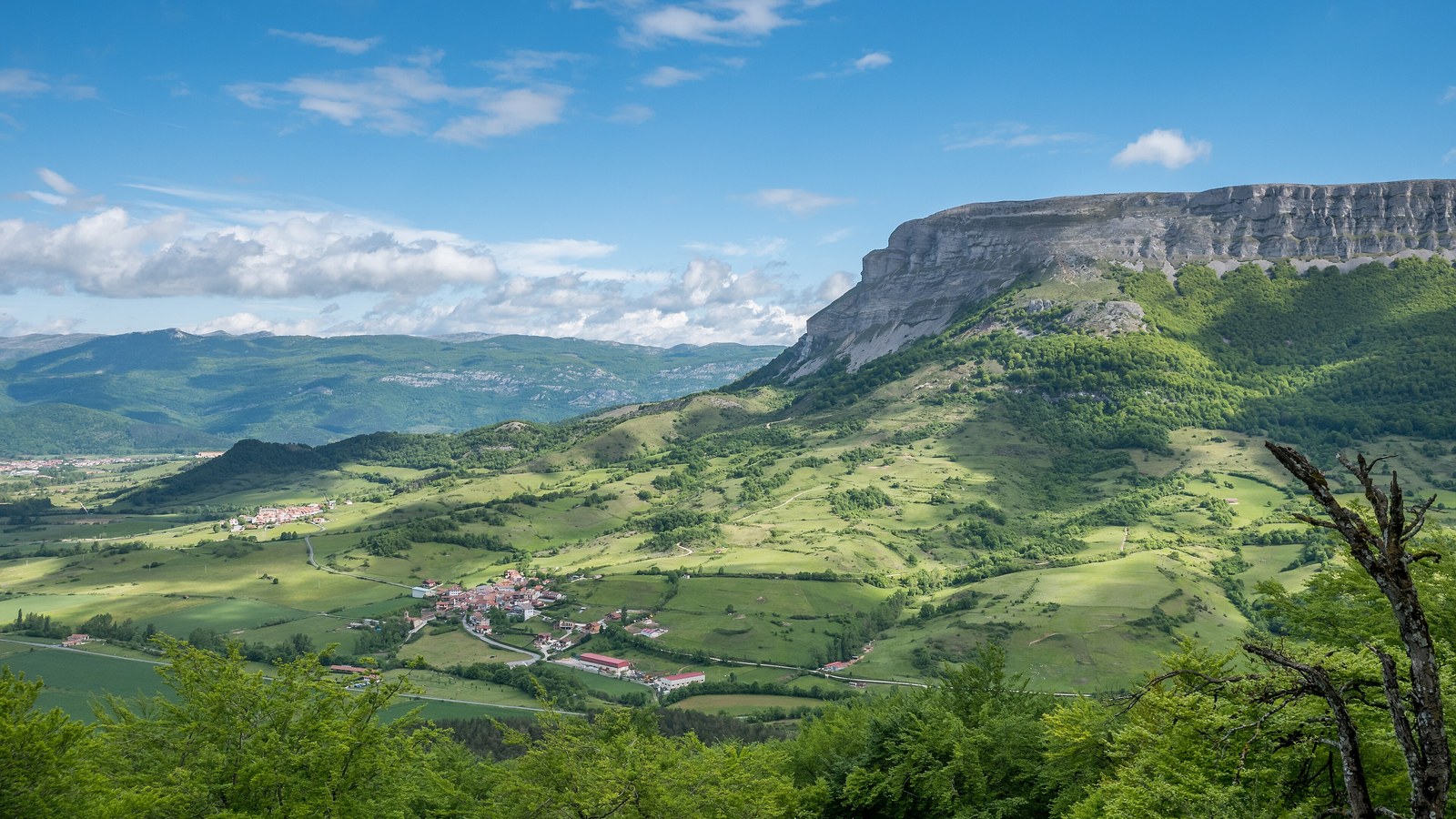
Image: Beriain from Dorrao, Navarre, 13 May 2017, Basotxerri, CC BY-SA 4.0, Wikimedia Commons. The landscape, not Abauntz cave and not the bones.
Sources consulted: Los neandertales también vivieron en Navarra: hallan los huesos de una mano de hace 46.000 años con ADN conservado — El Mundo; Los arqueólogos descubren los primeros restos neandertales de Navarra — La Vanguardia; La cueva de Abauntz reescribe la prehistoria de Navarra — Government of Navarre.











0 Comments
No comments on this article yet. Be the first!