


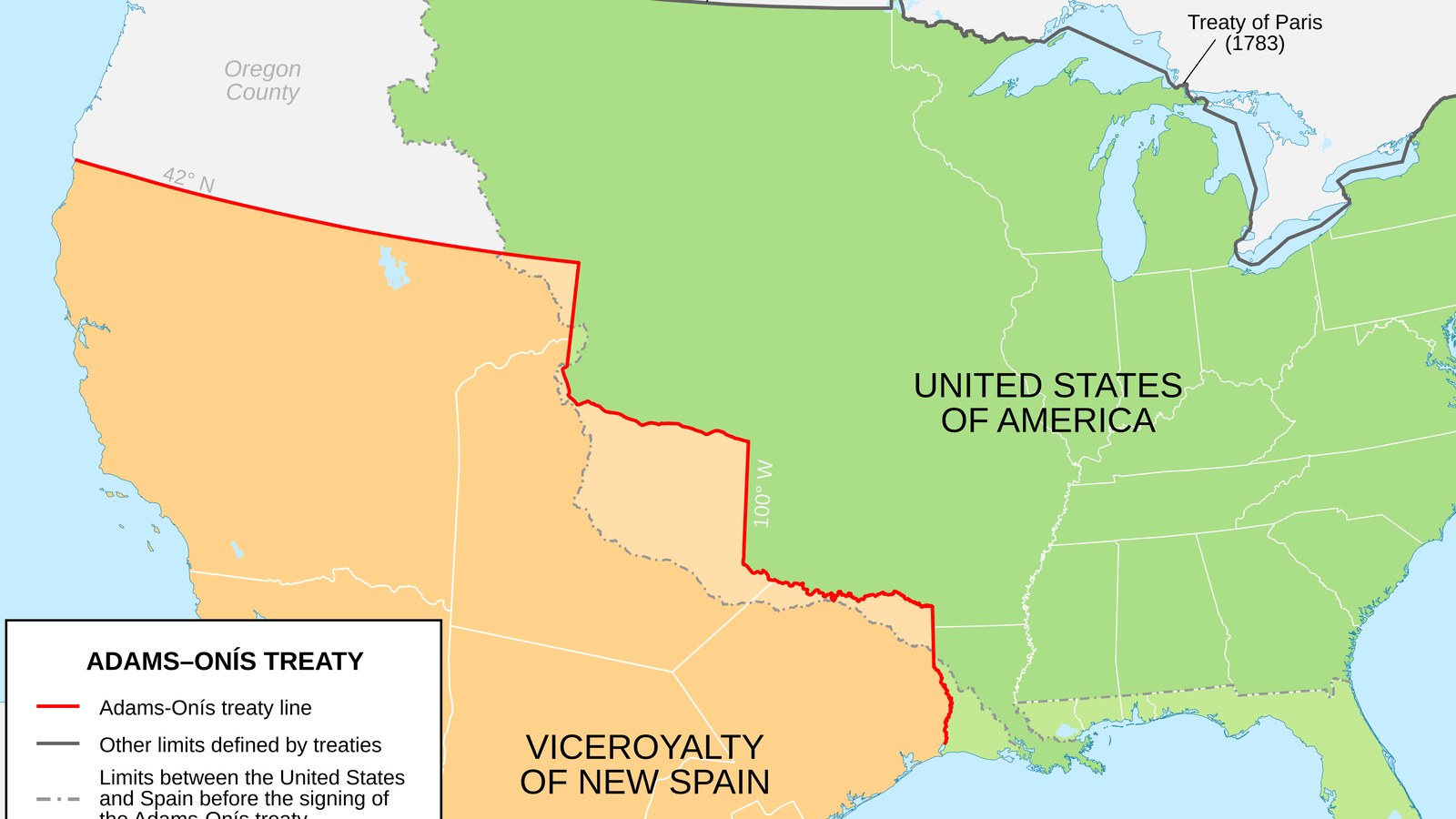
On 22 February 1819, at Washington, John Quincy Adams, Secretary of State, and Luis de Onís, envoy extraordinary and minister plenipotentiary of His Catholic Majesty, sign the Treaty of Amity, Settlement and Limits. Texts: English and Spanish. Full title: Treaty of Amity, Settlement and Limits between the United States of America, and His Catholic Majesty. Article 16: ratifications, exchanged in six months or sooner. The Senate votes on 24 February. Madrid delays until October 1820. The exchange takes place on 22 February 1821. It is not a purchase of Florida for five million.
Article 1: a firm and inviolable peace and sincere friendship, without exception of persons or places. Article 2: His Catholic Majesty cedes to the United States, in full property and sovereignty, all the territories which belong to him, situated to the eastward of the Mississippi, known by the name of East and West Florida. The adjacent islands, public lots and squares, vacant lands, public edifices, fortifications, barracks, archives and documents which relate directly to the property and sovereignty, not private property. The archives, left with the commissaries of the United States.
Article 3: the boundary west of the Mississippi begins on the Gulf of Mexico, at the mouth of the Sabine, continuing north along the western bank to the 32d degree of latitude; thence due north to the Rio Roxo of Nachitoches, or Red River; following that river westward to 100 west from London and 23 from Washington; then crossing the Red River, due north to the Arkansas; along the southern bank of the Arkansas to its source, in latitude 42 north; and thence by that parallel to the South Sea. The whole as laid down in Melish’s map, Philadelphia, improved to 1 January 1818. If the source of the Arkansas falls north or south of 42, the line runs due south or north to that parallel. Islands in the Sabine, the Red and the Arkansas belong to the United States; the use of the waters and the navigation, common. The United States cede and renounce forever all rights west and south of the line. His Catholic Majesty cedes all east and north of it, and renounces them forever.
Article 4: a commissioner and a surveyor on each side, to meet at Natchitoches on the Red River before one year from ratification; they run and mark the line; plans and journals, part of this treaty. Article 5: the inhabitants of the ceded territories, free exercise of their religion, without restriction; those who wish to remove to the Spanish dominions may sell or export their effects, without duties. Article 6: the inhabitants incorporated in the Union as soon as consistent with the Federal Constitution, admitted to the privileges of citizens. Article 7: the officers and troops of His Catholic Majesty withdrawn, possession given within six months after the exchange of ratifications, or sooner; the United States furnish the transports and escort to the Havana.
Article 8: grants of land made before 24 January 1818 confirmed; all grants since that day, when the first Spanish proposal for the cession of the Floridas was made, null and void. Article 9: the parties reciprocally renounce all claims for damages to the time of signing; the United States, the injuries in the convention of 11 August 1802, prizes of French privateers condemned by French consuls in Spain, the suspension of the right of deposit at New Orleans in 1802, unlawful seizures. His Catholic Majesty, the same injuries of 1802, the sums advanced for Captain Pike’s return, Miranda’s expedition fitted out at New York, unlawful American seizures. Both renounce the recent events in the Floridas. The United States will cause satisfaction, by process of law, for injuries suffered by Spanish officers and inhabitants from the late operations of the American Army.
Article 10: the convention of 11 August 1802, ratifications exchanged 21 December 1818, is annulled. Article 11: the United States, exonerating Spain from the claims of their citizens to which the renunciations extend, undertake to make satisfaction to an amount not exceeding five millions of dollars. Three commissioners, citizens of the United States, at Washington, within three years. Payment from the Treasury or by stock at six per cent, from sales of public lands in the ceded territories. Article 12: the treaty of limits and navigation of 1795 remains, except articles 2, 3, 4, 21 and the second clause of article 22. Article 15: Spanish vessels, laden only with productions of Spanish growth or manufactures, from the ports of Spain or her colonies, admitted for twelve years to Pensacola and St. Augustine, without other or higher duties than vessels of the United States; no other nation the same privileges. The twelve years begin three months after the exchange.
The line at 42° gives the United States a shore on the Pacific, under the Anglo-American joint occupation of 1818. Mexico recognises the line by the Treaty of Limits of 1828. This is not the Treaty of Guadalupe Hidalgo.
Image: Milenioscuro, map of the Adams–Onís Treaty, 5 November 2018, CC BY-SA 4.0, Wikimedia Commons. Cropped to 16:9. A modern map of the 1819 line, not the signed act.
Source consulted: Adams–Onís Treaty. Treaty text: Treaty of Amity, Settlement, and Limits, Washington, 22 February 1819.











0 Comments
No comments on this article yet. Be the first!