


In Geneva, on 23 July 1962, thirteen governments signed the Declaration on the Neutrality of Laos. The International Conference on the Settlement of the Laotian Question, which had opened on 16 May 1961, closed on the same day.
The text incorporates the statement of neutrality issued by the Royal Government of Laos on 9 July 1962. Together the two instruments constitute an international agreement and enter into force on signature, under paragraph 5.
The Declaration’s signatories are Burma, Cambodia, Canada, the People’s Republic of China, the Democratic Republic of Viet-Nam, France, India, Poland, the Republic of Viet-Nam, Thailand, the Soviet Union, the United Kingdom and the United States. Dean Rusk and W. Averell Harriman signed for Washington; Andrei Gromyko for Moscow; Chen Yi for Beijing; Malcolm MacDonald for London.
Laos did not sign the Declaration as a fourteenth identical party: its commitment sits in the 9 July statement, which the conference takes over in full. On the same day, however, the Kingdom of Laos signed the Protocol, through Quinim Pholsena.
The Declaration recognises the sovereignty, independence, neutrality, unity and territorial integrity of Laos. The signatories undertake not to introduce troops or military personnel, not to establish bases, not to draw the kingdom into military alliances, and to respect its refusal of SEATO protection.
The Protocol has twenty articles. Article 2 requires the withdrawal of foreign troops and military personnel no later than thirty days after the Commission notifies that inspection teams are present at the points of exit. Article 4 prohibits reintroduction. Article 5 reserves a Franco-Laotian arrangement for the transfer of French installations and, if Vientiane so requests, a precisely limited number of French instructors.
The International Commission for Supervision and Control remains the 1954 body: Canada, India and Poland, with India in the chair. The conference co-chairmen are the British and Soviet foreign ministers. The authentic texts are English, Chinese, French, Laotian and Russian. The depositaries are London and Moscow.
This is distinct from the 1954 Geneva Agreements, which recognised Laotian sovereignty after the Indochina war, and from the 1973 Paris accords, which would later reaffirm respect for the 1962 instruments. The July Geneva act is also not the Zürich joint communiqué of 22 June 1961, which the Laotian statement invokes.
Paragraph 4 of the Declaration provides for joint consultations with the Royal Government in the event of a violation. The conference does not judge later compliance here; it records only the signed text.
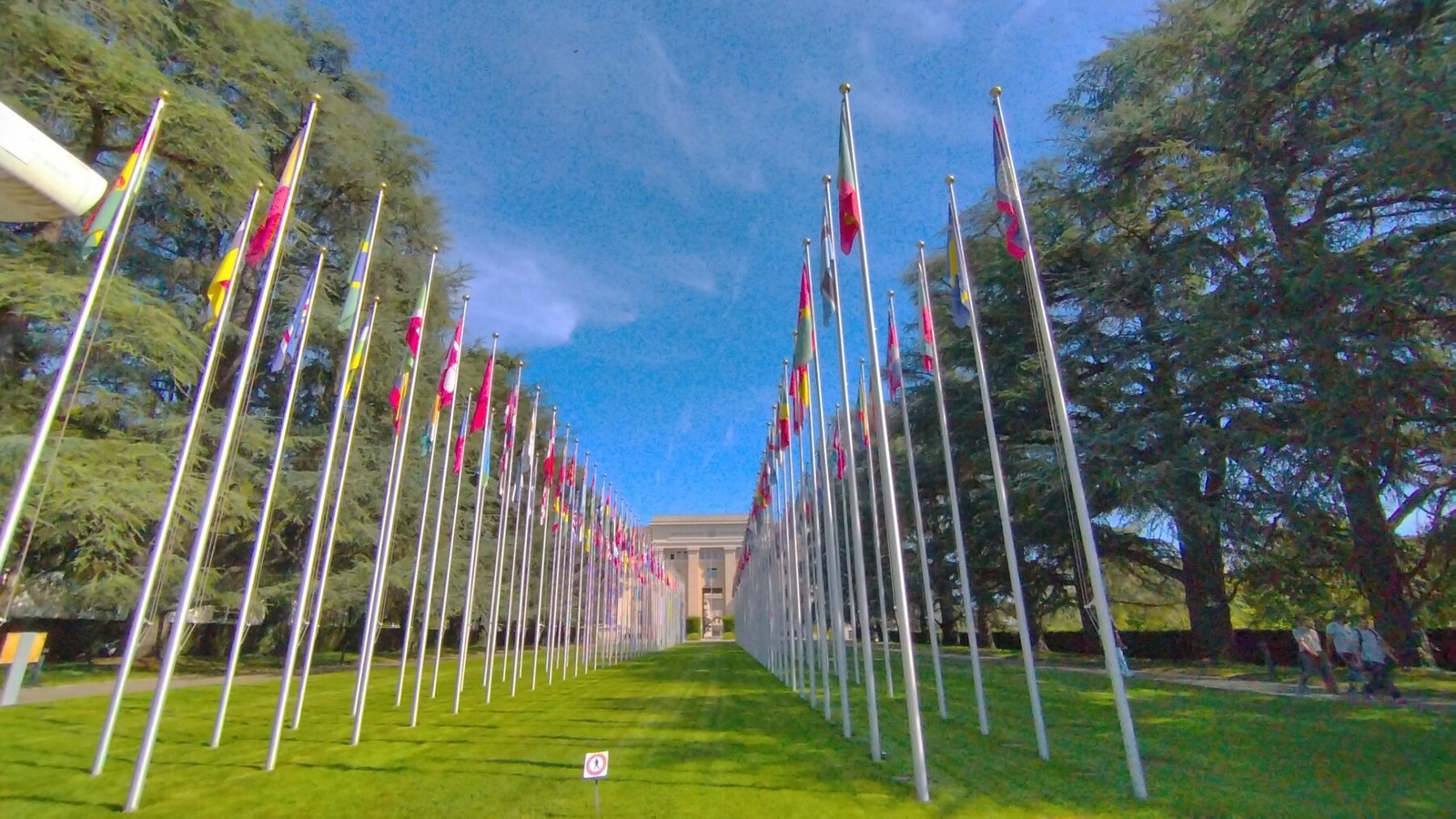
Image: flags garden at the Palais des Nations, Geneva; Juan Sanchez Gil / MediaSociety, 18 August 2023; CC BY-SA 4.0, Wikimedia Commons. Cropped to 16:9. The 1962 signing took place at the Geneva conference, in the same complex.
Source consulted: International Agreement on the Neutrality of Laos. Treaty text: Declaration on the Neutrality of Laos, Geneva, 23 July 1962 (UNTS 6564).











0 Comments
No comments on this article yet. Be the first!