


The Anglo-American Petroleum Agreement was signed in Washington on 8 August 1944. Talks opened on 25 July between a United States delegation headed by Cordell Hull and a United Kingdom delegation led by Lord Beaverbrook, and closed in plenary session on 3 August under Harold Ickes. The text, an introductory article and six numbered articles, was published in the Department of State Bulletin of 13 August and as British Cmd. 6555. Article VI: it was to enter into force on a date to be agreed after each Government notified its readiness; it would continue until three months after notice of termination or until superseded by a multilateral petroleum agreement. It was never brought into force. It is not the revised agreement signed in London on 24 September 1945, which the Senate likewise declined to approve.
The introductory article recognises that an abundant supply of petroleum in international trade is essential to security and economic well-being, that world resources are adequate for the foreseeable future, and that the principles of the Atlantic Charter and of collective security are to be observed. Article I: the orderly, world-wide development of petroleum resources for international trade, having regard to reserves, suitable methods of exploitation, economic factors and the interests of producing and consuming countries, within applicable law and concession contracts — a framework, not an allocation handbook.
The five principles Hull transmitted to the Senate are: adequate supplies at fair prices on a non-discriminatory basis for nationals of peaceable countries; the sound economic advancement of producing countries; equal opportunity to acquire exploration and development rights in areas not then under concession; respect for valid concession contracts; and the absence of restrictions inconsistent with the purposes of the agreement.
Later articles provide for an International Petroleum Commission of eight members, four appointed by each Government, charged with estimating long-term world demand, recommending broad policies for operating companies, analysing short-term problems of production, processing, transport and distribution, and reporting to the two Governments. The Commission has no executive power. The two Governments were to prepare an international conference for a multilateral agreement and a permanent International Petroleum Council.
Hull laid the agreement before President Roosevelt on 24 August for the Senate’s advice and consent. Opposition from the American petroleum industry led to its withdrawal from the Senate on 10 January 1945. The 1945 revision met the same fate; on 5 July 1952 it was returned to the State Department by joint resolution.
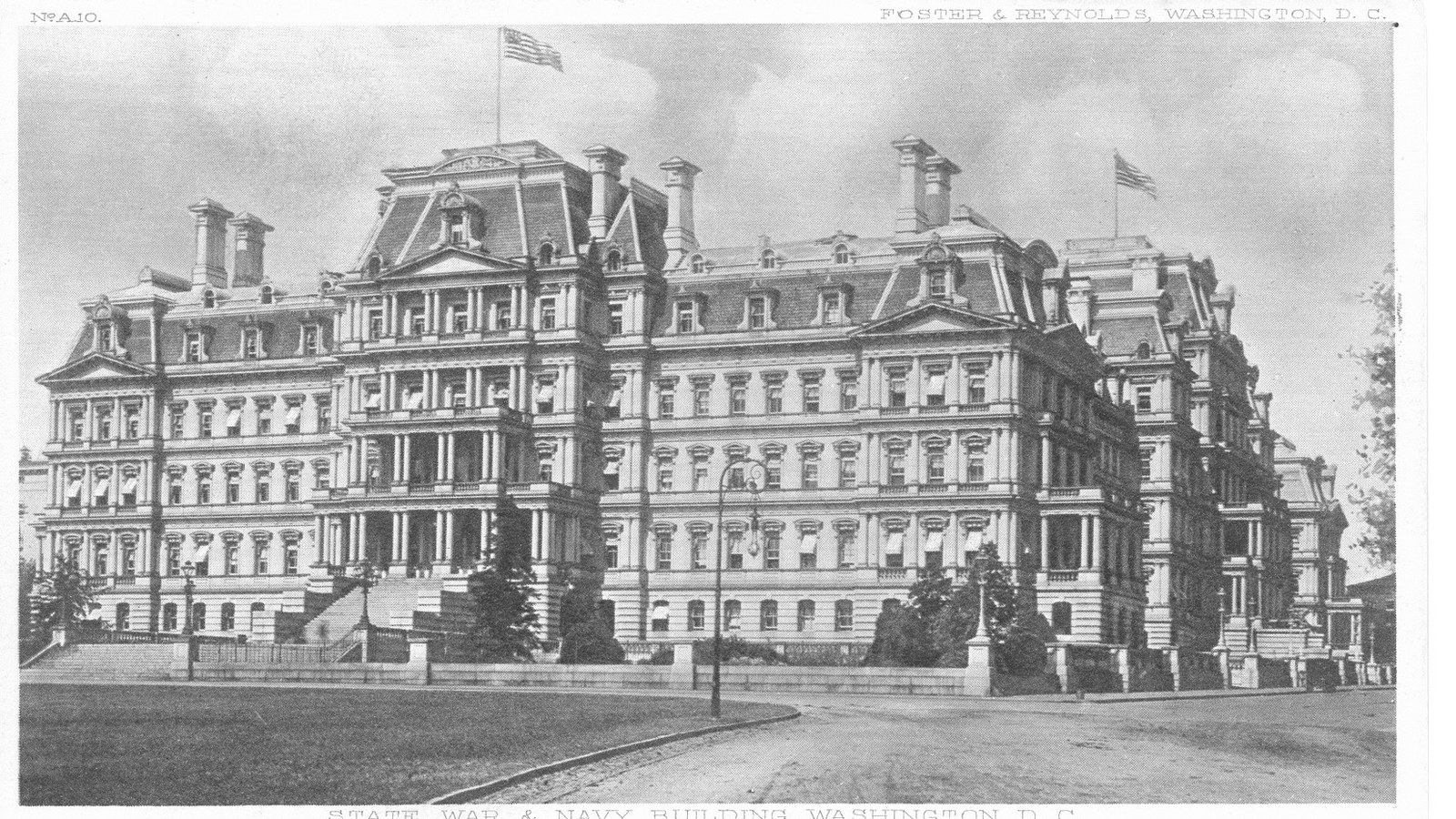
Cover: the Eisenhower Executive Office Building in Washington, the State Department’s building in the years of signature; we do not claim the signing room. Wikimedia Commons, free licence.
Sources consulted: Anglo-American Petroleum Agreement; Agreement on petroleum (FRUS 1944, vol. III).











0 Comments
No comments on this article yet. Be the first!