


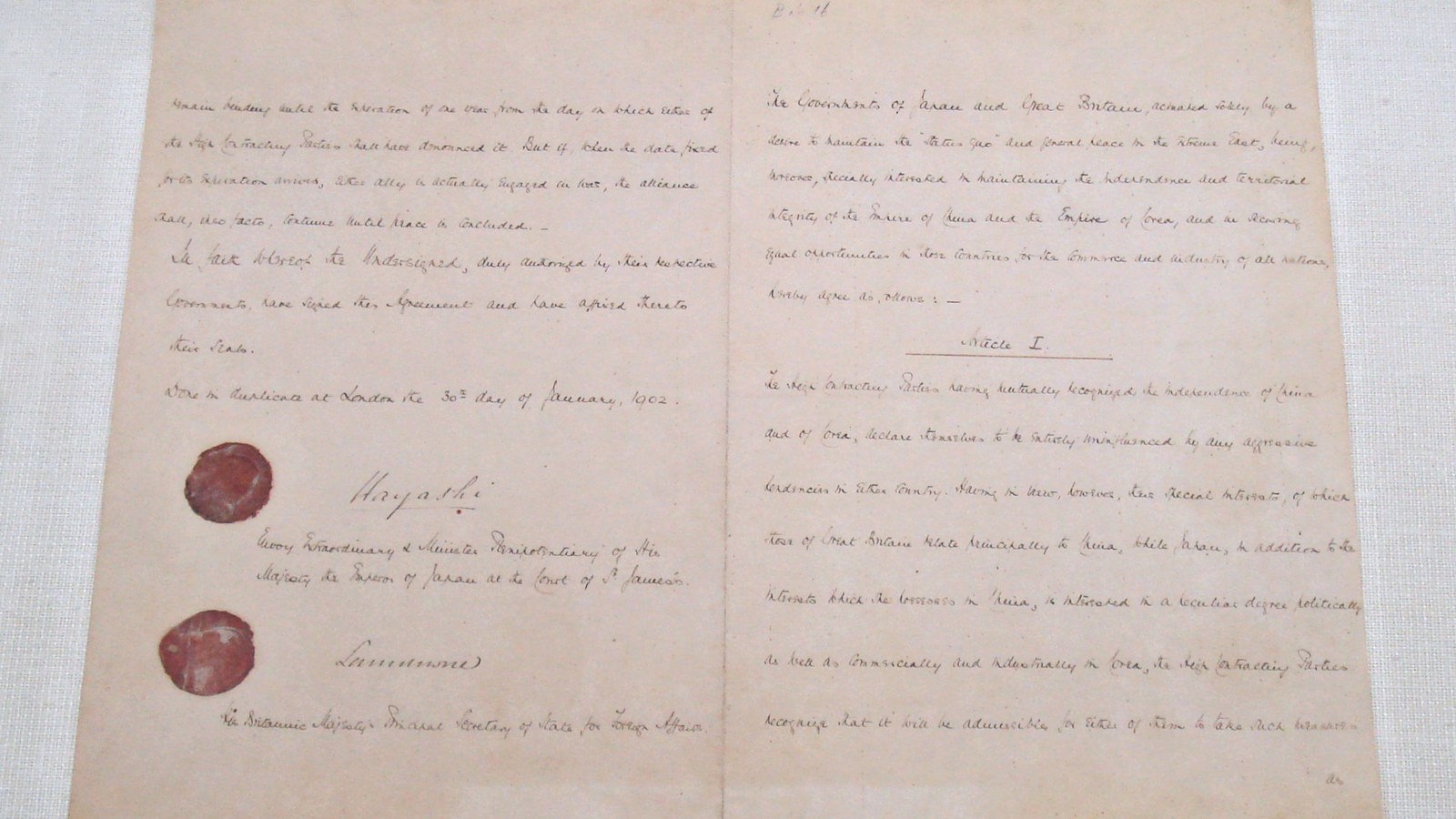
On 30 January 1902, in London, the Agreement between Great Britain and Japan relative to China and Corea — the first Anglo-Japanese Alliance — was signed. Signatories: Hayashi Tadasu, Envoy Extraordinary and Minister Plenipotentiary of the Emperor at the Court of St James, and the Marquess of Lansdowne, His Britannic Majesty's Principal Secretary of State for Foreign Affairs. A single original in English, in duplicate. Lansdowne reported the signature the same day in a dispatch to the British minister at Tokyo. It was published on 12 February 1902. UKTS: Treaty Series 003/1902 (Cd. 914).
The preamble invokes maintenance of the status quo and general peace in the Extreme East, the independence and territorial integrity of the Empire of China and the Empire of Corea, and equal opportunities for the commerce and industry of all nations. Article I: the parties mutually recognise the independence of China and of Corea and declare themselves entirely uninfluenced by aggressive tendencies in either country; they nevertheless recognise special interests — those of Great Britain principally in China, those of Japan in a peculiar degree in Corea, politically as well as commercially and industrially — and that it will be admissible to take such measures as may be indispensable if those interests are threatened by the aggressive action of any other Power or by disturbances requiring protection of the lives and property of their subjects. This is not an intervention handbook.
Article II: if either party, in defence of those interests, should become involved in war with another Power, the other will maintain a strict neutrality and use its efforts to prevent other Powers from joining in hostilities against its ally. Article III: if any other Power or Powers should join in hostilities against that ally, the other will come to its assistance, conduct the war in common and make peace in mutual agreement. In 1904–1905 the formula discouraged a coalition of the 1895 Triple Intervention type; Britain remained neutral toward Russia as a single adversary.
Article IV, in the FRUS and Wikisource texts: neither of them will, without consulting the other, enter into separate arrangements with another Power to the prejudice of the interests above described. (A worldjpn transcription drops “neither” and reverses the sense; it is not used here.) Article V: whenever those interests are in jeopardy, the two Governments will communicate with one another fully and frankly.
Article VI: the Agreement comes into effect immediately after the date of its signature and remains in force for five years; if neither has notified twelve months before expiry the intention of terminating it, it remains binding until one year from denunciation; if when that date arrives either ally is actually engaged in war, the alliance continues until peace is concluded. Wikipedia lists “effective” as 31 January; the official formula is immediately after signature.
The Agreement was renewed on 12 August 1905 and on 13 July 1911, distinct instruments. It was replaced by the Four-Power Treaty of the Pacific (Washington) and ended on that treaty’s ratification in 1923. Cover: the Japanese page of the Agreement. Wikimedia Commons, public domain.
For context: Anglo-Japanese Alliance. The text: Agreement between Great Britain and Japan, FRUS 1902.











0 Comments
No comments on this article yet. Be the first!