


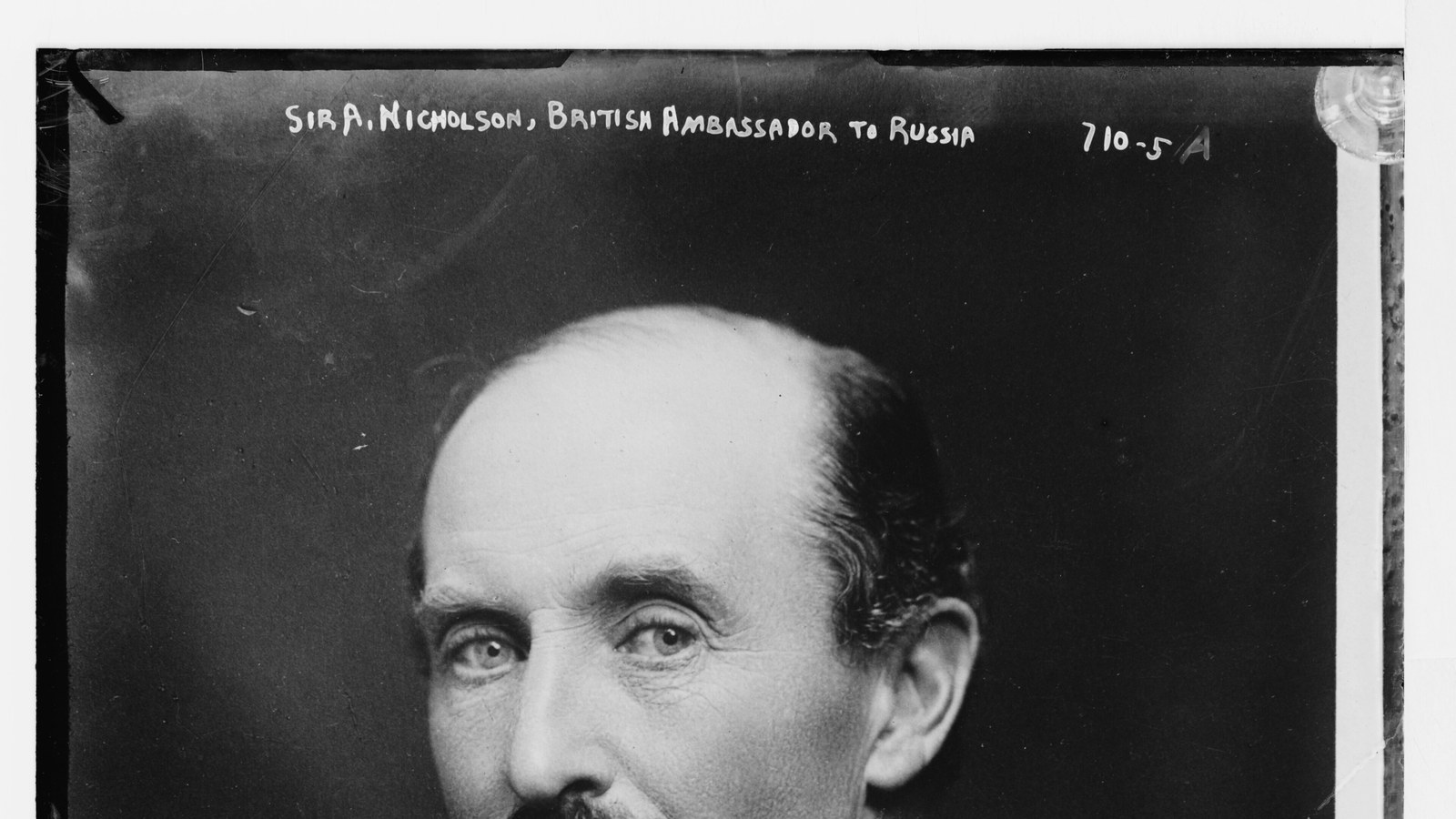
In Saint Petersburg, Sir Arthur Nicolson, British ambassador, and Alexandre Iswolsky, Russian minister for foreign affairs, sign the convention relating to Persia, Afghanistan and Tibet. The instrument, new style, is dated 31 August 1907; old style, 18 August. It is not the Entente Cordiale of 1904, and it is not the Convention of Lhasa of 1904.
The text says the two sovereigns wish to remove, by agreements, causes of misunderstanding on the Asian continent. Behind it stand the Great Game, Russia’s defeat by Japan in 1905, the German railway towards Baghdad and, in Persia, the constitutional revolution begun in 1905. Edward Grey wanted an understanding; Iswolsky, come from Paris, finishes it at Petersburg.
The Persian arrangement declares respect for Persia’s integrity and independence, then cuts the country into three. Great Britain will not seek concessions — railways, banks, telegraphs, roads, insurance — beyond the line Kasr-i-Shirin, Isfahan, Yazd, Kakhk, to the meeting of the Russian and Afghan frontiers. Russia will not seek concessions beyond the line Gazik, Birjand, Kerman, Bandar Abbas. Between the lines each may compete, after prior word. Existing concessions stand.
The revenues of the Persian customs, except those of Fars and the Gulf, serve the loans to the Banque d'Escompte et des Prêts de Perse. The customs of Fars and the Gulf, the Caspian fisheries and the posts and telegraphs serve the Imperial Bank of Persia. If payment falters and one power wants control over sources in the other’s zone, they consult first, so as not to break the principles of the arrangement.
The Afghan convention: London will not change Afghanistan’s political status and will not take measures threatening Russia. Petersburg recognises the country as outside the Russian sphere, conducts all political relations through the British intermediary and sends no agents. The Treaty of Kabul of 21 March 1905 is recalled. Frontier authorities may speak directly on local non-political matters. Russian commerce receives the same facilities as Anglo-Indian. The arrangement does not enter into force until London notifies the emir’s consent.
The Tibetan arrangement recognises China’s suzerain rights. The parties respect territorial integrity and do not interfere in internal administration. They do not negotiate with Tibet except through the Chinese government, save for the British commercial agents of the Convention of 7 September 1904, confirmed by the Anglo-Chinese convention of 27 April 1906. They send no representatives to Lhasa. British or Russian Buddhists may speak on religious ground with the Dalai Lama. The annex repeats the declaration on the Chumbi valley.
Ratifications are exchanged at Saint Petersburg on 23 September. The Persian government was not consulted. Emir Habibullah Khan, when he reads the terms, feels humiliated: no one had told him. It is not the Treaty of Björkö of 1905, and it is not the Triple Alliance.
The signatures, in duplicate, are Nicolson’s and Iswolsky’s. The convention will later enter the fabric of the Entente; Soviet Russia renounces it in 1918.
Image: Sir Arthur Nicolson, ambassador to Russia; Bain News Service; public domain, Library of Congress / Wikimedia Commons. Cropped to 16:9.
Source consulted: Anglo-Russian Convention. Treaty text: Convention relating to Persia, Afghanistan, and Thibet, St Petersburg, 31 August 1907 (UKTS 34).











0 Comments
No comments on this article yet. Be the first!