


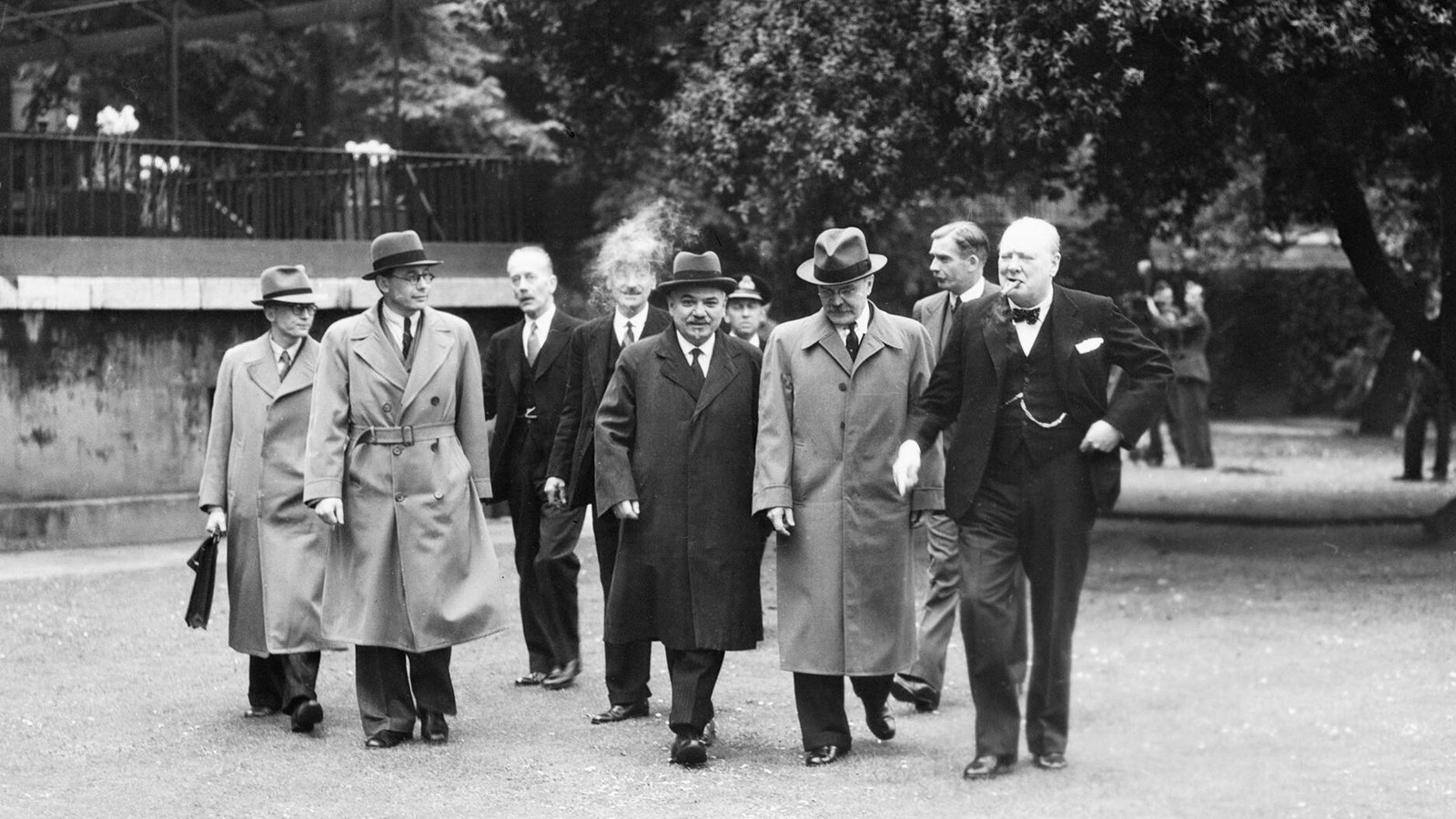
The treaty between the United Kingdom and the Union of Soviet Socialist Republics on alliance in the war against Hitlerite Germany and her associates in Europe and on cooperation and mutual assistance after the war, known as the twenty-year mutual assistance agreement, was signed in London on 26 May 1942 by Anthony Eden and Vyacheslav Molotov, in duplicate, the Russian and English texts being equally authentic. It is not the Moscow agreement of 12 July 1941, which it confirms and which, after ratification, it replaces. It contains no territorial clauses: Soviet claims to the 1941 frontiers were left out of the text.
The preamble seeks the maintenance of peace after the war, prevention of further German aggression in Europe, close collaboration with the other United Nations at the peace settlement, on the basis of the 14 August 1941 declaration by the President of the United States and the British Prime Minister, to which the USSR had adhered, and mutual assistance in the event of attack. Article I: in virtue of the alliance, the parties undertake to afford one another military and other assistance and support of all kinds in war against Germany and all those states associated with her in acts of aggression in Europe. An operational protocol is not transcribed.
Article II: the parties will not negotiate with the Hitlerite Government or any German government that does not clearly renounce aggressive intentions, and will not, except by mutual consent, conclude an armistice or peace with Germany or any associated state. Article III: they desire to unite with other like-minded states on proposals for common action after the war; pending that, they will take all measures in their power to render German aggression impossible of repetition. Article IV: if, after hostilities, either is attacked by Germany or a state mentioned, the other will at once give all support in its power; the article remains until superseded by the proposals in Article III or, failing that, for twenty years.
Article V: close and friendly collaboration after the re-establishment of peace for the organization of security and economic prosperity in Europe, taking into account the interests of the United Nations, without territorial aggrandizement and without interference in the internal affairs of other states. Article VI: all possible economic assistance after the war. Article VII: neither party shall conclude any alliance or take part in any coalition directed against the other.
Article VIII: ratification in the shortest possible time, instruments to be exchanged in Moscow; the treaty comes into force immediately on that exchange and thereupon replaces the 1941 agreement. Part One remains until the re-establishment of peace with Germany and her associates; Part Two for twenty years, thereafter until terminated on twelve months' written notice. The other Allies, including the United States, are not parties. A partition plan for Europe is not set out; the treaty excludes aggrandizement.
Cover: the British and Soviet delegations in London after the signing; period photograph, without restating the date. Wikimedia Commons, free licence.
Sources consulted: Anglo-Soviet Treaty of 1942; Twenty-Year Mutual Assistance Agreement Between the United Kingdom and the Union of Soviet Socialist Republics (Avalon Project).











0 Comments
No comments on this article yet. Be the first!