


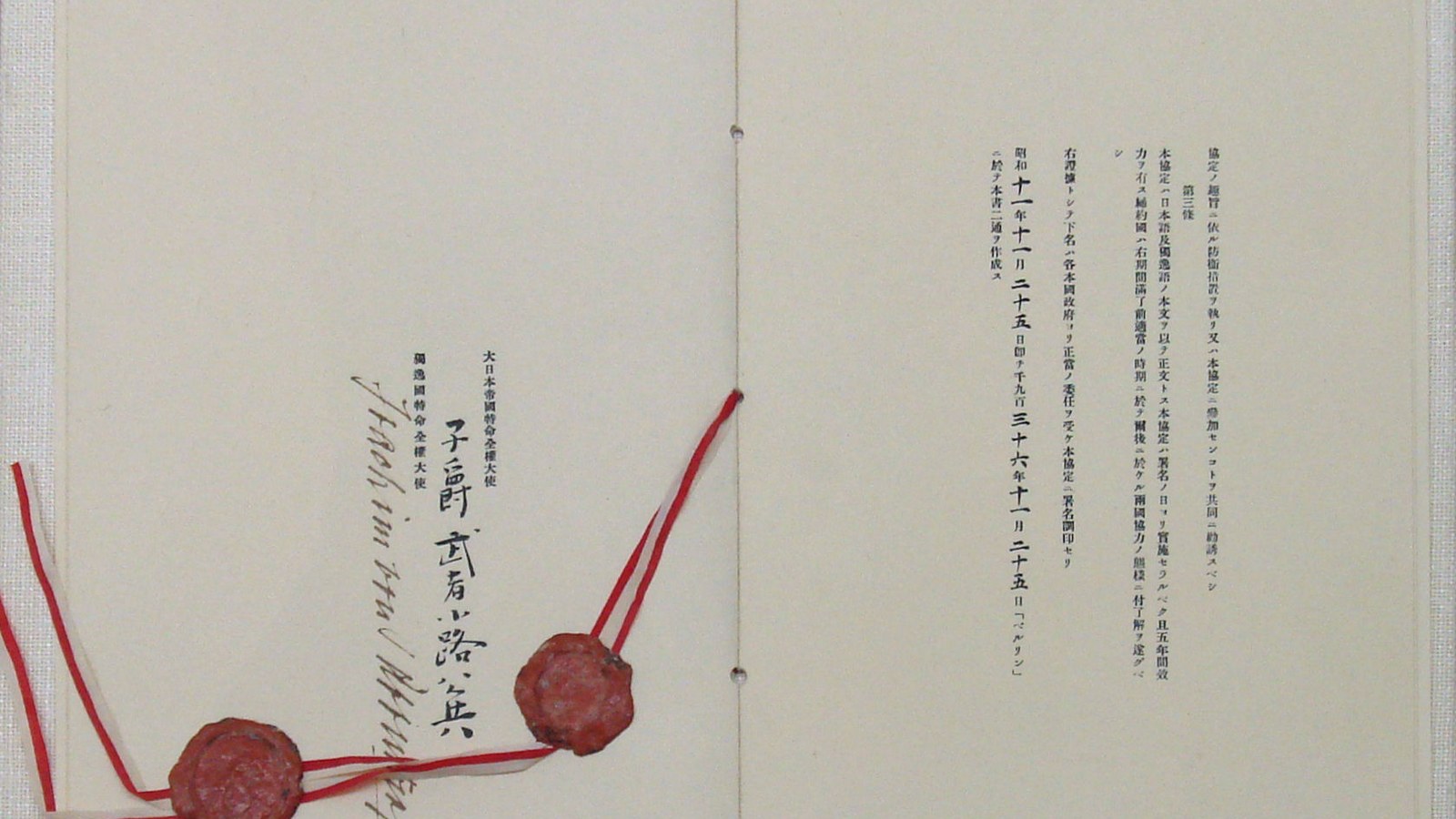
On 25 November 1936, in Berlin, Joachim von Ribbentrop, German Ambassador Extraordinary, and Viscount Kintomo Mushanokoji, Imperial Japanese Ambassador, signed the Agreement Guarding Against the Communistic International. The German and Japanese texts are each valid as original. It comes into force on the day of signature and remains in force for five years. It is not the Tripartite Pact of 1940 and not the Pact of Steel of 1939.
Article I: the two States agree to keep each other informed concerning the activities of the Communist International, to confer upon the necessary measures of defence, and to carry them out in close co-operation. Article II: they will jointly invite third States whose internal peace is menaced by the disintegrating work of the Communist International to adopt defensive measures in the spirit of the Agreement or to participate in it. Article III: in a reasonable time before the term expires, they will come to an understanding upon the further manner of their co-operation.
On the same day a public supplementary protocol was signed: the competent authorities will closely co-operate in exchanging reports and in measures of information and defence; within the framework of existing law they will take stringent measures against those who at home or abroad work on direct or indirect duty of the Communist International or assist its activities; a standing committee is established for further measures.
A secret additional agreement was also signed that day and kept from the public. Article 1: should one of the High Contracting States become the object of an unprovoked attack or threat of attack by the U.S.S.R., the other obligates itself to take no measures which would tend to ease the situation of the U.S.S.R.; the parties will immediately consult on measures to safeguard their common interests. Article 2: for the duration of the agreement they will conclude no political treaties with the U.S.S.R. contrary to its spirit without mutual consent. Article 3: German and Japanese texts are original; it comes into force together with the public agreement and for the same term.
An exchange of notes, annexed to the secret protocol, left Japan free to proceed with fishery and frontier talks with the U.S.S.R.
It is not Italy's accession of 6 November 1937 and not the renewal of November 1941.
Image: Copy of the agreement, Archives of the Ministry of Foreign Affairs of Japan; World Imaging, 2009; CC BY-SA 3.0, Wikimedia Commons. Cropped to 16:9.
Source consulted: Anti-Comintern Pact. Treaty text: German-Japanese Agreement Guarding Against the Communistic International, Berlin, 25 November 1936.











0 Comments
No comments on this article yet. Be the first!