
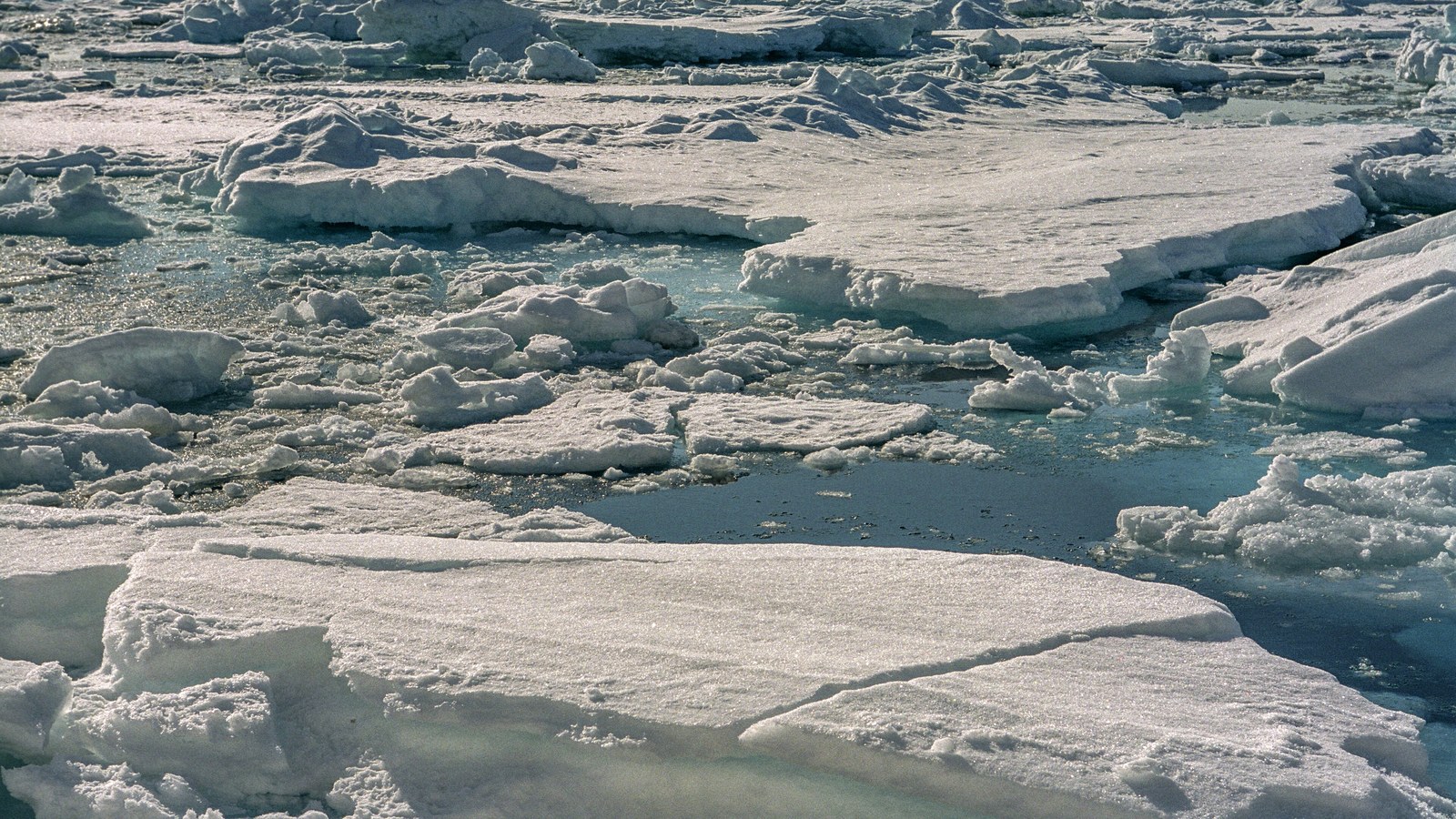
Arctic sea ice does not simply follow the wind, according to a University of California, Riverside-led study published in Physical Review Letters. The university’s 16 September release says discrepancies with models driven mainly by wind can be explained by collisions between ice floes.
Arctic ice is not a continuous sheet but slabs, or floes, from a few metres to a few kilometres across. Wind pushes them, yet speeds and how they spread do not match what wind force alone would predict. Simple wind-driven models understate how slowly the ice disperses.
The team — Bryan Shaddy (now at the University of Southern California), Alex Greaney and Bhargav Rallabandi — built a simulation treating floes as a granular medium on water, with turbulent wind and ocean drag. Compared with measurements in the Fram Strait, between Greenland and Svalbard, the model reproduced three observations: how quickly ice spreads, the distribution of floe speeds, and how motion varies from hours to days.
In dense ice fields, floes collide more often than the wind changes. Each collision dissipates some of the energy supplied by the wind and shortens the distance a floe can travel freely. The authors do not argue that wind and currents are unimportant, but that interactions between floes need to be represented.
A more accurate account of these processes can help models used for sea-ice movement, which also matter for navigation in polar waters. The result remains a physical explanation of existing data, not a stand-alone climate forecast.
The paper, “Anomalous Statistics of Sea Ice Transport are Explained by Collisional Rules” (Phys. Rev. Lett. 137, 114201), does not forecast where ice will go as the Arctic warms. It does offer a physical framework for climate models that cannot track millions of individual floes.
Image: Jerzy Strzelecki, ice floes near Svalbard, 19 June 2003. Wikimedia Commons, CC BY-SA 3.0. Not a field photograph from the study. Cropped to 16:9.
Source consulted: UC Riverside — Engineers solve puzzle of Arctic sea ice movement; Physical Review Letters — Anomalous Statistics of Sea Ice Transport are Explained by Collisional Rules (DOI 10.1103/g8y2-8ytt).








0 Comments
No comments on this article yet. Be the first!