


The Macedonian front gave way in September 1918: Franchet d’Espèrey’s offensive knocked Bulgaria out through the Armistice of Salonica. Constantinople lost its land shield in the Balkans. Talaat Pasha, back from Berlin and Sofia, saw that the war could no longer be won. On 13 October his cabinet resigned; Ahmed Izzet Pasha replaced him and sent the captive British general Charles Townshend to ask for terms. Enver had kept optimism alive with gains in the Caucasus after Brest-Litovsk, even as Damascus fell in October.
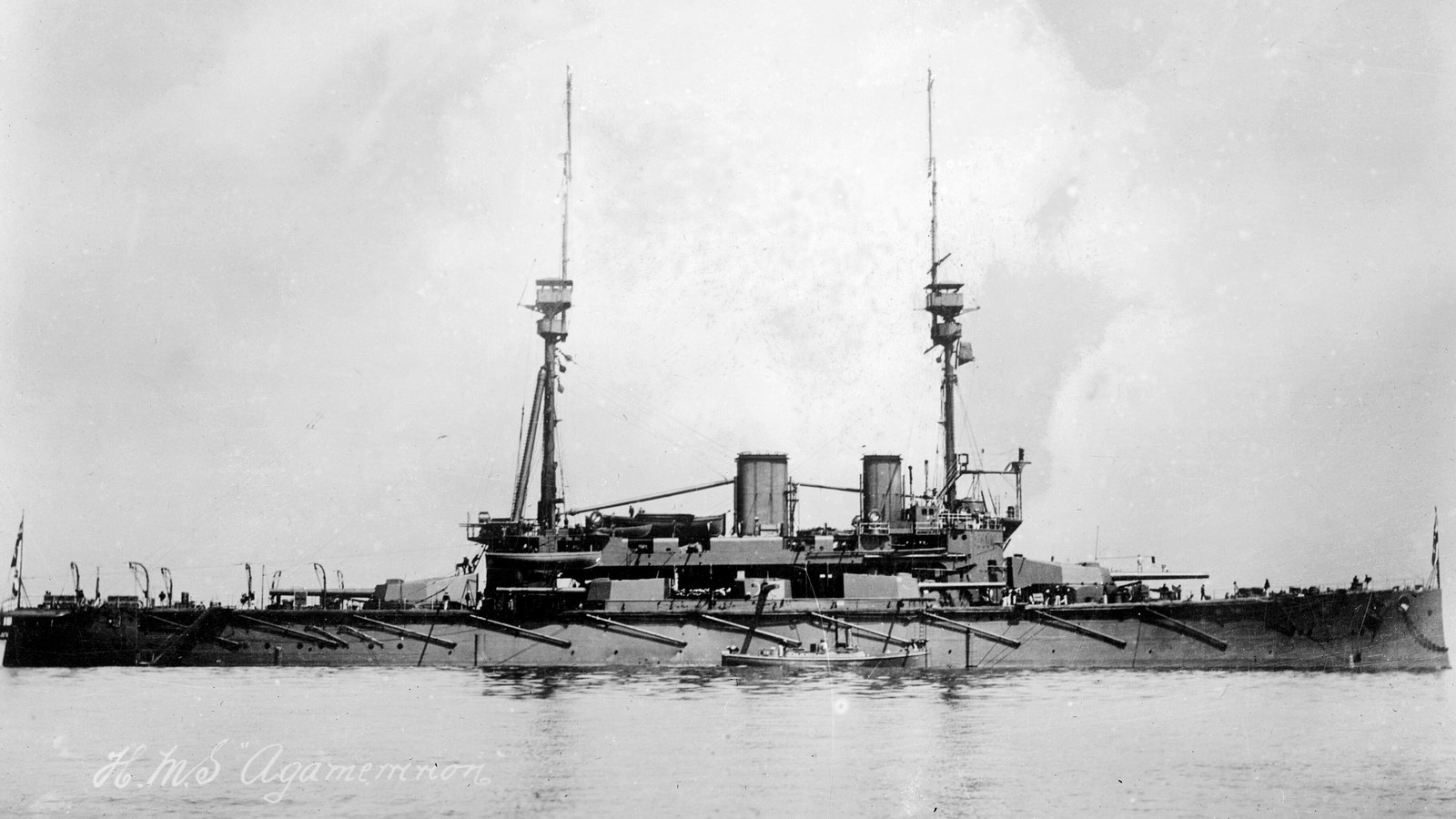
The Armistice of Mudros was signed on 30 October 1918, on board the battleship HMS Agamemnon, in Moudros harbour on Lemnos. For the Porte the signatory was the Minister of Marine, Rauf Orbay; for the Allies, Admiral Somerset Arthur Gough-Calthorpe, Commander-in-Chief of the British Mediterranean Fleet. It took effect at noon the next day. Talks had begun on Sunday 27 October. French Vice-Admiral Jean Amet was kept out: the British cabinet read the alliance terms as a right to negotiate alone. Clemenceau protested; Lloyd George answered with the Salonica precedent, which the French had negotiated.
Britannica summarises the clauses: remaining garrisons in the Hejaz, Yemen, Syria, Mesopotamia, Tripolitania and Cyrenaica were to surrender; the Allies would occupy the Dardanelles and the Bosporus, Batum and the Taurus tunnel system; they could occupy, “in case of disorder”, the six Armenian provinces of Anatolia and seize any strategic point if Allied security was threatened. The Ottoman army, air force and navy were demobilised. Ports, railways and other strategic points were placed at the Allies’ disposal. In the Caucasus, troops were to fall back to the pre-war Russo-Ottoman borders.
The British delegation had a list of 24 demands, but London allowed it to yield on all of them except occupation of the Dardanelles forts and free passage through the Bosporus — the key to the Black Sea and the Romanian front. The Ottomans thought the war lost and accepted the first draft almost unchanged. Neither side knew how elastic the other was. The vague clause of occupation “in case of disorder” opened the way to a de facto surrender. The Ottoman educated public was given a milder picture of the terms than they were; the disillusionment later fed the national movement.
The occupation of Istanbul followed, and a de facto partition of Anatolia, with Italian and Greek incursions in the name of “restoring order”. The Treaty of Sèvres, signed on 10 August 1920, imposed harsh terms; the Ottoman Parliament, hostile to them, was dissolved by the Allies on 11 April 1920. On 23 April the Grand National Assembly at Ankara, led by Mustafa Kemal, became the de facto government. The War of Independence lasted until 1923. The Armistice of Mudros was superseded by the Treaty of Lausanne, signed on 24 July 1923.
The table on which it was signed now sits on HMS Belfast at London Bridge, closed to the public. The Agamemnon’s table closed the Middle Eastern theatre of the Great War, but opened the dispute over the Ottoman inheritance — from Syria, Palestine and Arabia, which stayed on the Sèvres map, to the Turkish state drawn at Lausanne.
Sources: Armistice of Mudros; Encyclopaedia Britannica, Armistice of Mudros.











0 Comments
No comments on this article yet. Be the first!