


On 29 September 1918, at the headquarters of the Allied Army of the Orient in Salonika, General Louis Franchet d'Espèrey signed with Andrey Lyapchev and General Ivan Lukov the military convention regulating the suspension of hostilities between the Allied Powers and Bulgaria. Orders to cease fire are given at signature; the convention took effect at noon the next day. It is not the Armistice of Mudros, not Villa Giusti, not Compiègne and not the Treaty of Neuilly of 1919.
Article 1 requires the immediate evacuation of territories still occupied by Bulgarians in Greece and Serbia; no cattle, cereals or provisions are to be exported from those territories, which must be left undamaged. Bulgarian civil administration continues in the parts of Bulgaria actually occupied by the Allies. Article 2 demobilizes the entire Bulgarian Army except a force of three divisions of 16 battalions each and four cavalry regiments: two divisions for the eastern frontier and the Dobrudja, one for guarding the railways.
Article 3 surrenders, at points named by the high command of the armies of the East, the arms, munitions and military vehicles of the demobilized elements, stored by the Bulgarian authorities under Allied control; the horses also go to the Allies. Article 4 restores to Greece the material of the Fourth Greek Army Corps taken at the occupation of eastern Macedonia, so far as it has not been sent to Germany. Article 5: Bulgarian troops west of the meridian of Uskub (Skopje) lay down their arms and are considered, until further order, prisoners of war; officers keep their swords.
Article 6: Bulgarian prisoners of war in the East will be employed by the Allied armies until the peace, without reciprocity; Allied prisoners are surrendered at once, and deported civilians are wholly free to return. Article 7 allows Germany and Austria four weeks to withdraw their troops and military organizations from Bulgaria; diplomatic and consular representatives of the Central Powers, and their citizens, must leave in the same period.
The four secret articles, in the same American reprint of S. Doc. 147, reserve a special covenant, within eight days at most, for the passage of Allied forces over Bulgarian territory and the use of railways, roads, waterways and harbours, and for control of telephone, telegraph and wireless stations. A number of strategic points in the interior may be occupied provisionally as a guarantee, without coercion or arbitrary requisition; the commander-in-chief gives assurance that, unless unusual circumstances arise, Sofia will not be occupied. He reserves the right, if necessary, to demand the absolute cessation of every relation between Bulgaria and her former allies. Bulgarian ports are opened to Allied and neutral vessels.
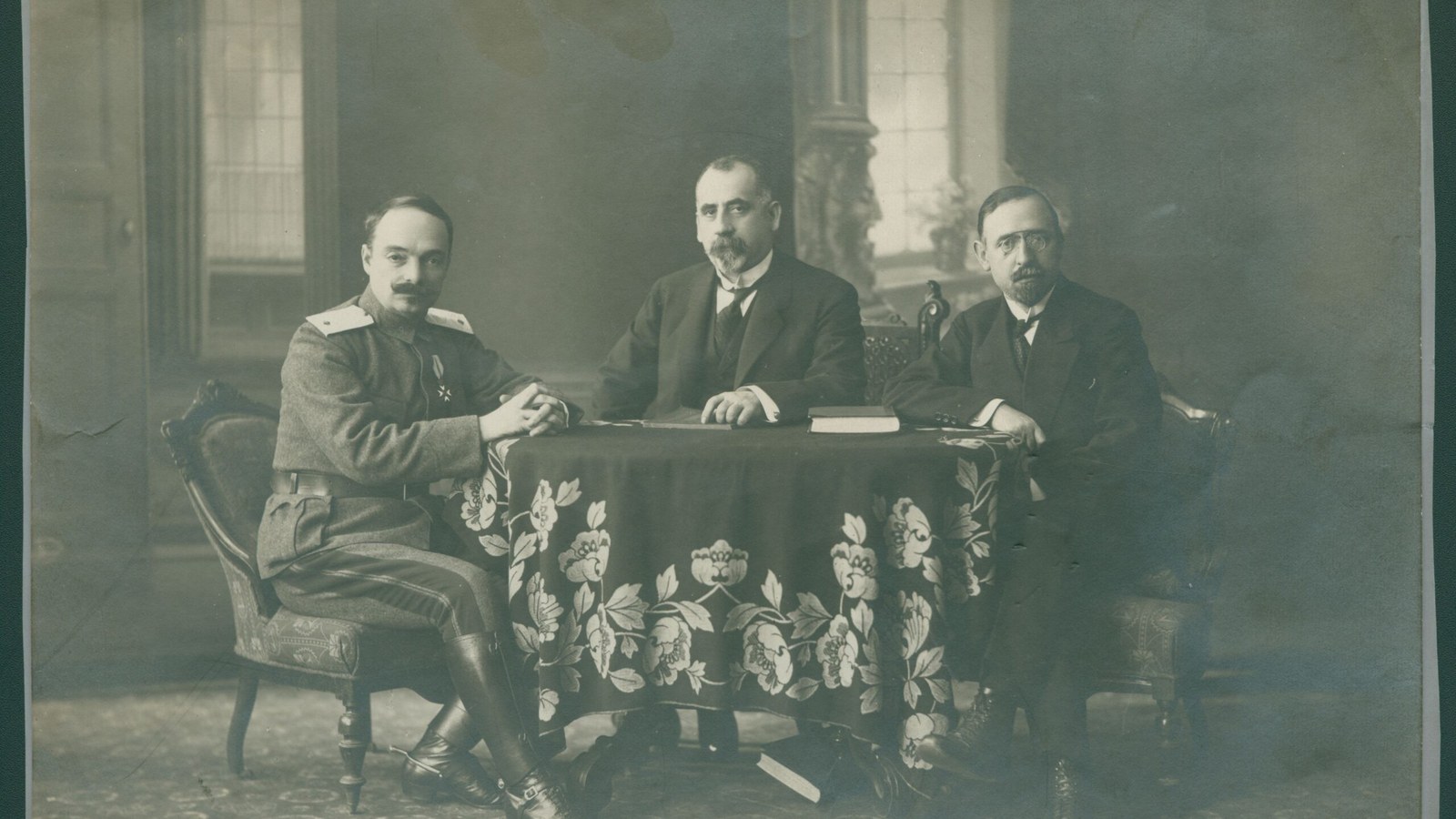
Cease-fire requests had gone out on 24 September, after the Vardar offensive. The photograph also shows Simeon Radev with Lyapchev and Lukov; the convention reprinted at Washington is signed by Franchet d'Espèrey, Liaptchew and Loukoff. It is not the armistice with Bulgaria of 28 October 1944.
The Bulgarian delegation: Andrey Lyapchev, General Ivan Lukov, Simeon Radev. Image: Wikimedia Commons, public domain.
For context: Armistice of Salonica. The text: The Bulgarian Armistice Convention, Signed September 29, 1918.











0 Comments
No comments on this article yet. Be the first!