


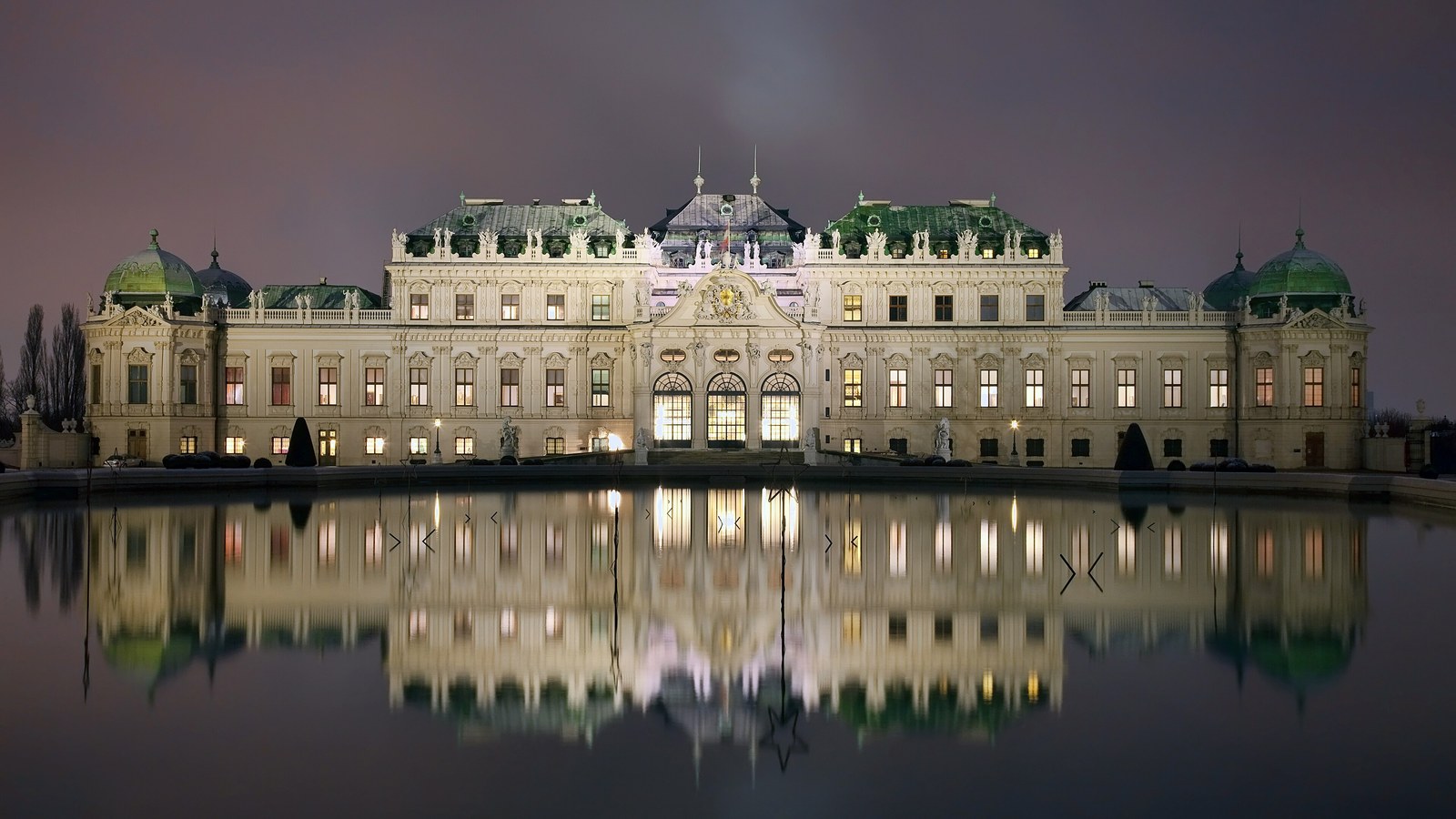
The State Treaty for the Re-establishment of an Independent and Democratic Austria was signed at the Belvedere Palace in Vienna on 15 May 1955 by foreign ministers Vyacheslav Molotov (USSR), John Foster Dulles (United States), Harold Macmillan (United Kingdom) and Antoine Pinay (France), by Austrian foreign minister Leopold Figl, and by high commissioners Ivan Ilyichev, Llewellyn Thompson, Geoffrey Wallinger and Roger Lalouette. It is not the Moscow Declaration of 1943, which it implements, nor Austria's later constitutional neutrality law. The authentic texts are Russian, English, French and German. It was published in Bundesgesetzblatt No. 152/1955.
The preamble records that Hitlerite Germany annexed Austria by force on 13 March 1938 and incorporated its territory in the German Reich; that the Moscow Declaration, published on 1 November 1943, regarded that annexation as null and void and affirmed the wish to see Austria re-established as a free and independent State, and that the French Committee of National Liberation made a similar declaration on 16 November 1943; and that, as a result of the Allied victory, Austria was liberated from that domination. The parties desire to conclude a treaty re-establishing Austria as a free, independent and democratic State and thereby to support Austria's application for admission to the United Nations.
Article 1: the Allied and Associated Powers recognize that Austria is re-established as a sovereign, independent and democratic State. Article 2: they will respect the independence and territorial integrity so established. Article 3: they will incorporate in the German Peace Treaty provisions securing from Germany the recognition of Austria's sovereignty and independence and Germany's renunciation of all territorial and political claims in respect of Austria. Article 4 prohibits political or economic union between Austria and Germany in any form whatsoever; Austria shall not conclude agreements or take measures likely to promote such union, nor permit organizations or pan-German propaganda to that end.
Article 5: Austria's frontiers shall be those existing on 1 January 1938. Article 6: Austria shall secure to all persons under its jurisdiction, without distinction as to race, sex, language or religion, human rights and fundamental freedoms. Article 7 sets out the rights of the Slovene and Croat minorities in Carinthia, Burgenland and Styria — organizations, press, schooling, and use of language in administration and the courts in the districts concerned; no school regulation is transcribed. Article 8: a democratic government, elections by secret ballot, free, equal and universal suffrage. Article 9: dissolution of the National Socialist Party and affiliated organizations, and a ban on Fascist-type organizations and on activity hostile to any United Nation. Article 10 maintains the law of 3 April 1919 concerning the House of Habsburg-Lorraine.
Part II contains military and air clauses, including a prohibition of special weapons; the catalogue is not transcribed. Article 20: the Agreement on the Machinery of Control in Austria of 28 June 1946 terminates on entry into force; the forces of the Allied and Associated Powers and members of the Allied Commission shall be withdrawn within ninety days, and so far as possible not later than 31 December 1955. Article 21: no reparation shall be exacted from Austria arising out of the state of war in Europe after 1 September 1939. Clauses on German assets in Austria, including oil concessions, remain at the level of principle; field lists are not transcribed.
Article 37: any member of the United Nations which on 8 May 1945 was at war with Germany and then had the status of a United Nation, and is not a signatory, may accede; Yugoslavia acceded subsequently. Article 38: ratification; the Treaty comes into force immediately upon deposit of instruments by the USSR, the United Kingdom, the United States and France of the one part and by Austria of the other, with the Soviet Government as depositary. The Bundesgesetzblatt records 27 July 1955. Permanent neutrality is not in the Treaty: the Austrian Parliament enacted it as constitutional law on 26 October 1955, the day after the last occupation troops were due to leave.
Cover: the Upper Belvedere Palace, the place of signature; we do not claim the hall. Wikimedia Commons, free licence.
Sources consulted: Austrian State Treaty; Staatsvertrag betreffend die Wiederherstellung eines unabhängigen und demokratischen Österreich.











0 Comments
No comments on this article yet. Be the first!