


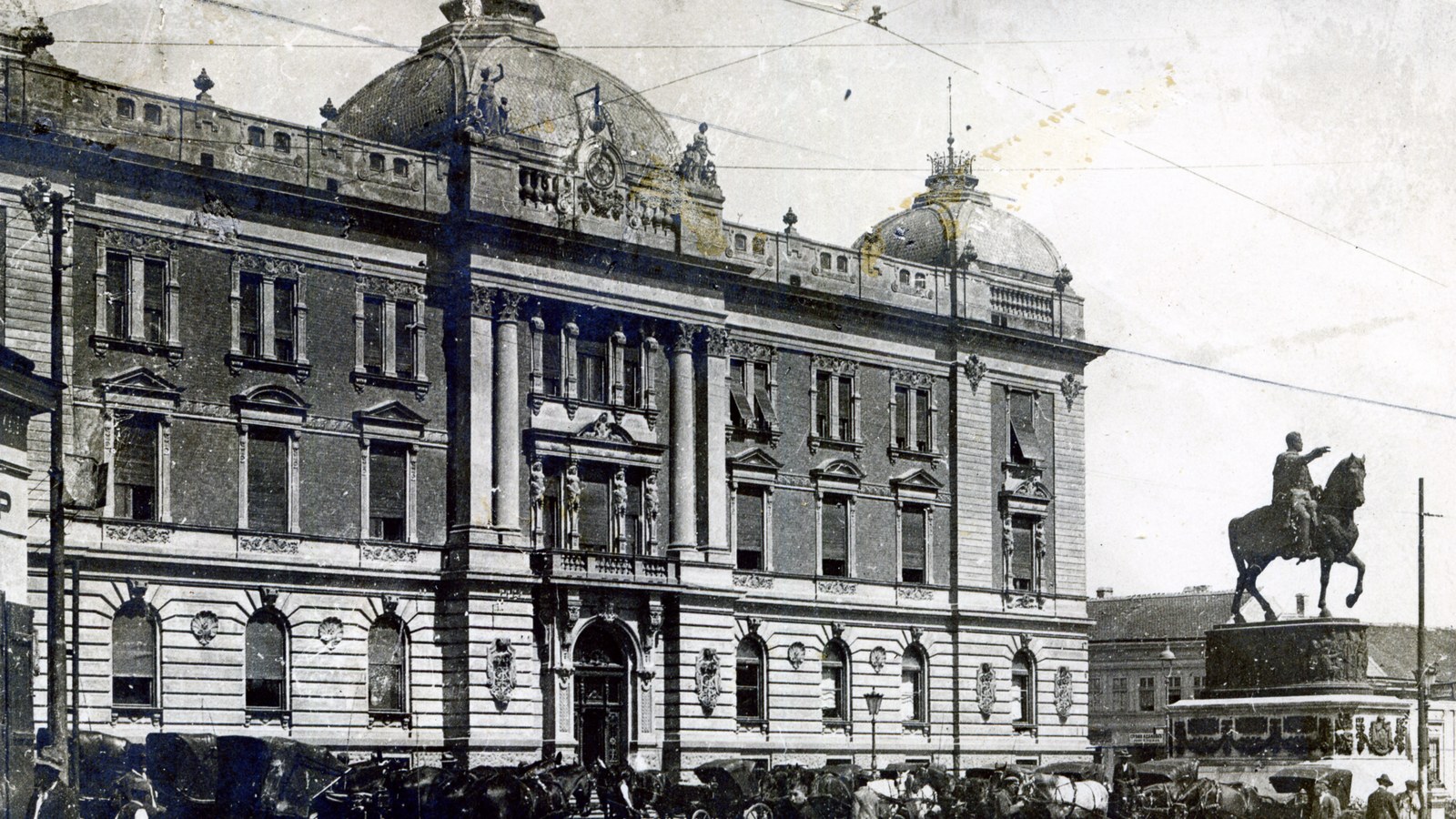
On 13 November 1918, in Belgrade, at 11.15 p.m., Voivode Živojin Mišić and General Paul Henrys, delegates of the commander-in-chief of the Allied armies of the Orient, and Béla Linder, delegate of the Hungarian Government, signed the Military Convention regulating the conditions under which the armistice signed between the Allies and Austria-Hungary is to be applied in Hungary. Two copies, with corrections of the heading and of Articles XI and XVIII. It is not the Armistice of Villa Giusti of 3 November and not the Armistice of Compiègne of 11 November.
Article I: the Hungarian Government will withdraw all troops north of a line through the upper valley of the Someș, Bistrița, Târgu Mureș, the Mureș to its junction with the Tisza, Subotica, Baja, Pécs (these places not occupied by Hungarian troops), the course of the Drava until it coincides with the frontier of Croatia-Slavonia. Evacuation in eight days. The Allies are entitled to occupy the evacuated territory on conditions laid down by the commander-in-chief; civil administration remains in the hands of the present Government. In the evacuated zone only police and gendarmerie indispensable to order remain, and men required for the safety of the railways.
Article II: demobilization of Hungarian naval and military forces, except six infantry divisions and two cavalry divisions required for internal order, and the police mentioned in Article I. Article III: the Allies have the right to occupy all places and strategic points permanently fixed by the commander-in-chief; Allied troops may pass through or remain in any part of Hungary; a permanent right of military use of railways, rolling stock, shipping of the State or of private persons in Hungary, and of draught and pack animals.
Article IV: within a month a reserve of 2,000 wagons and 100 locomotives (normal gauge) and 600 wagons and 50 locomotives (narrow gauge), figures approximate, including to compensate Serbia’s wartime deficiency; some portion may be levied from Austria. Article V: six monitors surrendered immediately at Belgrade; the rest of the Danube flotilla assembles in a port and is disarmed; a levy of 10 passenger vessels, 10 tugs and 60 lighters. Articles VI–VIII: within 15 days 3,000 railway technical troops with material to repair Serbian railways; a telegraph sapper detachment for communications with Serbia; within a month 25,000 horses and transport material, figures approximate.
Article IX: arms and war material deposited at places appointed by the commander-in-chief; a portion levied for units under his orders. Article X: immediate liberation of Allied prisoners of war and interned civilians; Hungarian prisoners retained provisionally. Article XI: 15 days for the passage of German troops through Hungary, dating from the armistice signed by General Diaz (4 November, 3 p.m.); postal and telegraphic communication with Germany only under Allied military control; no military telegraphic communication with Germany. Article XIII: the situation of Austro-Hungarian mines in the Danube and the Black Sea communicated immediately; Hungary stops floating mines from upstream and removes those in Hungarian waters.
Article XII: Hungary facilitates the supplying of Allied occupation troops; requisitions allowed if not arbitrary and paid at current rates. Article XIV: Hungarian postal service, wireless, telephones and railways under Allied control. Article XV: an Allied representative attached to the Hungarian ministry of supplies. Article XVI: Hungary ceases all relations with Germany and forbids transport of troops and munitions destined for German troops in Romania, unless by special permission of the general. Article XVII: the Allies shall not interfere with the internal administration of Hungary. Article XVIII: hostilities between Hungary and the Allies are at an end. The convention is not the 1920 Treaty of Trianon and does not draw the peace frontiers; the 1919 Vix Note and the Hungarian Soviet Republic are later.
Image: Uprava fondova, Belgrade, place of signature; unknown author, first decade of the 20th century; Museum of Science and Technology, Belgrade; CC BY-SA 3.0, Wikimedia Commons. Cropped to 16:9.
Source consulted: Armistice of Belgrade. Treaty text: Military Convention regulating the conditions under which the armistice signed between the Allies and Austria-Hungary is to be applied in Hungary, Belgrade, 13 November 1918.











0 Comments
No comments on this article yet. Be the first!