


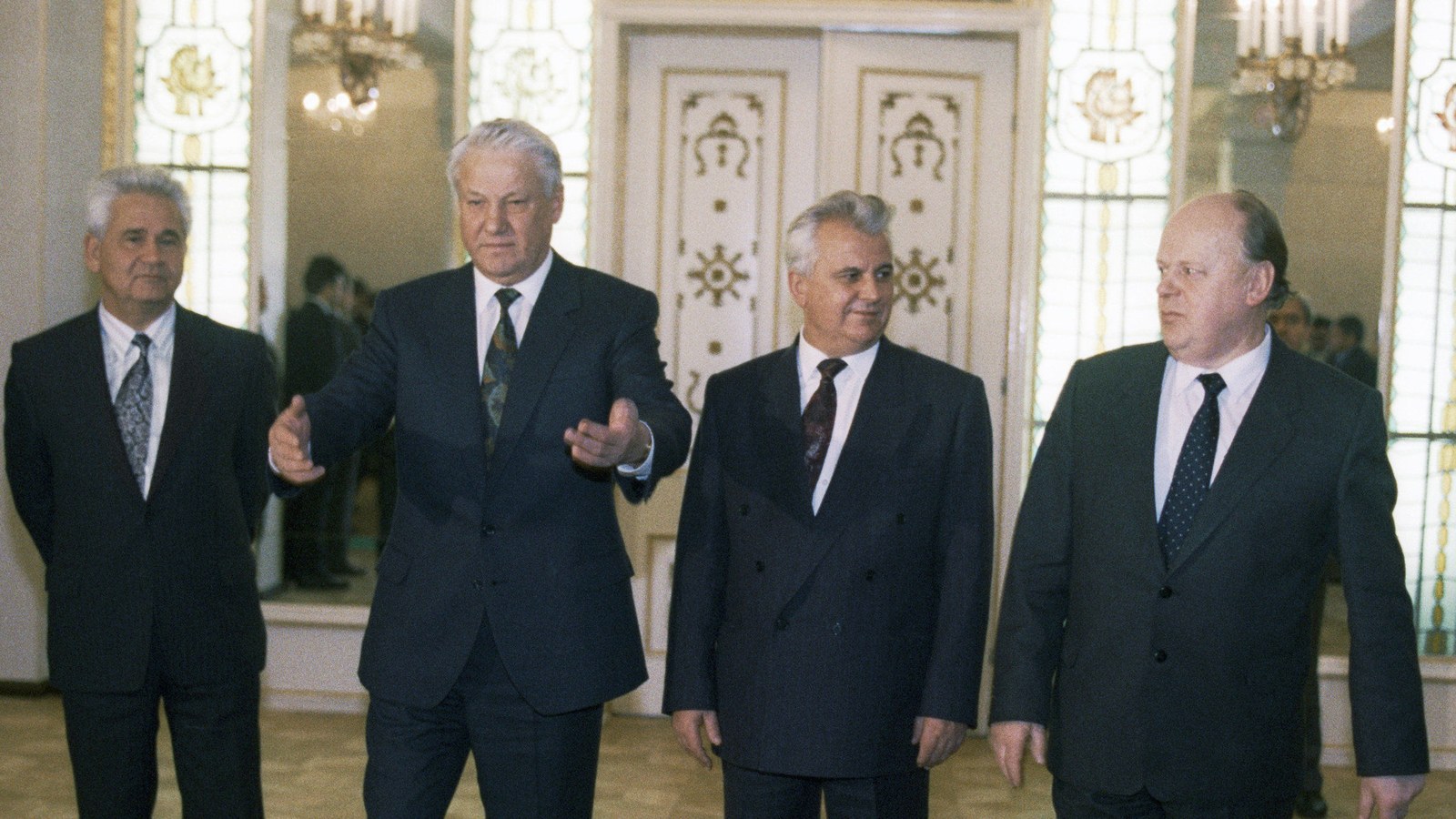
On 8 December 1991, at Viskuli in the Belovezhskaya Forest, the Agreement on the establishment of the Commonwealth of Independent States was signed. Testimonium: Minsk. Signatories: Stanislav Shushkevich and Vyacheslav Kebich for Belarus, Boris Yeltsin and Gennady Burbulis for the RSFSR, Leonid Kravchuk and Vitold Fokin for Ukraine. Authentic texts: Belarusian, Russian and Ukrainian, in three copies. It is not the Alma-Ata Protocol of 21 December 1991.
The preamble, signed by the three founder States of the USSR and signatories of the 1922 Union Treaty, states that the Soviet Union, as a subject of international law and a geopolitical reality, ceases to exist. The Parties seek democratic States governed by the rule of law, mutual recognition of sovereignty, the inalienable right to self-determination, equality, non-intervention, abstention from force and from economic pressure, and reaffirm their commitment to the UN Charter and the Helsinki Final Act.
Article 1: the Parties form the Commonwealth of Independent States. Article 2: they guarantee equal rights and freedoms to their citizens regardless of nationality, and the same civil, political, social, economic and cultural rights to citizens of the other Parties and to stateless persons, in accordance with internationally recognized human-rights norms. Article 3: they take under their protection the ethnic, cultural, linguistic and religious identity of national minorities and unique ethnocultural regions.
Article 4: equitable cooperation in politics, economics, culture, education, health care, the environment, science, trade and humanitarian fields; they will conclude sectoral agreements. Article 5: they recognize territorial integrity and the inviolability of existing borders within the Commonwealth; they guarantee open borders, freedom of movement of citizens and transmission of information.
Article 6: cooperation for peace, reduction of armaments, elimination of nuclear weapons and general disarmament under international control; respect for the aspiration to nuclear-free-zone and neutral-State status; a common military-strategic space under unified command, including unified control over nuclear weapons, to be regulated by a special agreement. Article 7: joint activity includes coordination of foreign policy, a common economic space, transport, the environment, migration and combating organized crime. Article 8: the planet-wide nature of the Chernobyl disaster and a later special agreement.
Article 9: disputes on interpretation shall be resolved by negotiation, if necessary at the level of heads of government and of State. Article 10: either Party may suspend the Agreement or individual articles upon one year's notice; supplements by mutual consent. Article 11: from the moment of signature, the norms of third States, including the former USSR, shall not apply in the territories of the signatories. Article 12: the Parties guarantee fulfilment of international obligations arising from treaties of the former USSR. Article 13: the Agreement does not affect obligations towards third States and is open for accession by all member States of the former USSR and other States sharing its purposes.
Article 14: the official seat of the coordinating bodies is Minsk; the activities of organs of the former USSR in the territories of the members shall cease. Depositary: Belarus. It is not the 1993 CIS Charter and not Mikhail Gorbachev resignation of 25 December.
Image: Yeltsin, Kravchuk and Shushkevich at Viskuli; Yuriy Ivanov, RIA Novosti, 8 December 1991; CC BY-SA 3.0, Wikimedia Commons. Cropped to 16:9.
Source consulted: Belovezha Accords. Treaty text: Agreement on the establishment of the Commonwealth of Independent States, Minsk, 8 December 1991.











0 Comments
No comments on this article yet. Be the first!